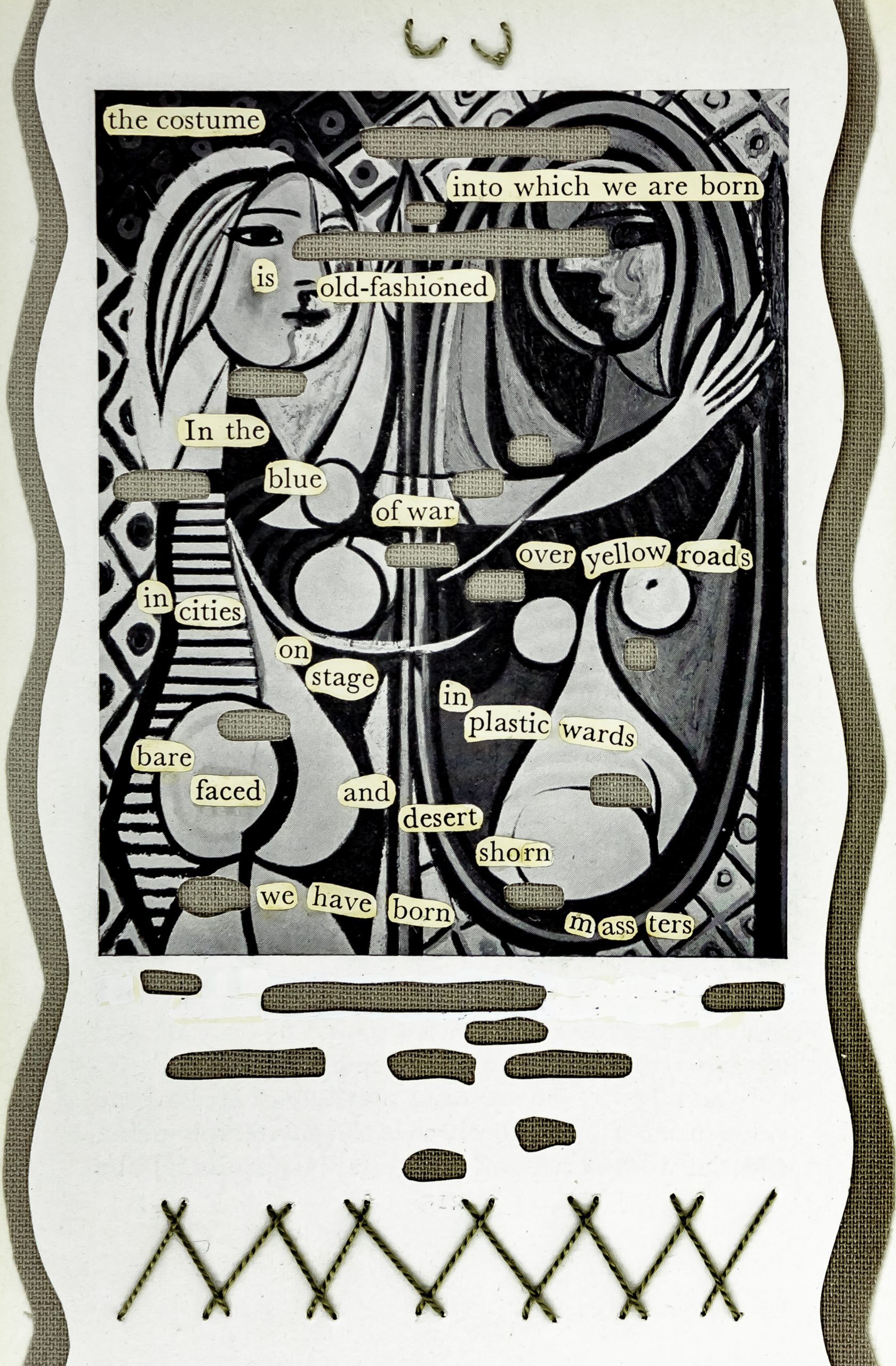
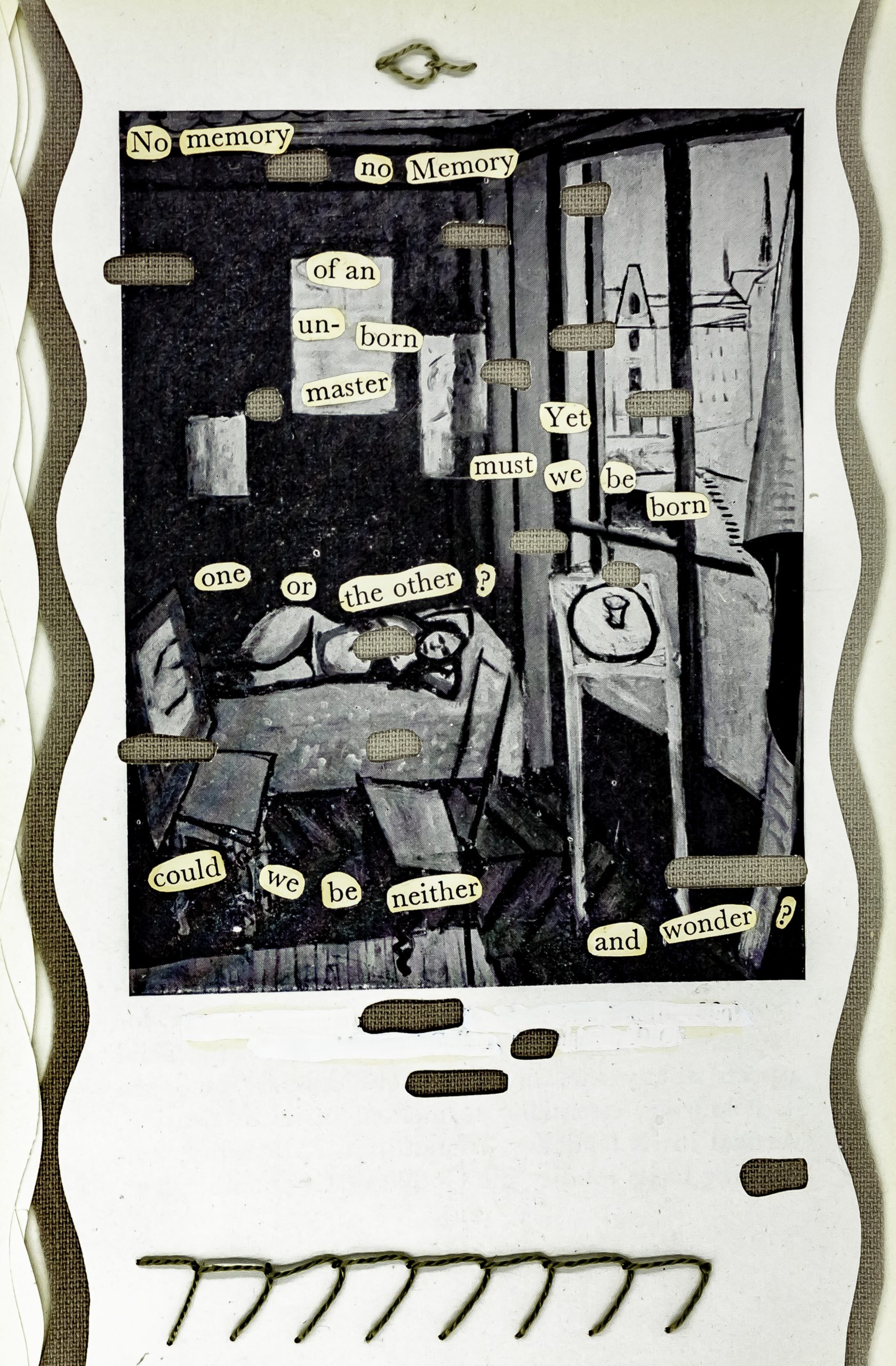
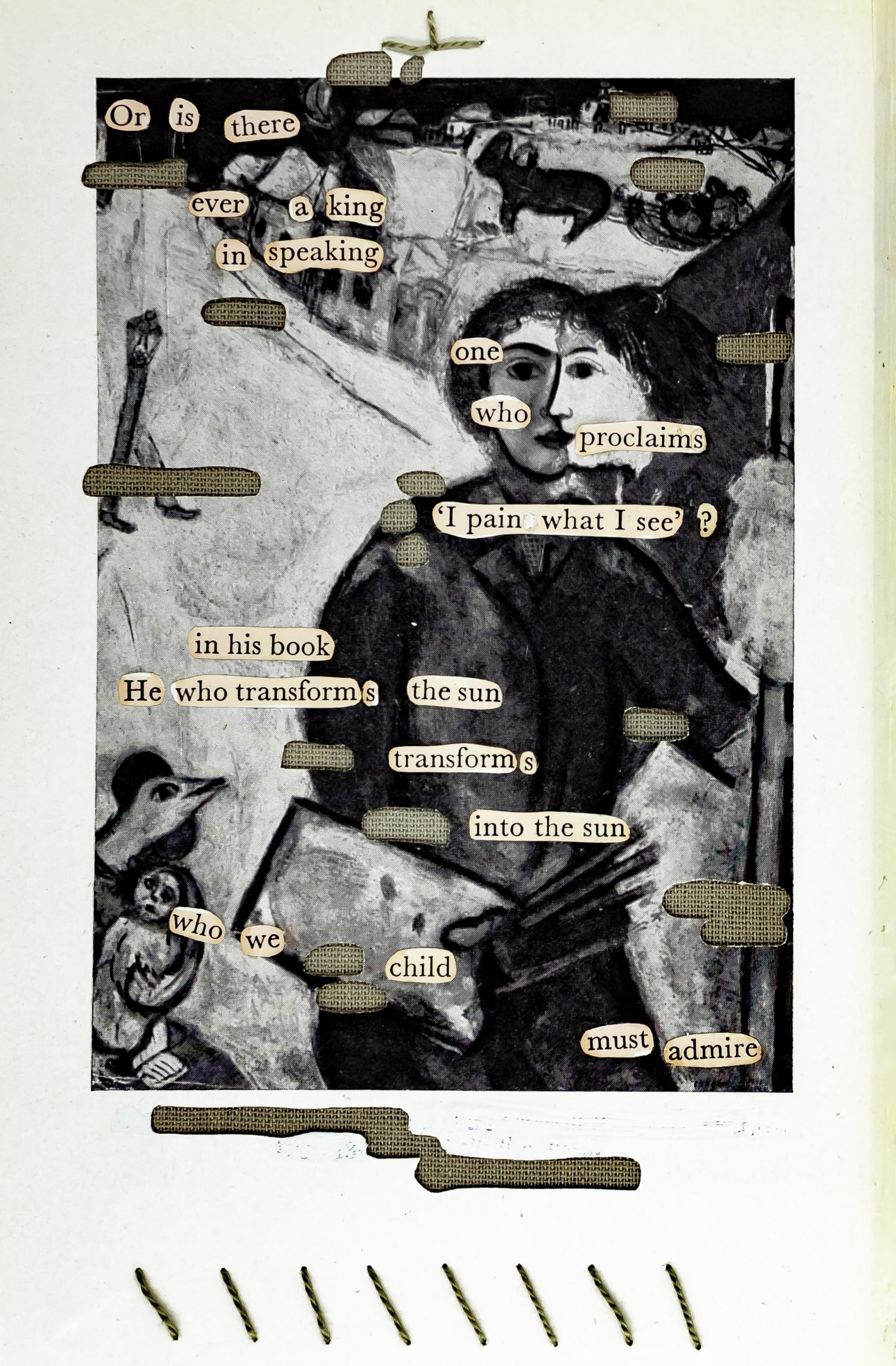
Ink


It’s the beginning of the school year, raining hard. C’s parents never leave town, but tonight is sweet and swollen—their departure some kind of unconscious allowance for youthful dalliance. They’ve gone to see friends, will return tomorrow.


C is freshly sixteen, a sophomore, which means the evening possesses infinite potential for teenage ruckus, a chaos she would have gladly exploited, but is, instead, sitting cross-legged inside her bedroom closet. The choice to keep the fact of the empty house from friends is part of a new installment of withholding, not unlike two weekends ago when her friends tied themselves in corsets, legs crisscrossed in fishnets, eyes blackened and glittery, and couldn’t understand why C wouldn’t join them for Rocky Horror. To walk out like that at midnight, to indulge her bare skin to the end of summer air, was compelling, certainly, yet she’d refused, sat in a patio chair, half listening to CocoRosie, half expecting K not to show. That night, the odds were in her favor. K had shown up around 1 a.m., after her parents had fallen asleep, in that quiet, liminal hour that had, over the past three months, come to feel synonymous with him. Other nights, he wouldn’t show at all, leaving C alone with her writing and desire. If he comes tonight, C decides, she will give it to him if he asks—her body. Her virginity, a nagging, heavy thing she is ready to cast off. She pulses with nervousness.


Inside the closet she lights a small votive candle, enough for total luminescence. The closet in her room, her room inside the only house she’s ever lived in: suburban, old, creaky, wooden. The closet is barely a walk-in, tracks of carpet nails steal inches from the tight quarters, and there’s a wide wooden step separating the space into two tiers—the upper platform just large enough to sit on, which is where C is, tucked away behind a waterfall of clothes.


On her face, makeup. She’s dressed in a fitted shirt, tights—a stretchy black skirt lies outside on the bed, ready to slide into. She’d finished getting ready, sucking in, changing clothes, clamping the straightener over her hair until the entire room smelled of charred tissue paper. She’d paced, lit incense, opened the window to let the storm smell in and considered what she might do until K got there, if he even showed up at all. In the past she would take out her favorite book or a notebook, reading or writing until he arrived to find her that way: gripped, intellectual, withholding. “What are you doing?” he’d sometimes ask, and she’d smile coyly, close the book and say, “How are you, K?” This was in the summer when the nights were humid and the moon was always out.


Something urged her to the closet. The desire to feel contained, resume her waiting close to the womb of her consciousness, an innate teenage desire for dimness.


More books and papers than clothes. On the floor below her, a haphazard row of thrifted shoes and an old cardboard trunk. Inside, a matrix of journals, books, loose papers with black, blue, pencil writing, a beating drum of life. By the time she is a senior, there will be no room left inside the box, the material collapsed all over the floor, all angst and longing.


C’s phone vibrates: Walking. C and K’s houses are almost four miles apart; it will take him at least an hour to get here. The news of his distant travel on foot, in the rain no less, thrills her, proves something. She looks at the time: 8:36. She’ll wait until 8:40 to respond. From the depths of the trunk, C finds the clean manila folder, the one labeled C + K—a not-so-subtle attempt at encoding. Inside the folder is a thick packet of their online correspondence, so hefty it had taken all the printer ink. There are emails and Instant Message conversations going back three months, when K was bored one night and sent her a simple message, hello. She studies for clues to his inner workings, every utterance like a delicate poem worthy of dissection. She lets out a sigh. She flexes her muscles to release the anticipation running beneath the skin. She looks at her phone. 8:41. You must be getting soaked, she types and sends. A little wetness never hurt anyone, K replies. She reads into his words, smiles, buries her face into a jacket hanging above her head.


C is coming down from her first summer of men, John and Max interested in her at the same time—a sudden jolt of attention.


John’s main appeal resided in the fact that he is a year older and had a new obsession with C. “It’s lame,” he said when she asked him about his nickname, Coffee. “It’s just because I coughed a lot one time when we were all smoking. Now I’m stuck with it.”


“That is lame,” she agreed.


On their first hangout alone, Coffee took C to The Portal, a place she’d heard people talk about and which she discovered was nothing more than a family of shrubs, fucking bushes, alongside a neighborhood church. No one can see in, he emphasized, but from inside you can see out. He’d kissed her so hard, and she was so focused on doing it well, she didn’t feel her arm rubbing against the brick side of the church. When they came up for air, C’s arm was bleeding—it was bleeding a lot. “Oh shit,” he’d said. A few weeks later Coffee started confessing his love to C, and their hangouts consisted of him crying over her dating Max, her sweet, good-looking friend who would come over while her parents were at work. In broad daylight they’d watch movies in their entirety, not touching until the credits rolled and Max would get this boyish look on his face, lean in close and say, “I know what we can do now…” his dimples too cute, his tongue in her mouth like a torpedo.


Both wanted to be her boyfriend, but she was afraid of her own sexuality, too self-conscious, too in love with K, the one she knew she could never fully have, the fact of him like a sacred name embroidered in the skin, not fit for articulation. With K, she understood the urge of lovers to tattoo each other’s names onto the flesh. If asked, she would ink him into her, somewhere where it hurt, like down the long spindle of her spine.


She looks down to her body, to her hands smudged with ink. Yes, she says silently. Tonight is the night.


One might say C, barely a sophomore, is too young to reminisce over teendome, but she’d already completed one year, had accrued a rebellion, steadfast, miserable, thrilling. Her high school is large, the teachers terribly disengaged, sour. While most of her peers deal with the lack of care by erupting into violence, C and her friends opt to guzzle 40’s of High Life in the school’s basement, or ditch all together, go to the public library and read what’s useful—oh, the immaculate shelves, the books like dormant specimens, coming to life under C’s touch.


From the trunk, C pulls more paper, a wrinkled computer paper in her best friend’s large, masculine handwriting: Beauty has much more to do with an individual perception of something than any tangible or quantifiable quality, it begins. She doesn’t know how this private manifesto ended up in her box, although in the past she’d been guilty of stealing scraps of her friends. After two 40’s, the information strewn all over Naomi’s attic—cartoons depicting their own lives, paintings, journal entries—tantalized C in a drunken way and convinced her of their ability to reveal something subtle, yet remarkably true about this friend she loved. So she’d trace her hand over the floor—Naomi’s entire attic the equivalent of C’s closet, both always writing themselves out of something—and like a deck of cards, she would pull whatever felt smoothest under the pads of her fingers, slip the paper into her bag to open later, a piece of her friend to fold into the reservoir, Jung’s collective unconscious, a weak, murky attempt at reconciliation for her thievery. Her knowledge is my knowledge. Like most things, she didn’t think about getting caught, didn’t end up with anything that was, necessarily, personal, except the one that read: I am not very articulate, I am bad at math, I don’t consistently recycle, I steal alcohol from CVS, I’ve never had a boyfriend, I don’t play any sports, I think I know everything—a double-sided litany of self-loathing. C didn’t judge, liked the fact that she could read it impartially, fold it into the canon to dissolve with her own loopy thoughts.


The candlelight bobs, heat rises in the closet. A dark cherry smell grows, the smell of blunt papers kept hidden away in a shoebox above her head. She stands up, using the upper platform to peer over the top shelf that houses a typewriter, her grandma’s old hat rack, and in the very back, the box she’d painted gold. She removes the lid; inside it smells of bong water—papers, but no weed. She’ll have to wait for K.


Like Coffee, K has a street name, one that she would never use, but is there, sewn in, part of his identity, painted on the walls of their high school and the restaurant he worked at. He is two years older, their freshman-year drug dealer, that’s how it started. She loves what he does with words, the way he calls her Ma, as in, “Sup Ma,” as in, “I like how you think, Ma,” or can say, in all charm and seriousness, “Hello young love, the moon is bright and full, let’s make love on your roof beneath it,” perfectly delivered, astonishingly real. Yet the ins and outs of his everyday life are murky—he offers only snapshots—shards of parties, pieces of friends, shadowy nights alone making art—all of it so encrypted she’s left to design his hidden life for herself. Coffee had recently found out about the two of them, not that there was much to find out, and had messaged C a somber little message that read, You’re fucking K-Wil? You got yourself the player. She didn’t say anything. And they weren’t fucking.


K’s reputation is obsolete when he comes over, kisses C’s neck, plays whale songs on a small speaker. “This shit is real,” he’d say to the amniotic sounds. He’d say, “I want to be Rastafari, a poet, an artist; I want to leave my mom’s place, I want to take you for a drive.” He teaches C to drive down the slick streets of her childhood, and then sneaks away at sunrise. Addiction, obsession, crept up on her, slowly then all at once. Now she lied, gave up nights to see him on the flimsy chance he’d make it. How much time had she wasted waiting? She glances back to their folder, to the C and the K, finds an old pencil, and writes C + K, they make the same sound…but they are not interchangeable.


In the closet her palms sweat. He’s walking in the rain, four miles. She can hear the rain pounding down on the flat rooftop and wonders if the dining room ceiling has begun to leak. She thinks about getting up, but the thought of the house feels too big, too filled with her parents’ belongings—she wants to stay close to her things. Among the pile of books, Miranda July, Freud, zines, a dictionary whose pages she flutters between her fingers, the paper-wind wicking the candlelight. She closes her eyes, pretends she is on a train, the flicker practically audible on her eyelids. Then the fire goes out, and the darkness feels good too. You smell like a birthday cake, she can imagine him saying to her hair when he greets her. She gropes around for the lighter, lights the candle back up, lands her finger on a random word in the dictionary, on the word truncated, meaning shortened, sounding a lot like trunk, like the one in front of her housing her mess of thoughts, so dissimilar from abridged. For a moment C grows tired of her manic upheaval, her restless writing, her own obsession with his words and how he might use them on her tonight, all of it so cluttered. Had she a metal pail, she’d have all the tools to start burning, cleansed and ready for him. Blank, new, virginal. Instead she pulls from the trunk The Four Noble Truths, a packet from Political Philosophy, one of the few papers from last year that felt worth keeping.


…The truth of suffering, the truth of the cause of suffering, the truth of the end of suffering, and the truth of the path that leads to the end of suffering. More simply put, suffering exists. The concept of pleasure is not denied, but acknowledged as fleeting. Pursuit of pleasure can only continue what is ultimately an unquenchable thirst. The same logic belies an understanding of happiness. In the end, only aging, sickness, and death are certain and unavoidable.


She’d written in the margins, and this marginalia makes her laugh, jolts her out of her own silence. Aside the truth of suffering she’d written school = imprisonment, and next to pleasure she’d drawn a pot leaf; unquenchable thirst, a simple heart. The predictability of her trope embarrasses her, brings heat to her cheeks. More intriguing, however, was what she’d written in a sloppy script barely recognizable at the bottom of the page: Every person, no matter how plain has one great erotic performance in her life; the second performance would only be a copy of the first. It was a quote from somewhere, a book or song lyrics. She scans her mind in search for a connection to The Truths, the two pools of ink like shadows of one another. She finally settles on the idea that they are related merely by the fact that knowledge builds on other knowledge—something else she’d heard and jotted down. Joined but unjoined. What would it feel like to finally let their bodies do the talking?


Her ass hurts. She grows restless, anxious. She won’t get up yet, afraid her thoughts will spread thinly over the furniture, like she’ll have nothing to say when he arrives. In the pocket-sized book, Freud has a lot to say about sexuality, dreams, the subconscious, and the points at which they intersect. Maybe this is something she can talk about. Plant the seed of seduction by talking psychology, quoting the dead. She yanks the jacket from the hanger, uses it as a cushion, crosses her legs again, and thinks of him walking in the rain. A lovely landscape of purple and blue erects in the hippocampus. This is how the night will build, like it always does. They’ll talk and talk and when their words have crescendoed themselves, after their speech draws into the folds of the long night, they will lie down, this time in her bed, this is that night.


Below her, she feels a light rumble, practically undetectable, then the sound of the kitchen door closing. Shit, she thinks. She’s still stocking-footed. She tiptoes out of the closet. Outside, the bedroom air is cool, humid, the spell broken. The rain comes on slower now. He doesn’t call out for her, but she can hear him making his way through the rooms downstairs. She quickly slides into her skirt. Lightning cracks the sky, illuminates two over-stuffed pillows on the bed so they look like storm clouds, or phantoms. The house is old, each stair with its own category of sound, so C can almost track K’s progression, his slow ascent.


“Hey!” she finally calls out, releasing her voice.


“Hello?” K slowly opens the bedroom door, where C stands still, shocked out of her solitude.


“Hey,” she says again, leaning in for a long, damp hug. More than how he looks, he smells so good—faintly vanilla, but more masculine, like figs and leather, brown sugar—a scent she believes was crafted for her own enjoyment. She could live off this smell. He carries an orange construction cone.


“For you. A gift from along the way.”


“Something I’ve always wanted.” She laughs. The cone is huge, streaked with traffic muck.


“So, what have you been up to, chica?” K’s eyes scan the room, land on the closet where candlelight dances softly and jagged corners of paper poke out. It must look like some strange séance, C thinks. She had wanted him to see the oddity of it all, to wonder about her as much as she wonders about him, but now she feels exposed, naked, wordless.


“I was just looking at stupid shit I’ve written,” she says, blowing the candle out and clicking on a lamp. “I can’t believe you walked here.” She waits for, it was worth it or, I’d walk longer to see you.


“The rain is my friend,” K says instead, setting the cone down.


“Do you want to head to the patio? I still have some of your beers from last time. They’re warm. I had to hide them.” C gestures toward the darkened closet, where two High Lifes lay nestled inside coat pockets.


“I actually can’t stay long, Ma. Zach needs me to hook him up with something tonight.”


“What?” The news is sharp, hits her like a frigid wind. “What do you mean? You just walked, like, four miles to get here.”


“Yeah, tell me about it. And it’s a beautiful night.” K lowers to the floor, sits at the closet’s threshold. “I’d much rather kick it with you. We’ll do this again.”


C grabs her bath towel off of the hook and hands it to him. She sits on her bed, tries to hide the sudden rush of disappointment, but it roils. Come here, she thinks, I’m ready.


“I’m still looking all into Rastafarianism. I want to write my own bible one day, write my own religion,” K says, patting himself dry. He goes on talking about things so abstractly she confuses it for his genius. She soaks him in, would be happy to skip the conversation for tonight if it means she could feel his mouth on hers, become absorbed in that smell. Instead she tells him about The Four Noble Truths and he tells her about the way he watches his mom suffer; she’s ill, an immigrant, divorced, and angry. No one else has heard this coming out of his mouth before, she thinks.


K points to the trunk. “Tell me what you’ve been writing,” he says again. From this angle, everything inside looks like nothing more than a messy pit, an unruly recycling bin.


“Oh, nothing. It’s stupid,” C says, cursing herself for leaving their folder out in plain sight. And how many of those documents were laced with his name? How many journal entries began in I need, or, I can’t stop, etc? Too many, probably.


“Nah, I bet your writing is dope,” K says. “I have a box, too, filled with photos of me as a little punk kid.” C tries to imagine K as an innocent, young boy, but nothing comes to mind. In front of her his arm muscles glisten from rain and his confidence spews like his own beautiful odor. “I think I see one of you right there.” K points to some gloss peeking out from behind the manila folder. Before C can protest, he reaches inside her closet and pulls a small deck of photos from the rubble, not seeing the folder. Missing it all together. Outside the storm resumes its pounding, shaking the wooden floorboards and lighting the room with its electricity. She cups her hands over his, over the photos.


“Come on, I bet you were cute,” K says. Together they peer down to the photo of C and her dad at the zoo; C lounging in a blue kiddie pool; C on her first bicycle; and she hopes, she prays the photo she doesn’t want to be there won’t be, and then K shuffles through and finds it: a young C, five or six years old, on her bed wearing white tights, a white turtle neck, and large, plush rabbit ears, lined in pink. Between her legs, a half-dozen rabbit stuffed animals: one sitting upright holding a small brush for grooming its long ears; another red-eyed, albino; two man and woman rabbits dressed in Victorian clothes, velcroed paw-to-paw—married rabbits. The image is innately sexual, of course taken innocently, a little girl dressed identical to her toys, on her dreamy, pastel bed. Outside a horn sounds off, K’s friend ready to take him away from her. But K is transfixed, doesn’t move. Please find this sexy, she thinks. Silence hangs between them, just the rain falls. He looks up at her.


“I liked my rabbits?” C says.


K reaches for her face, tugs at her hair a little, draws her close.


Kiss me, she thinks. But K doesn’t kiss her. He bypasses her lips, goes straight to her ear; the skin around the drum tightens.


“You look like. A little. Bunny. Porn star.” His words slide in. Explode. The car in waiting wails its horn, doesn’t let it up for several seconds. The two look at each other, and C cannot tell if it’s longing that she feels.


But still she says, “Stay.”


And still he says, “I have to go.”


“My parents will be gone all night.”


He gives her a hard kiss between the eyes before descending.


Downstairs, C watches the car rush away, making small waves in its hurry. The cavernous rooms and she alone among them. Isn’t that enough? But he is gone, and she is left with the same humid quiet, the same rain coming down in sheets, his words echoing in her ears. The dining room ceiling drips one drop at a time onto the floor. The rhythm has a numbing quality, but yearning has a way of jostling the body back to feeling. She meanders into her mom’s study, past the stacks of books that hold no interest to her. She grabs a fancy calligraphy pen off of the desk, then approaches the staircase and begins climbing, articulating her foot heel to toe, heel to toe, heel to toe, the way she’d read monks do in walking meditation. I am here, she thinks, I am here, but all the while her fist is tight around the pen, the nails carve red crescents in the flesh. The night is long ahead of her and there are words, she knows, that will make the time go by, but she’s not sure which ones or when they’ll find her.
 

Share

Another Day

—a found poem: Virginia Woolf’s The Waves


I feel the bruised cry of birds in my body

when I wake.


Thinness rushes my pink imperfect heart

and I am cast down at another day—


hands and feet and body.

Here is idleness, brown water, disgrace.


The sun is yellow and laughing

leaves stir and patter across the lawn


and I long for darkness and sleep—

its brass thud, its pirouetting slam.


I lie here and watch the bedroom

harden into night.


Share

Metaphorical Ghosts


There are so many ways to describe

            the fact that we die and are reborn


countless times: the New Year’s resolution list,

            the myth of a phoenix rising from ashes,


the box of hair dye and the scissors, the poets:

            dying is an art, like everything else.


I do it exceptionally well.

            I do it so it feels like hell.


But no one ever talks about the ghosts.

            The dead ones that that turn your bones


into a creaky, old haunted mansion.

            And no one talks about how frequently girls die


in a lifetime. Girl after girl after girl after girl.

            Some of them are mischievous and hopeful,


frolicking in your ribcage like a child who thinks

            everything will turn out all right.


Yet some of them are screaming.

            And when you hear the way she cried out,


again, it keeps you up at night. You don’t know

            how to escape her, banish her,


remove her like a threatening mass. But some of them

            you encounter in the night like lost strangers.


That girl that walked the pier barefoot

            in a fluorescent bikini with other girls,


that girl who hated herself so much

            she had no understanding of the power


of her body. But the water’s rhythm, hungrily

            tonguing the sand, spoke its subliminal language:


the eros that promised it would erupt in waves

            within her body underneath a boy’s body.  So that


when the boys came along, sunned and shirtless

            in their glistening madness, and told the girls


to jump off the ledge, chanting, do it, just do it,

            don’t think about it, and the idea of drowning


passed briefly overhead like the shadow of a seagull,

            she leapt in. And the boys laughed, caught it all on film.


And you know she made it to the surface again,

            gasping life more forcefully than ever,


and the water droplets on her body

            were proof of her glittering courage,


toweled off a beat too slowly by the boys,

            and you know it was fine—it was, yes, it was fine—


she survived, she giggled, she gave the boys her number,

            so who then is this young girl that just coughed


salted sand onto your poem with seaweed in her hair?


Share

On Cocktail Parties

“Two people who know they do not understand each other, breeding children whom they do not understand and who will never understand them.”    —T.S. Eliot, The Cocktail Party


My parents met in a nightclub on Catalina Island. My mother was 28, my father 26. My father was on the island with a group of friends, childhood buddies from Ohio who had all moved to southern California together after WWII. My mother, born and raised in Los Angeles, was visiting with her best friend. The story goes that my dad begged her to dance. Later, when my mother refused to go back to his hotel with him, he called her a prude. She vowed that anyone who called her a prude would have to marry her, and six months later, that’s exactly what happened. Growing up, I never understood what one thing had to do with the other, and when I asked, they simply answered “Cocktails.”


It’s widely accepted that the creator of cocktail parties is Mrs. Julius Walsh of St. Louis, Missouri. In May 1917, The St. Paul Pioneer Press reported that Mrs. Walsh invited fifty guests to her house on a Sunday at high noon for a one-hour gathering. The event was an instant hit, and within weeks cocktail parties became a St. Louis institution. The first known cocktail party in England was held seven years later, in 1924. In T.S. Eliot’s dark comic play, The Cocktail Party, a wife leaves her husband just as they are about to host a cocktail party in their London home. The husband must devise an explanation for her absence to keep up with social appearances. The wife returns with a mysterious guest, a psychologist who counsels the couple individually. As the play progresses, husband and wife come to realize the ways they have been deceiving themselves. Two years later, and better adjusted, they host another cocktail party.


Things I hated growing up: My parents’ fights. Rain. The letdown after Christmas. Cocktail parties.


By 1960, my parents had traded the San Fernando Valley for the small town of Thousand Oaks, a place where everybody knew everybody. Our house sat on a small street with one house next door and three across the street. One end poured into a winding avenue with rounded cul-de-sacs full of one- and two-story houses with bikes and dolls and skateboards littering their yards. The other end opened to a main road with a round hills beyond it.

These were the years punctuated by my parents’ fights. Although I knew from the sitcoms we watched on television that this was not considered the normal behavior of a married couple, it was all I knew from my mother and father. After the move to Thousand Oaks, my dad had close to an hour drive to and from Los Angeles every day for work, and when he was late, it was easy to blame the traffic. My mother suspected otherwise. She resorted to all the stereotypical tricks of jealous women: scouring through his jacket pockets, demanding to know what happened to his missing cufflink, why it took him three goddamn hours to get home.


“And don’t tell me traffic. Your secretary said you haven’t been in the office all afternoon. Where were you? Who is she? I can smell her sleazy perfume all over you, you sonofabitch.”


My dad ignored her as best he could. Because of his easygoing nature, it seemed to the three of us kids that she was the one always picking a fight. Their arguments grew worse before a holiday, birthday party, or vacation, when it seemed like my mother held on to any insecurities or suspicions for as long as she could, erupting into a tirade threatening to disrupt even the most rock-solid plans. More than once my mother blamed my dad as she called off our plans. We’d go to bed, anxious and disappointed, only to be roused early in the morning with instructions to “Get up. Get dressed. We’re going.”


The morning of my tenth birthday party, after a particularly horrible argument broke out, my mother accusing my dad of yet another affair, she threw her hands in the air and said, “That’s it! Call your friends and tell them you’re not having a party because your father can’t keep it in his pants!”


My dad, trying his best to console me through my tears as well as reason with my mother, fought back. “Leave her and the kids out of it. Look what you’re doing!”


You’re doing this! I’m not doing a thing!”


I had made most of the phone calls, claiming a sudden stomachache, when my mother, subdued and placated, told me to call my friends back. I was going to have my party, after all.


The cocktail parties began around the time I was in the third grade and ended by the time I finished sixth. My mother chose early January for their annual shindig, allowing for the Christmas rush to abate but for the tree and decorations to remain in full display.


My parents’ loud arguments intensified right before a cocktail party, tapering off just long enough to get through the night, only to resurface again the next day. My mother yelled at my dad for the attention he gave or that was given to him by their female guests. “I saw the way you looked at that hussy!” or “Joanna was hanging all over you!”


My dad’s friends were another source of aggravation. A tight-knit group, they were party regulars. My mother couldn’t stand them. An extrovert, my father became louder and sillier among his friends, their talk always revolving around wild teenage shenanigans, like when my dad was eighteen and followed an older married woman from Ohio to Texas, or the foray into a whorehouse at fifteen. There were so many of them, stories as well as friends. Jim, a dark-haired painter, and his wife Millie, a brassy blonde with a wide smile. Cat and Fat, twins with their respective spouses. Louie, a loud Italian with a big heart, accompanied by his current lady of the season. Bill with the ready laugh was on his second marriage to Carolyn, a younger, pretty brunette with aspirations of becoming a pilot. My mother liked Carolyn, and I did, too. She and Bill had no children together and would divorce before having any of their own, but not before Carolyn learned to fly.


Our neighbors came too, couples whose wives my mother met through work and parents of friends of mine and my siblings. This last group never ceased to amaze me, the eagerness with which they reached for their drinks, their voices rising with each glass. My best friend Lauren’s mother—glum Mrs. Stenson, who barely said a word when I was at their house—became radiant after a glass or two. Henry and Deidre Hand lived directly across the street. Henry was British with bad teeth, Deidre a feisty Irish redhead. She had a reputation in the neighborhood for watering her front yard wearing a one-piece bathing suit, bending over low to the ground as she maneuvered the hose over every crack in the driveway.


My parents paraded my brother and sister and me around to prove or disprove claims of inches grown or braces that worked wonders. I felt like the holiday lights or the rosebud-trimmed china: something brought out once a year. We always wore the new flannel pajamas we received at Christmas, Bobby in something boyish and blue, Kathy and I in pink and green flowers.


“Oh, aren’t you just the spitting image of your mother,” I heard over and over as I glanced at my mother, refusing to see any resemblance at all. My dad put his hands on my brother’s shoulders, steering him into the thick of his childhood buddies, where he was greeted by elbow nudges and “Hey, Bobbo!” Kathy worked the crowd with an innate flair, her long golden ponytail bouncing up and down. When the show was over, it was off to bed with orders to keep doors shut and no getting up for water. Shy and introverted, I welcomed our bedroom banishment. My stomach twisted with each ring of the doorbell, flip-flopped as I witnessed my parents shapeshift into characters I didn’t recognize. My outgoing dad upped his enthusiasm, greeted everyone exuberantly, entertained with dancing and jokes, and made sure everyone had a fresh drink in hand. My mother, naturally quieter, with just a few friends she considered close and always critical of everyone and everything, revamped into a chirpy, playful hostess: “Oh Bill, no one tells that story like you do” and “Louie, your spaghetti sauce is divine. I must have the recipe. Don’t go holding out on me now.”


It was impossible to reconcile these two revelers with my parents.


Once my sister and I had retreated into our room, I lay awake worried that someone would open the door by accident, thinking it was the bathroom. I worried that someone might stray where they didn’t belong.


It happened once. I was nine, ten, eleven; I don’t quite remember. After a few whispered minutes, my sister fell asleep, leaving me to listen to the muted sounds of the party slip under our closed bedroom door.


I heard the doorknob turn before I noticed its slow circular motion. A man, my dad, stood in the doorway, checking in on me and my sister. I sat up in bed, happy to see him.


“Daddy!”


Only he wasn’t my dad. My bedroom was dark. The only light came in from the hallway, dim from the lamps lit in the living room. His features were shadowed, the light at his back, becoming clearer as he stumbled into my room.


Things I noticed: The clock showing 11:20. Frank and Nancy Sinatra’s “Something Stupid” playing on the stereo. A woman’s raucous laughter from the living room, followed by male bellowing. My fear. Henry Hand approaching.

The overbearing smell of alcohol clung to him like a stale second skin. I glanced at my sister, asleep in her bed, hoping he wouldn’t see her.


I lay back in bed, clutching the blankets closer.


“Hullo. Still awake are you?” He walked farther into my room and softly laughed. “Oh, you thought I was your daddy?”


I may have nodded, may have said yes. I wanted to yell, wanted to call for my parents, wanted to tell him my dad would be right back, wanted my dad to be right back, wanted to be anything but a terrified girl.


He peered over the side of my bed. The smell of alcohol was sticky, clung to his speech, slurring his accent. “Do you like me? Are you afraid of me?”


I might have said yes. I might have stayed silent.


He sat down on the edge of my bed.


“Of course you like me. There’s nothing to be scared of, love.” He traced his fingers along my arm. “I like you, too.”


I shut my eyes as I began to feel outside of my body. I pulled the blankets over my head, scooting away from him as I felt his weight lean over the bed. He might have squeezed my leg before getting up from my bed, or he might have grazed his hand over my body, lingering toward my thighs before walking out, closing the door behind him.


The next morning I scanned the living room, noticing traces of the night before, from the half-empty glasses scattered across tables in the living room to the sleep deprivation in my mother’s green eyes. As she complained of the mess, I told her that Henry Hand had come into my bedroom.


She hesitated before answering, and I noticed the briefest flicker of alarm rise in her eyes. “You must have had a bad dream.”


“No, I was still awake. I couldn’t sleep with all the noise.”


“Oh, it wasn’t that loud. I’m sure it was just a dream.”


“No, it wasn’t a dream. I would know if it was a dream. He came into my room and—”


“You don’t need to worry, lots of dreams seem real.”


A handful of black-and-white Polaroid photographs remain as evidence of my parents’ cocktail parties. The women are adorned in their cocktail dresses and Colgate smiles, the men more casual in their attire but every bit as dazzling in their charm. Hemlines were longer than hairstyles, as women favored the short, bouffant style trendy at the time, except Carolyn, who was the first of the group to wear a miniskirt, and she wore it proud.


In one shot, my dad, Jim and Millie, Bill and Carolyn, and an unidentified couple sit scattered on our cream-colored sofa. Maybe my mother took the picture, as she’s nowhere in the frame. Everyone is smiling, some looking at the camera, others looking at each other. In another picture, Millie turns to Carolyn, Carolyn’s head thrown back in laughter. My mother sits off to the side, in conversation with a woman I don’t recognize. In another, my dad sits in the middle of our small sofa, Louie and Fat flanking either side. My dad’s blue eyes are closed, his hands outstretched and his mouth open, as if in the middle of a song. I’m struck by how young he looks, how young they all look, much younger than in my memories of them. All of them younger than I am now. It’s easy to see how things could get past them.


Share

Sun & Air

Sun


In Oregon once, the acolytes in saffron

sweatshirts and idolatrous medallions

made a vow to grow roots and change

address, to elect the man with the sunset

sport coat to serve as mayor and recast

community codes, to pull a nail here,

an ordinance there, the streets signs

of their Christian neighbors taken down

to make way for the Sanskrit of their master.

At last, the real estate of consciousness

was growing.  Less in communal rapture

and rage that climaxed in bewildered tears

than the watchful stillness that came after.

Surely there was nobility in this.

The lotus of their suffering flush, effulgent.

Somewhere a ribcage cools in a field,

stoned on love, that kind that lifts the fog

above its place on earth, but after that,

what?  The new human, the archetype

their teacher promised, what they were hoping

to become, what they feared the locals

in hunting gear and office would destroy?

And can you blame them.  Say a torch

broke the glass of your hotel in Portland

or a long sleeve poisoned the salad bars

of your town cafés.  Who would not feel

some shadow of their partisan nature fall

into the arms of your frightened kind.

I have been that child, that prideful victim

of my own outrage.  Call it the fitful

cleansing of a birthmark, the forever

failed extradition of histories of abuse.

Call it shell-shock; or war; or call it

what it is, salmonella and kerosene

and the scarlet seam of the unclean

lesion breaking, but do not call it new.

Puritans of permission raise their cries

as Christ does at the altar, disseminating

wine with a bitter summons to forgive.

Submission and refusal.  How better

to survive the next ice age or spiritual

contagion: a thicker coat, warmer meal,

a feast day between tribes; how better to live

and let live than deep inside a system

of guards to wave friends and family through.

The body of the chosen is a body

after all, and so in need of water, harbor,

seasonal fire and the couriers of sleep.

It shrouds itself in skin, as Bibles do,

and great redwoods, and the new human

laid beneath their limbs, a child of heaven

awakened from a scare to find herself,

transfixed, in a crystal of estrangement,

christened in the amber of dusk and dawn.


Air


The holier the stone the more like stone

the power and resolve that laid it, there,

in the heart of the contested common.

The last of the temple King Solomon built.

So say the faithful in their signature black

though doubtless they understand: to build

a wall is no king’s work, but that of servants

who will go nameless, and if another god

claims his prophet hitched here his horse

with wings, there is little to say to make

a god recant, revise, or otherwise move,

to abandon a place like that.  The prayer

whispered or tucked into a hole in stone

might be, in installments, one long prayer,

incanted under the breath, and if it helps,

it helps, it mortars, mends, transmogrifies

the dullness of loss that makes a stone a stone,

a holy land a calf whose gold is blood.


*


Every comic dies now and then, but then,

if called, they rise, and folks remember best

the deeply wounded ones who made them

laugh like friends.  I am thinking of you,

Greg Giraldo, who told Joan Rivers once,

You used to look your age, now you don’t

even look your species.  And then her face—

wounded, tightened, paralyzed, stitched,

healed and babied with the finest lotions—

gave way, and I saw a little white light in

her teeth, a bit of joy, however nervously

touched, beyond the scalpel of this affront

or that desire to be young, I saw her death

in the arms of your addiction, the one

that took you too damn soon, to sit in heaven

and roast God, as your best friend put it,

as if nothing were sacred where everything is,

and each cold mask crumbles into laughter.


*


When I think of idols that have died,

I think of the toy my father saved from

his childhood, how it reddened his shelf.

Beside his picture with the governor,

a small truck with no one in it.  It served

as proof of the boy I never met, never

understood.  He had so little child

in him, let alone the sentimental kind.

You should always keep one reminder,

he said.  I always did, always thought

he loved me better when I was small.

Look at me, said all the rusted places.

And when he left us, they said it again,

look, but what they revealed remained

an empty promise.  But I could see it,

touch it.  It had wheels.  Hollow places.

When I think of death, I think of this.

And it flew into walls and drove right through.


Share

A Hollyhock… + The Fifteen-Year-Old Dog…

A Hollyhock That Once Belonged to Stanley Kunitz

Later that week      I found it in my right side

pocket. It had begun    to bloom, blue.      Tissuey soft.

To the bottle      of carbolic acid     went your father.

To brain plaque,        the weed      of forgetfulness,

went your mother.        Still you felt      a fondness

for the natural thing,      you loved      even the mulch,

and the flower          of the mallow family, hollyhock.

Come in, you said.    From one specimen     of the garden

you cut me     a sprig,        which I pocketed. Banished

from light,     from you, from      its princedom, a small

Gautama.         Then I forgot      it was there, down

there in the dark, doing          its precise work anyway.


The Fifteen-Year-Old Dog That Surrenders Is

The tongue hangs fat to lick the air,

gray and dry as a gag. Your whole life

you panted after whojustcameherenow,


a bone over there you could smell before

you could see, the wide patch of yard

and a figure of a hart darting in a feral


blur through trees. The joy when some

hand behind you lets go and sends you

running down the open snowy road,


and you are yourself again or for the first

time. Though now what use is there

to tense the metal leash. Now to learn


to work the new trick: one who waits.

It was long ago you learned to stand

off. You learned to stand for nothing.


That was the beginning of your training.

That was when the sky was your whole head.

Now to go on. And to go on. To become


the sick mule, the tagged skin, gnawed bone.

To learn the first art with more willingness,

and then to sit, lie down.


Share

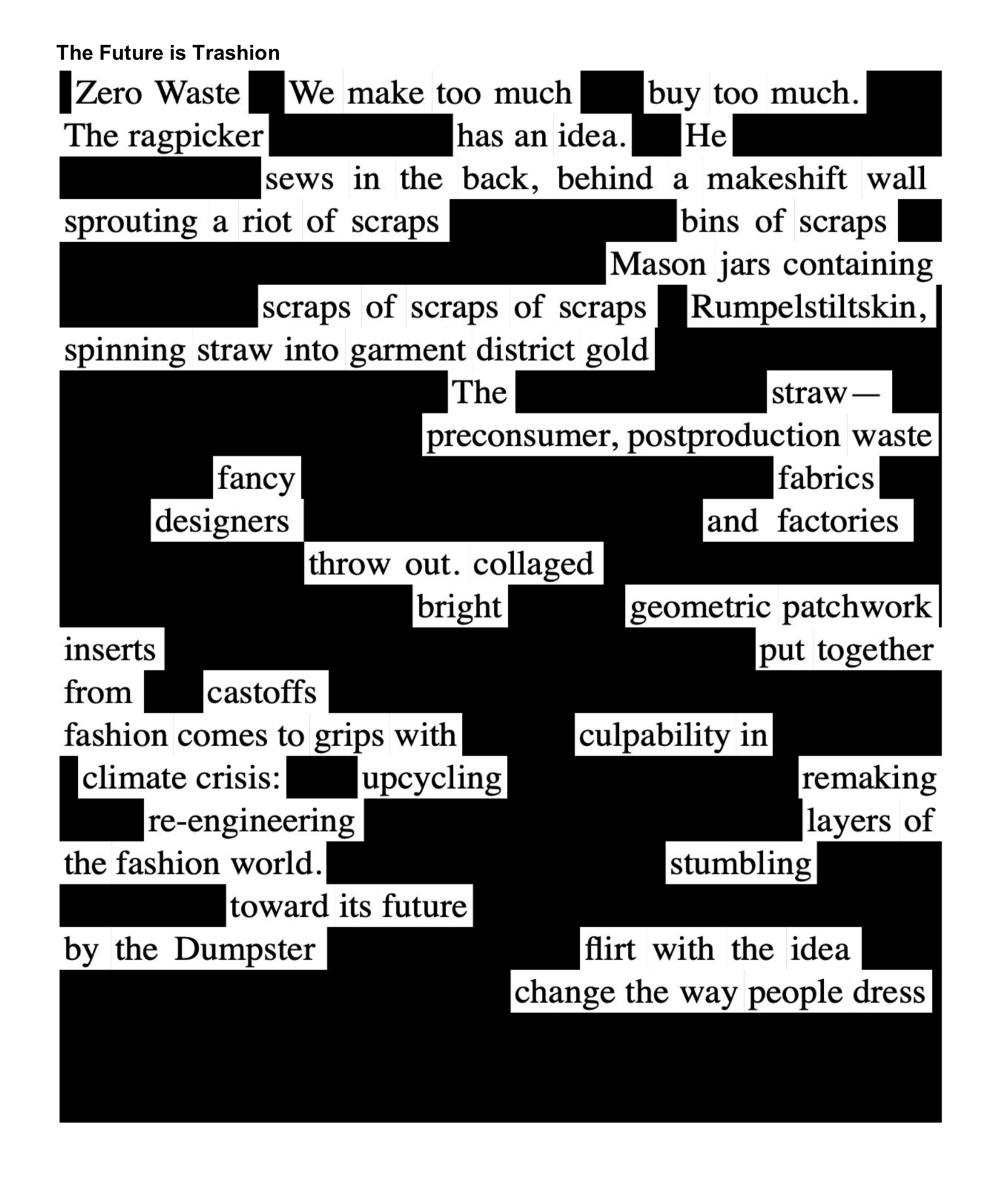
The Future is Trashion

Erasure based on “The Future is Trashion” by Vanessa Friedman. New York Times. December 26, 2019.

Share

Act Now + more


Act Now

When I’m low, I hang out

with the slugs and sugar ants,

I ignore the emails, You will run out

of storage in the cloud.

The clouds

will always make space for me,
I already live in a fog

and there’s always room for more

photos, a virtual bookcase.

As much as I love

being able to type my sadness

to a stranger, my screen sometimes

reaches out and puts its hands

on my hips—stay here a little longer.

I know I’m brave

when I leave my earbuds on the table

next to my cat. And when my stomach

knots, it’s because I’ve hit reply all

and now Dick knows he’s living

out his name like a job description.

This is when I know

I need to stand up and stop

being another head without body, a mind

plus fingers typing. Sometimes

when I’m walking down the street

a neighbor runs up to me to tell me

how Crossfit is working for her,

I press Skip ad until I see the real-time video

of Max, the dog who lives three doors down

and is dealing with depression

because his owner just died.

This is when I reach down

and wipe the goo from Max’s eyes,

and realize how much happier I am

when I sit in the middle of empty road

under an unlimited sky

holding a dog who has no idea

why his owner isn’t coming home.


If We Had Better Lighting, Our World Would be a Soap Opera

Global warming is more than me leaving

the heat on 80 degrees in the guest room.


There’s a shadow on our planet’s lung

and the narrow road is what we drive now

because half of it has slid into the ocean.


We are living longer, but we’re doing it with less

sex and friends. The view from here is gorgeous,


but who to share it with? I am watching the world

turn, all my children becomes all my adults.

I try to count our steps to the grave—5, 100,


1000? More? I’m less than optimistic.

I’m the character who is drinking wine


at noon in her nightgown. The soap operas

are failed decisions and mistakes are real life

choices. Global warming makes my cheeks


flush. Climate change is another way

to introduce myself, to undress and dive


into the ocean that wants to swallow me.
Let me cry dramatically before the scene ends,

let the director drag me to the shore.


Sunflower, What Have You Gotten Yourself Into1

Tonight a neighbor told me how climate change

was a hoax as we stood under an orange sky


from the smoke of wildfires and when he coughed

because the air quality was not good enough


for his lungs I said, It hasn’t rained for years

and when the birds started falling from the sky


he said, That happens sometimes, it’s cyclical.

God bless the confused, I said to the waves


reaching over into our yards, to the oceans

so warm the icebergs are the ice cubes


the barista places into our lattes, this should

cool it. And at night when I walk home


in a tank top because what was once a winter

is a mild spring, I lean back and watch the bats


circle and eat up whatever insects we have

too many of and I think my god, we fucked this up


so quickly, as I admire the moon that almost winks

at me, as if it knows how many years we have left.  


 1Title from a line by Kim Rashidi.


Share

Cooing & Longing

Cooing

A bird perched on the fence for a minute—

its cooing brought me out of the house.

There was so much color on its feathers.


Its beak didn’t jut forward but bent downward

like in most of birds of prey, but this one didn’t prey.


I couldn’t feed it so it left sooner

than it used to when you were here, no grains

to litter the compound with, but then

there was no kind of fodder in the house.


It was the kind of bird that knew its beauty—

perhaps a special thing for its species.


I had thought it would cut me some slack,

but, like you, it didn’t, fleeing on instinct;

like you, it left a trail of leaves in its wake.


Longing

I remember the first dry season I spent

in that house you lived in until you died.

Harmattan almost bent you double,

dragging in its dusty perfume across miles

and into every room, sparing nothing

so much so I never knew I would ever

be so expectant of rain; even the birds,

the animals were having a hard time

of all the charade that was the weather.

Even the wooden shelves cried as they cracked,

their grains warping into undulant hills.

I was addicted to the city life.

I tried to hide my feelings because

somehow the weather benefitted you.

You had never so stood at the window

with such longing, in your eyes, to be outside.

I looked into your clear brown eyes and tried

to will the young agile person I knew

who would walk miles with me merely to see

what the landscape was like at the moment

because, for you, no one stepped into

the same landscape twice, for you the wind

was always changing something, eroding

either the soil, or the trees of their leaves,

the rain would always wash something away;

even the cities could not escape this.

It was like a process of aging.

Sometimes the wind brought more than dust

and its empty smell: now a sweet smell

but one which you doubted: maybe it was

the smell of bodies carried over miles,

maybe the dust was part of their bodies.

I knew it couldn’t be real yet I let

myself to imagine it, as scary

as it was, for didn’t we hear about how

the rivers, though how dried up they were,

still vomited tumescent bodies

from their silvery bellies, about how

the beggars didn’t wake up in the streets,

their stiff bodies curled up like balls of wool?

I tried to find things to love in this place

but couldn’t, rather reasons to leave

were monthly stacking. Minna was almost

like this and each day the people I stayed with

tried to convince me to cut the place some slack,

I took a piece of my clothing and quietly

folded it and threw it in my traveling bag

until one night I realized it was full.


Share

Evolution Kit

According to the manual, the “Theistic-Science World Building Kit” contains the following:


1. One forty-gallon terrarium (48″ x 12″ x 16″)

2. One shaker of “Evolution Mix” biosphere food (red)

3. One prepackaged rock to make the core

4. One shaker of “Planetary/Ecosystem Dust” (blue)

5. Something called “Matter,” which has the exact color and consistency of chalk dust

6. The Evolution Manual, as yellow and glossy as a school bus


The manual tells Katie that she should expect all life in her biosphere to map onto the evolutionary trails of Earth species. She can expect fish to crawl up on land, sprout into dinosaurs and birds: an inherited morphology spread throughout the ages.


STEP ONE: Pour Matter into biosphere and add one to five shakes of Evolutionary Dust.


STEP TWO: Begin.


Katie pours the chalk dust into the terrarium. She sprinkles a heavy dose of blue dust and a bit of red. It looks as though she has dumped food coloring into milk. The blue gains dominance, takes the red and drowns it. Katie imagines hydrothermal vents blasting within the rifts of the biosphere’s surface like primordial, cosmic wounds.


She does not regret her drunken purchase. The kit was purchased whilst shitfaced the night she got laid off. The package arrived on May 21st, which Katie remembers only because it was an ex-boyfriend’s birthday. The return address listed the town of Gammelstad, Sweden, but the box claimed manufacture in Stockholm, and the postage stamps revealed a journey from Oslo to Reykjavik to Paris for some reason to Reykjavik again to Halifax to Denton, Texas, where it found Katie’s front door. The return label said Play God Theistic-Science Company in block blue lettering, followed by a clip-art icon of a FedEx truck, even though the shipping service was a third party called Ilmarinen, Inc.


Katie adds more Planetary/Ecosystem Dust and goes to bed.


When she wakes, fish have formed in the theistic-biosphere. The terrarium is an aquatic underworld: jellyfish sway near the surface; shadowy agnatha—jawless fish—swarm at the bottom. Small, armored sharks with little plated spines of cartilage that the manual calls acanthodii appear. In the tank’s center, there is a tiny quadrant of shore.


STEP 3: So, you think you’re beginning to see fish.


Titaalik roseae, a four-limbed Devonian vertebrate fossil found in Nunavit, Canada is thought to be one of the first creatures to have walked on land from the sea. Both fish and tetrapod, the Titaalik supported gills, fins, a pelvic girdle, and partial wrists. Keep watching. The next step is dinosaurs.


Katie looks back at her terrarium. She wonders if the tiny creatures she sees emerging onto the shore resemble Titaalik, their toothy mouths gaping, marble eyes glistening like new olives.


The world around her but for these little creatures feels ill with the lack of hope.


It is sunset by the time there are dinosaurs. Evening coats Katie’s window in shades of blue. The dinosaurs are small at first, but by the time Katie is getting ready for bed, wings break through their scales in the most beautiful colors: Jupiter red, asteroid brown, Neptune green. Katie falls asleep in front of the terrarium.


In her dream a great wind blows through the house, far too powerful for her tiny dinosaurs to fly. To protect them Katie must huddle over the biosphere with a blanket around her shoulders, arms spread out like a mother bat, to block the wind.


When she wakes, the dinosaurs are the size of bumblebees, flying and bumping into the glass. One of them belches a candlewick cough of flame.


STEP 4: After archaeopteryx, notice mammals.


But there are no mammals, and Katie recognizes the dinosaurs for what they are: dragons. They buzz like trapped flies, spurting flame at each other. It is impossibly cute.


If any cryptozoological creatures appear, immediately implement World Extinction Kit (sold separately at a 15% percent discount with purchase of a second Theistic-Science World Building Kit).


Online, Katie looks up the Extinction Kit. There is a tiny rock that looks like an asteroid and a shaker of something called “Anti-matter.” There is no explanation as to why the dragons must die. Why can’t Katie have dragons instead of dinosaurs? She watches the dragons play with each other. They keep bumping into the glass. Katie opens the top of the terrarium.


One immediately begins to nest in the rafters. Another begins hoarding loose grains of rice in her pantry. It sits atop the rice as if on a bed of gold. Katie chucks the Evolutionary Manual in the trash. There is no real plan to a world, she knows this. Only chaos.


The terrarium is a dead planet now. No more creatures will appear. Katie wonders if the dragons feel like astronauts, like explorers. She wonders if they are triumphant or afraid. If the sound of her microwaving ramen sends a message of doom throughout the apartment. If they heave a tiny sigh of relief at the “ding.” She wonders what it feels like to have left behind the world of false order and live in the stars.


Share

The Murder Hornet

can fly sixty miles in a day

& decapitate its prey

quicker than licking

honey off a thumb.

Size has its advantages.
& its costs. My mom
told me early I’d pay

for the size of my heart.

You feel too much, she said.
You want too much.

In the Love Addicts Anonymous

meeting, a white man in a gold ascot

said, I need to be devoured by love.

Devastated, I added, swallowed whole.

Murder hornets are efficient killers,

but is any torture more elegant

than chasing what you’ll never catch?

There was one time in my life

my heart felt right-sized,

quiet, & I was so at peace

I was invisible. The robin

thought I was a chair or tree

the easy way she cleaned

her feathers near my feet.

More often my feelings swarm,

a storm surge, how water alone

can warp metal, level a village.

When I keep feelings at bay

I appear okay, recalling

how Gulliver’s giant size

made him too dangerous

to keep.

Share

Tomorrowland & Man’s Dominion

Tomorrowland

I think it is equal in importance to that moment in evolution when aquatic life came crawling up on land.

—Wernher von Braun on humanity entering space, Los Angeles, 1955–1957


Some days after work, I’d rent a speedboat

from Long Beach and hop it out to Catalina

for an evening dive. What a thrill every

time, the chill of sliding through blue skin,

descending down the long teal folds of fulgid

kelp. A bright humming brain of gold baubles

lifting braids to the sky like a praising willow

swaying in the sugared light. I was almost lost,

weightless and wondering through the ocean

with no one following me but the moon as it

rose to look upon its navel. Omphaloskepsis: to

consider the divine inside the belly. When Jonah

was ankle-sunk in stomach acid, he was learning

the volcano’s wrath that gave birth to land. I could

spend hours floating in the whale constellation,

that dark, starry sea of seas. The umbilicus of space

that ties us to the womb of ocean. I wanted a rocket

to break through the egg with its tooth, dislocating

heaven and earth’s denotations. When we first

fumble around in the moon’s cratered belly, what will

we call our new lexis? How will we learn to be in

the universe but not of it once we leave behind our

world? The mystical isn’t in the ecstasy of floating

through space, our fragile bones eroding, but in

bearing the burden of our attachment toward a

center. Peter met Christ on the water because

he wanted to be like him. I designed Lunetta to churn

out gravity for the future to meet the cosmic Christ.


Man’s Dominion

And don’t tell me that man doesn’t belong out there  [space]. Man belongs wherever he wants to go—and

he’ll  do plenty well when he gets there.

―Wernher von Braun, 1958


Standing at the edge of the Yucatan

jungle, I felt an urge to just run

blindly into it. The adrenaline was like a

timpani drum roll, paving the entrance

for the brass. I hired a guide, and as we

pushed through curling palms, ferns, and

snagging vines, I swear I could smell the jaguar’s

urine on the trees it had sprayed, hear

echoes of the animals that had fled before it.

I could hear a mosquito filled with a pyramid

of blood. When we saw the jaguar,

I became quiet as space, holding every

sound against the butt of my rifle.

Like when I held the liturgy candle,

planning each step so I wouldn’t spill the wax,

trying to pretend no one was watching.

His fur was glistening jet oil, his gaping mouth

a range of snowcapped teeth. The God who

framed his symmetry pitch-dark dared to

lock my limbs into their grooves

as well. He meandered through the lushness as a black

hole against a canopy of stars, his gold eyes

moving like jumpy flying saucers

in a child’s sloppy flipbook. I aligned

the crosshairs half a meter ahead of him

and pulled the trigger like a prophet

releasing a message before the people were ready.

My throat felt as if I had swallowed too

much water. I strode through the mist

toward my trophy, the graceful carcass already

hazy with flies. I had my guide put it in the jeep

and drive me into town to have it skinned.


Share

To the Elk

They were hanging it against the barn wall. The head limp to the side. With a snowmobile they had dragged the dead elk from wherever in the mountains the pile lay where it had been gutted. For this bloody spectacle.


“That’s a big fucking animal.”


The porch of the main cabin: Wyatt was there with her, and so was this man Dale from Seattle plus the three highballs in his veins. That’s a big fucking thing, Dale kept saying. This was at the ranch that was in Wyatt’s family. The Smith River was nearby. It was Thanksgiving night.


“They got one last year too,” said Wyatt.


“It’s bigger than a buffalo.”


Savannah was thinking of her father and brother and this same performance. They would return home to the triplex by the refinery, north-side Great Falls, with a carcass in the truck bed and blood dripping from the tailgate. And she was saying to herself, for this….


Up the porch steps came the hunters. They had been out all day and were covered in mud, and Savannah thought they smelled. Wyatt congratulated them and asked about the hunt. An uncle said they’d been lucky to shoot it from fifty yards. It ran a hundred and died, and a young cousin took the killing shot.


Wyatt’s uncles and cousins started applauding. They shook hands all around. Even in daytime she didn’t remember their names, and it was not daytime. The dark was long past gathering; it had mustered.


“Last year they got a bigger one,” Wyatt said.


By now the hunters had gone off to their different cabins to clean up.


“Bigger?” said Dale. “Bigger than that?”


“It’s missing half its rack.”


Savannah looked at the head again and saw only one antler.


“Do they spar?” asked Dale.


“I think they grind them against the trees,” said Wyatt.


“Not as impressive.”


“True.”


Speaking to her now, Dale said, “Let me ask. As a Western woman, does this arouse you? These men returning from the hunt?”


“I hope not,” said Wyatt. “I’m related to them.”


“I don’t mean the men. I mean the blood. I mean the sight of this big, beautiful dead thing.”


Savannah said, “I’m used to it.”


In fact by now—being from this region and educated in a different one (the opportunity belonging to so few from that refinery neighborhood)—she had a rule for herself: no dead animals or fresh-caught fish, not in real life and not in any photographs in any public medium, app or profile, or anything else. None of that spectacle would be permitted with regard to whatever partner or friend she kept. Wyatt’s pictures were full of other things: the neoclassical façade of the apartment building where he used to live in Missoula, an Old Fashioned in a bar in Chicago where his roommate from college played jazz guitar, a portrait in graduation robes and the sandstone arcade columns flanking him, that one now six years old and his hair (shorter back then) tousled from doffing the cap, the PBK cord helpfully around his neck in the foreground….


“Does it arouse you, Dale?” Wyatt asked.


“No, I’m so boring. No kinks for me. For me it’s all dollars and cents.”


“You’ve seen more blood than any of us.”


Seattle Dale was a political communications consultant. Fundraising was his higher function.


“Violence to me is writing a strongly worded email. But—I mean—you look at this, and you know these men can provide. I mean, this is vacation—it’s fun—for us. But—I mean—it’s something, something more.”


His tumbler was down to the ice melt.


“It doesn’t arouse me,” Savannah said.


A cone of light and warmth and festivity spiraled out like a dust devil when the door opened. A terrier called Sonny with long distinguished whiskers came out and trotted down the steps and went to piss on the snowy lawn. Inside, Wyatt’s aunts and mother, and his father also, were preparing the table. His father specialized in sweet potatoes.

When the little dog came back Dale went in for another drink and called the dog in using baby sounds. At last they were alone.


She watched Wyatt’s face. There was nothing there but anticipation for dinner and for his wine. She had looked at him before and had seen whole worlds where they would go together and more from which he’d come. A lick of dark hair came down out of the front of his cap. He put himself together well and tried to dress of his time, but it did not subsume him. Not too clean with the effort, his good shirt just a little too big. He liked big clothes. To have something fit perfectly—was that another of the things that would make him feel ashamed of his upbringing?


The glass against Wyatt’s lips now. Rare content passed through his eyes as he swallowed, the fire weeping in them. He made his deep voice go high and feminine. “Does it arouse you?”


“Ask me again,” Savannah said.


“As a Western woman?”


She moved to hit him, and his arm was around her.


“It’s cold.”


“I’ll get a fire going in our cabin.”


“That sounds nice.”


“Thank you for doing this,” he said. “I know it’s unbearable.”


“It’s not. It’s really not. I love them.”


There were many people she didn’t know. But at length you would know them. It was not being away from home, that wasn’t the difficult thing. Anyway you only had to get through dinner and then go to the little cabin and go to sleep. The drive had been beautiful, and they hadn’t argued.


She stood on toes to kiss the bottom of his neck.


“Do you really?” he asked.


Tears were in that question. Tears were good. And her rule was a good rule, a necessary rule to have for men. Education in history and politics had made her question whether it was for the better passage of life not to have relationships with men. That was a resounding theory up until graduation. Anyway, at minimum you had to have a rule you stuck with.


He went to wash his hands before dinner. When he was gone she admired for a while the dark mountain on the horizon above the ranch gate. The cold clean air touching her eyes, inflaming the veins. She didn’t look at the dead elk on the side of the barn. Then she went in for dinner.


The table was so crowded with people that her shoulders never relaxed. Her shirt went too low, she thought.


The food was very good. The green beans were perfectly seasoned. There were two turkeys; one was local and lean and the other was a butterball. They filled their glasses with red wine out of towering decanters. She was at the end of the table beside Wyatt. His father was at the head. She was across from his mother. It was a good meal. Everyone talked to each other.


“How come you didn’t want to hike,” the mother was saying.


“I thought I’d stay around and get something done,” said the father.


“Get what done?”


“Work. Caught up on emails.”


She watched Wyatt. He was drinking fast. She touched his knee under the table. His leg was vibrating under her hand. You could duck under these little breakers of talk like a child playing in the surf, but Wyatt was not possessed of that lightness. Later they would have to talk at length about it—whatever thing was said at the table that stood out to him as particularly abhorrent.


Things got formally quiet as everyone took turns saying gratefuls. The woodstove atmosphere and the gray iron of the gun barrels on the walls and the smell of the old rugs and leather furniture gave the quiet an oppressive quality like overwhelming heat, inescapable intimacy, absorbing silence into it.


From the other head of the table, “To the elk.”


“To the elk.”


“Beautiful. Just beautiful.”


“It’s special.”


“There are times you’re facing an animal and you’re not ready to take a life. It’s not an easy thing. To the elk. And to Harrison. He took the shot.”


She drank a little faster after the toast. When her turn finally came, she said, “Thank you for welcoming me. It’s a wonderful place.”


“To the ranch.”


“The ranch.”


They drank. All agreed—the ranch and the dead elk held all that was beautiful and dear. She didn’t look at any particular face; from having run meetings she understood how to look between people when addressing a table. She went on, “It’s been a good year. Better than I expected.”


Wyatt mugged for the crowd, and everyone laughed.


“Really, thank you for having me.”


Later they stood around the long kitchen island and ate the pie she had baked. She explained again to one of the aunts the decision they’d made to move in and what went into it. The uncle who had toasted the elk asked what she was doing for work and followed her answer with, “Do you work together?”


“No,” said Wyatt. “She works for a Dean. I work in Admissions. The worst office to be in right now.”


“It’s a good place to work,” she said. “I can do four tens in the summer when I want. The benefits are good. Campus jobs are nice.”


“When you add your union dues to the premiums you’re losing half a paycheck,” said Wyatt.


“But you can’t have one without the other,” she said.


“It’s beautiful how that works.”


“Can you run this up the flagpole?” the uncle went on. He had not listened. “Why the cuts to English? You can’t cut English. What’s the point of having a public college if you’re going to get rid of English?”


“English isn’t going anywhere,” she promised, wearily. Because she thought there was more than just the appreciation of literature in his concern for the survival of English.


“Well, run it up the pole if you can. It’s terrible what’s happening over there with the cuts. And Will Tunt retiring is a big loss.”


“It’ll get better,” she said.


“Enrollment always goes up when there’s a recession,” said Wyatt. “Folks would rather be in grad school.”


The uncle had taken several big bites of her pie. He told her how delicious it was and asked if she had made it herself, yes. After a long while the grown-ups were too drunk to stay awake and the teenage boy cousins had grown too weary for the world outside their heads and the girl cousins were sleeping in the corners cuddling with the dogs and it was over, she had survived it, and Wyatt was not saying anything else about the college where they worked and how it was a poor school serving poor students who were going to stay poor, and they were on their way out.


“Take Sonny with you,” said his father. Handed the terrier’s leash to his son. “Don’t worry, he’ll be good.”


Together they walked the little dog from the big cabin to the small cabin where they were staying.


While Sonny sniffed around at the base of the cabin steps, they sat on the porch, on top of a bench covered with a buffalo hide, and they looked across the lawn at the barn where the dead elk was hanging. Savannah wondered if it was going to start smelling.


“I wish I’d been out there to see,” said Wyatt.


“I don’t.”


“I mean to see it when it was alive.”


“I’m glad you weren’t there to see it get killed.”


They were holding each other. The wind moved over their faces, and they squeezed closer.


“Not that I want to hunt,” Wyatt was saying. “But you sort of wish that you knew what it was like.”


“I don’t. I don’t want you to be like,” she raised her voice and imitated Seattle Dale, “Harrison.”


“Me neither. I just wish I knew.”


“It was fun walking to the cliff,” she said.


The hike they’d done in the afternoon took them across the western expanse of the family’s great tract, past a tipi erected for ambience, to the edge of the river gorge. Fathoms down, you could see the frozen banks. In summertime you could swing from a hammock between two ponderosas with a cocktail in hand, maybe a book in your lap. This was how she imagined him.


Then she thought that the dead elk had moved, swung a little.


“It’s—” he started. “My dad didn’t know how to field dress an animal. His dad never taught him how to hunt. I’m not any better because I don’t do it.”


“It’s not about being better.”


“One feels somehow emasculated,” he said.


“Because you don’t know how to hunt?”


“Not exactly. I don’t think you’d get it. You remember Chuck asking what I do?”


“He didn’t ask you. He asked me.”


“But then he asked if we work together.”


“So.”


“I always have to prove my worth. That’s what I mean: I don’t think hunting is impressive. But doing something impressive is impressive. Knowing how to do things.”


“I don’t think that’s what Chuck meant.”


“I know my family.”


She didn’t want to argue. She said something about how it would be cold and unpleasant to have to go pee in the middle of the night, since the nearest outhouse was across the lawn, behind the barn with the dead elk. After that they went inside and got changed for bed; or, she did, and he started trying to make the fire.


The plush duvet cover was cold on her bare legs. The hairs stood up, and while she waited for the fire to start she was self-conscious of having prickly legs. Sonny was on the ground, sitting obediently and anxiously, watching her in bed. Wyatt was kneeling and using a hatchet to make kindling. Erratic banging shook the door when he wedged the blade into a crack and slammed a log against the stone base of the fireplace to split off flakes of pine. He built a pyre in the iron woodstove with newspaper and tinder and tried to get the flames started and took a long time to do it and tried opening and closing the flue and could not get it right.


“It’s so cold,” she said.


“Almost got it. I smothered it last time.”


“Maybe you could just get in with me.”


“No, I have to do this.”


She could fall asleep even when she was freezing, especially after enduring something. Enduring did make you tired, but it was alright to be tired because you could sleep easily. Her father had said to her once, do you sleep easy because you’re a princess?


She was almost in a dream and Wyatt was still working on the fire, and she felt Sonny climb up onto the bed and lay down on top of her feet, and her legs got warmer, and then she was all the way in the dream and almost asleep but still heard the newspaper flare up quickly and burn out each time he tried and tried, Wyatt still in the waking world.


Much later in the night she woke up because she had to pee. It was hot in the cabin. The fire was going, she did not know for how long, and the twin bed beside the queen was unmade but empty.


She pulled sweatpants on and went to the door and had to push it very hard till it flew open and slammed against the wall. No other noise out there. She saw the moonlight, bright on the snowy lawn, and the big cabin like an embalmed giant. She saw the elk, its fur matted and dark, and the tongue spilling out of its cracked mouth. Its open eye was black.


And Wyatt was sitting on the bench next to the cabin door. He was all in his winter gear, which he had formerly peeled off when he labored to make the fire, and his elbows were on his knees and his cheeks were in his hands, and he was undoubtedly facing to look at the elk.


“It’s cold,” she said.


“It’s not too bad.”


“Do you want to talk?”


“About what?”


He wasn’t wearing shoes. His bare feet were on the ground, his toes a few inches from the pastry-thin ice. He had taken off his thick wool socks and left them between his feet, inside out.


“What are you doing? Come to bed.”


“I can’t,” he said.


“Come on. Don’t do this.”


“I’ll be in later. I’m sorry.”


Savannah recalled that she had to pee. Without answering the apology she went down the cabin steps. The sudden reminder, the pressure in her stomach returning to the front of her conscience, was as heat coming back into a room after a door is shut against winter.


She walked out over the snow. The dead elk grew larger and larger in sight the closer she came to the barn. The texture of its fur was nauseating, more than the smell of the outhouse.


Sitting down, she hated herself for the lapse. It wasn’t useful to be bitter about anything, but it had gotten to you anyway. The transference: you’d caught it just as it was done.


When she returned he had already gone back in. The socks remained. She picked them up and shook a little ice from them. In the cabin he was lying flat on the twin mattress, with hands folded on his chest. She got on the queen and pushed all the bad air from her lungs.


“Come on up.”


“Just calming down.”


It was the same thing. Civilized men would kill something, civilized men would watch. In his pictures the elk was there. Strung up between the arcade columns, its outline and ghost.


“Get in with me.”


After a minute he said, “Alright.”


There was love too, that was true. He was the product of a rule, an algorithm that had narrowed so many variables to her preference. They resisted the same things. Like the logs and pine flakes and newspaper it would keep the fire going, but also they would be consumed and used up. There was no rule concerning what to feel.


Share

Pollarding & Animal Spirits


Pollarding

In this unwitting dawn. In the begonia
I put in the poem because of its incantatory


sound. In the vine I thought was a sweet

pea—to put a sweet pea in the poem—


but was actually a weed, common vetch.
In the still early summer heat like gentle


pressure on the forearms and wrists.


A trio of military planes screams overhead.

I squint into the glare and the leftover


cosmetic product on my hands flashes
in a type of dim recognition. Wash it off. Who


is going to read about botanical misprision.

There’s a war on and I am the yellowing


pages of Bishop’s National Geographic.

There’s always a war on and its location


is not a function of place but of people, plucked

for the vase or the oven, wilting or burning or


eaten as a delicacy. The word of the day

is upward. The word of the day is all cops


are bastards. Who am I to say what we should make

of the clay at our feet, minor gods with shovels


and grass seed, with kilns and molds, the joints of

our fingers curling around some texture, releasing


it in the checkout aisle or through the window

that backs the checkout aisle.


After adrenaline, a comedown just like any
other high. You’re sitting on the floor in a hoodie


and biting all the skin off your lips. Outside,

the day continues to mulch itself, there are


robins, someone is invoicing someone else

for another order of rubber bullets.


The symbolic vulture will not arrive


To hunch in the middle distance. Sorry,
I’m back now, I was on the patio this whole time,


my mouth is bleeding and the roar has faded
such that it might be mistaken for an air conditioner,


the mechanical hum of comfort
in deeply inhospitable environments,


a fueled and speedy monarchy, it’s coming,
I tell myself, get up, it’s well-rested and armed


to the teeth literally but also and importantly
for my purposes metaphorically, a giant blossoming


of dipshit noisemaking. It doesn’t have to go
to the office and it is responsible for the existence


of Phoenix, Arizona. I wobble on my feet

like a newborn anything. I am melancholic


about structures. Look: no matter what you grab

out of the kitchen drawer, it can be used


as a lever. In what follows, we’re on the side

of the ice, those tropical begonias be damned.


Animal Spirits

“If the animal spirits are dimmed and the spontaneous optimism falters, leaving us to depend on nothing but a mathematical expectation, enterprise will fade and die.” —John Maynard Keynes


Enterprise withering on the vine. Enterprise left to rot in the sun.

Out of its carcass, a cooler wind—


/ / /


If the world is bad to you, you are sad.
If the world is good to you, but you know about the world, you are sad.
If the world is good to you, and you do not know about the world, you will not be sad.
If the world was bad to you but it is no longer, it is easy to forget about the world, and easy to

forget you were ever sad.


O dripping globe. What we’ve blamed

on the elements. On the accident
of our cells rather than the rapidity

with which we turn water to cement.


/ / /


The idea that the brain is the seat of the soul is older than most people think it is.


The history of naturalizing economic activity is exactly as long as you think it is.


We were made for money / / we were made of money


/ / /


Falling through a substrate,
the gentle “u” of the body as it faces upward. The hands and feet like a dancer’s, directional.


On the curb, a man turns over shovelfuls of dampened sand in a wheelbarrow. The sound is like

stiff fabrics hung too close to one another on a line. A recursive intimacy.


A brief and wild optimism, and then the grinding sludge of machinery, its unmatchable

excitation.


/ / /


A bull in the blood.
A bull made of blood, made of air, air carried in the blood air seated in the brain.


The brain a bull. The world a bull with its hooves on the world.


O beast that could be gentle. Asleep in the beige autumn of the shaken head, slow wading

through the pool of counter-liquefaction.


Abolish selling.
In the hand outstretched, these cool bristles
like a hand broom, a horned smoothness and the scent
of fields and a fire recently extinguished. This animal pause.


/ / /


Frenzied acquisition of undergarments,

small vases, linens, soaps, followed by the hatred of stuff—


/ / /


The dog on the surface of the water, the dog on the silver of the coin.1


1See Robert Burton, in Anatomy of Melancholy, on rabidity: “That in Hydrophobia they seem to see the picture of a dog still in their water” (222).

Share

Invasive

Then there was no more singing.

All the lights in their throats cut:


the protest of evening wolves & black

bears nuzzling a parched creek for any-


thing that might sustain them another

white-skinned winter, those foreign


birds we never learned the names for.

Invasive, my grandfather called them.


Like the silver carp haunting our

local river. Bullfrogs & possums.


He called us natives after living

three generations on the same


hard land it took so much blood

to own. At the end of the path


the bullet takes to meet the right

body, the right body drops like


nothing worth losing sleep over.

It’ll cost two men three hours


to drag it home in one piece.

That wilder silence lasts but


a brief eternity. Before the unseen

choir shakes the forest. Again,


the same damn wolves & starlings. Men

still dragging. The season closing.


Its wiry legs kick & quiver in our hands.

Like strings. Song. Our song now to sing.


Share

King Speaking


“King Speaking” is a sequence excerpted from the latter half of a book-length erasure, Her Read, forthcoming from Texas Review Press in 2021. Her Read reconceives the entirety of The Meaning of Art (Faber & Faber, 1931), a highly regarded exploration of art from prehistory to the modern era by British art and cultural critic Herbert Read. Though the maternal body appears with frequency, zero womxn artists are included in the early editions of this text. In 1951, Barbara Hepworth becomes the sole female artist to be admitted.


I began this makeover summer of 2016, in that pre-election heat, when rage at the latest iterations of hate on the American political stage, in conjunction with erasures playing out in my own life, made other writing seem impossible. From the voice of the male critic surveying male bodies of work, I began excavating a first-person lyric, the imagined voice(s) of womxn artists.


The concept of “mastery” appears with frequency over the course of the book, issues of dominion—that is to say—control—over a medium of expression, over other humans, and of course, over the Earth. One may well ask, what is art but a pronunciation of mastery? One may ask, must it always be?


Though I call this erasure, collage is a more accurate descriptor of this late excerpt. The surgical reconstruction contrasts cruder, monochromatic pages early in the text—used canvases treated only with correction fluid. As the book advances, the speaker gains agency over the text, revising the rules to serve to her fluencies. One rule is not broken: all language excavated and redeployed in this text can be harvested from a single copy of Read’s seminal text.


Materials:  source text, correction fluid, archival inks, bookbinders glue, florist tissue, window shades, general purpose thread, embroidery floss.

Share

Long Marriage (Parable of the Skull)

Over years we lifted it sometimes
from its cardboard box, studying


the fifty teeth and gazing into the open
eye sockets, this possum skull we found


in our sixth year, half-buried in the dirt
behind the rental house. For decades, then,


we moved it everywhere we went,
and always it lay quietly, as patient as dirt,


and only now and then did I imagine it
dreaming that skin formed once more around


its body—the moon face and moon tail—
so it might waddle again along the river.


This poem was originally published in The Florida Review (43.2, Fall 2019) and was a runner-up in the Humboldt Poetry Prize.

Share

Notes on Pet Monkeys and How to Manage Them

I.     CAGE ITEMS


This box should be fairly heavy. The door
never needs opened or undone. Bend the rim
into a square. Little danger to your
self—the room to be afforded him.

A looking glass hung up by a small chain—
your pet’s vanity exceeds belief. A
flimsily made affair is soon bitten
to pieces. Body of a cage. Many a
good monkey is killed by swallowing
fragments of glass. Rub on a coat of
maroon. A little ornamental topping.
Or Venetian Red, most suitable of
colors for a cage. All that remains
is to procure your monkey and put him in.


II.     CLASSIFICATION


From the time my fingers were big enough
to manufacture fly-cages with hollowed
cork and pins—all other lines of
fancy well threshed out—Simians have held


great fascination. The schoolboy’s definition
is “the plural of monk.” Or humonculous.
Much is lacking in what might have been
told. I cannot pin. Great naturalists


have labored to show a relationship.
I cannot pin my credibility.
Below the average human idiot’s,
the head of a chimpanzee. I am drifting.


What might have been. A fertile source of
drollery. My fingers were big enough.


III.     AILMENTS


Disease—Symptoms of Indisposition

Quinsy—Good Riddance—a small apple

hollowed out—Toothache—Headache—treat him

as you would a child—Useful Article—


as you would—Broken Limbs—a human
being—Rheumatism—RuptureRisk of

Being Bitten—first he should be en-
veloped—Treatment—in a bag—Costive-


nessBiliousness—Monkeys Eating Their
Own Tails—a ready sale is better than
the nuisance—Excrement—the “Kill or Cure”
Treatment—treat him as you would a human


being—Simple Remedies—a small apple hollowed

out and plugged again is greedily devoured


IV.     CONCLUDING OBSERVATIONS


Savagely grabbed, the hand that has fed and
petted him all along. The very moment
novelty is lost, sit and write off an
advertisement to Exchange and Mart,


Bazaar. I haven’t always had the heart.
A passing menagerie generally

has a vacant cage. With an iron bar
a sharp and heavy blow. An exceedingly


human-like affair. As if we all of us
come at last to this. In skinning him
yourself you’ll find his hide fairly tough.
Put him in a natural posture. A bit


of dried moss, artificial leaf you might
purchase at the milliners. Keep him in full light.


The source material for these pieces is Notes on Pet Monkeys and How to Manage Them, Arthur Patterson’s 1888 handbook, which was published in response to the colonialist British fashion of adopting exotic animals without any idea of how to properly provide care for them. These poems erase and rearrange the text into sonnet form. The poems were originally published in The Florida Review (43.2, Fall 2019) and were the winner of the Humboldt Poetry Prize.

Share

Freebirds

My mother calls to tell me she cannot get on the plane. She has had a premonition.


“You’re going to crash?” I sit upright in bed, sheet clutched to my chest. When she says stuff like this, my skin gets crawly.


“Not exactly a premonition.” She sighs. “I can’t say what will happen. A foreboding. Emmy, I’m not thinking straight. I can’t zip up my suitcase. And I wanted to get out of here so badly.”


“Are you sure it’s the plane?” I look to my left where the baby is sleeping in her bassinet. I look to the right where my husband is sleeping in our bed. “Could you be foreboding something else?” I say as I tiptoe out of the room, which is not actually a room. We put up a wall in the studio after the baby was born.


No, says my mother, she’s sure it’s the plane, and of course, I could try to reason with her. I could tell her to go ahead and pack that suitcase, get in a taxi, buy a tea and sit at the airport, see if the foreboding recedes. Until she’s actually on the plane, she has not committed to anything. Instead, I say, “I don’t know what to tell you.” Because really, what should I tell her to do? Get on the plane and then the plane crashes and then she’s gone and then it’s my fault? Because planes do crash. They do.


In the background, at my mother’s house, radio voices are murmuring. “I have to think,” she says. “I’ll call you back.”


As soon as I hang up the phone, the baby is up. By up, I mean that she’s screaming. She’s always screaming and we don’t know why. I don’t know why. My husband comes out of the bedroom and hands her to me. “I have to go,” he says.


“It’s six thirty in the morning.” I follow him into the bathroom. He’s a real estate broker, which means that he works on commission, which means that the more he works the more money he makes, at least in theory. I’m no longer sure I buy this direct correlation. He works seven days a week. Before we had a baby, this wasn’t a problem. But now we do have a baby.


I sit on the toilet, bouncing the baby in my lap, while my husband brushes his teeth. “My mother might not be coming,” I say.


He spits into the sink. “Is she sick?”


“Sick in the head!” I say. “You’d think she’d want to see Eva. Who wouldn’t want to spend time with this delightful creature?” I kiss the top of Eva’s head, which is covered in the silkiest hair, soft and ticklish on my lips. She smells like a baby, like white soap and milk. She likes to be bounced, likes the sound of the water and the echo of our voices in the tiny chamber of the bathroom. She and I spend a lot of time in this bathroom. On the rare occasions when she is content and awake, I adore her so much I want to stuff her whole hand in my mouth. Both hands at once.


My husband is sliding the stroller out of the way to get to the door when my mother calls me back. “I’m in line at security,” she says.


“What changed your mind?”


“I’m a fifty-four-year-old woman. I cannot live my life in fear.”


I spy her on my building’s doorstep, from four stories up. She is covered chin to foot in a camel-colored, fur-trimmed coat. Her bright blond hair spills over the collar. Since the divorce, she has made herself thin and sort of glamorous.


She is also late. More than two hours late. Thirty minutes ago she called from a taxi to say she was on her way but couldn’t talk. Before that, I was very worried. Fear gnawed my stomach from the inside out. I called the airline. The plane had landed safely, on time. So if something had happened, it had happened only to my mother. Baby in my arms, growing heavier by the minute, I paced the apartment. What had she been foreboding? A car accident? A fainting spell?


“I met the pilot,” she says, over coffee, at the cafe around the corner, Broadway and 100, where we have settled ourselves at a cozy table. The baby is asleep in her stroller and I am actually drinking my coffee, my guard down, more relaxed than I’ve felt in weeks. If I need to use the bathroom, my mother can stay with the baby. If the baby wakes unexpectedly, perhaps she can even hold the baby.


“He’s a very nice pilot.” She pauses. “He’s not actually a pilot.”


“What is he?”


“He’s a flight attendant.”


“How did you meet a flight attendant?” I say, pleased by the inanity, the frivolity of this conversation. Really, I am pleased to be having any conversation. I am so happy my mother is here and I am not sitting alone.


“It’s a long story,” she says. “But when I called you from a taxi, it wasn’t really a taxi.”


“What was it?” I say, stupidly, my brain dulled by motherhood, perhaps, which is what happens to you, they say.


“He keeps his car at the airport. He was kind enough to give me a ride.”


“If he gave you a ride, you should have been early. Or at least, not two hours late.” I pause, comprehension forming. “What did you do in his car? Mom?”


“Oh my goodness, nothing like that!” My mother flushes. “But he was very nice. We had a wonderful conversation.”


“That’s great,” I say and I mean it and I would ask for more details, such as whether she’s planning to see him again, but the baby is starting to stir. I watch her like I’m watching a bomb about to explode. Except, if a bomb were about to explode, I’d run. My mother is distracted. She hasn’t noticed yet. I stand from the table. “I’ll be right back. Could you watch her?” I don’t look back.


The last time my mother came to visit, I was very pregnant and my mother was the thinnest I’d ever seen her. She was on a mission. According to her surgeon, you were not supposed to touch your face until you had achieved your ideal weight. This was the reason she hadn’t gotten a mini-facelift years ago. For years, she was a slave to her daily pint of pecan ice cream, until, one day, she wasn’t. One day she realized she could live and thrive on little more than lettuce.


“Don’t lose any more weight,” I told her. “You’re thin enough.”


My mother patted my shoulder. “Don’t take this personally, honey, but your perspective might be a little skewed.” She was very concerned for me and how unwieldy I must feel, how uncomfortable I must be in my swollen body. But I thought I looked fine, maybe better than I’d ever looked. I’d asked her to wait a month before visiting so she could be in town for the birth, but she said she could not push off her trip because she needed to schedule her surgery before the doctor’s schedule was full and she really wanted to get my feedback before she made her final decision. There were so many options, she said—facelift, brow lift, botox. “We could Skype,” I said but she shot that down quickly. She needed me to see her in person, the texture of her skin, the full 360 degrees.


She had not been to the city in a while, since before the divorce. Like a flower, you could see her drinking in the energy; you could see her bloom. Smohio, Ohio, she said, she loved everything about the city, the noise and the streets and the interesting little apartments.


“When you were a baby,” she said, “we lived in an apartment like this.” I knew this story. Living in that apartment as a hopeful young wife was a shining time for her. Dad was gone all day, a low-level administrator, not yet the boss. The days were just us, playing in the complex playground, walking to the mall next door. She loved to tell how there was a hole in the fence between the mall and the complex, two missing boards. The shortcut saved ten minutes walking, a lot in the winter. The geometry of it was tricky, but after many attempts, she figured out how to take me out and angle the stroller through just right.


On that trip, we were both waiting, preparing for a big change. In the mornings, I put on my one pair of dress pants with the stretchy panel and took the train to my boss’s office in midtown East, where I worked as an executive assistant. In the afternoons my mother and I wandered the city in the late September heat, shifting from one café to the next, where I would sit back with my hands on my belly, under which I could feel the baby moving, poking and pushing from inside of my body, and my mind was overtaken with the strangeness of this, I couldn’t really think about anything else, but my mother’s mind was somewhere else. When the waiters came to ask us if we wanted something to drink, she’d be pulling at her face, lifting the skin with her fingers, asking if this was too tight or not tight enough. I wanted to be able to tell her that she looked fine how she was, but the truth was, she looked so much better, younger and fresher, when she lifted up her face.


A week after the baby was born, she backed out of her facelift, paying a steep penalty for the cancellation. She spent her deposit on a peel and fillers instead. “I’d love to come see how you look,” I told her. “But I really can’t leave this baby.”


Now, in the bathroom mirror, I look at my own face, which would look better with a little makeup. I luxuriate in the ease of washing my hands and smoothing out my hair without a baby tucked under my arm. I feel so light and unencumbered I could fly straight up to the sky.


When I get back, the baby is screaming. I hear her before I see her. The sound of her cry is the sound of pure uncomprehending terror. She always sounds like this when she cries. Are these her authentic emotions, I wonder, or is she the girl who cries wolf all day long?


“Where were you?” says my mother, thrusting her into my arms.


People are looking at us. “Let’s go,” I say, as I bounce the baby up and down, bouncing her into oblivion. She quiets and falls asleep. I put her hat on her head and zip her into my coat, which is about three sizes too large for me, chosen because she and I will fit in it together.


On the street, I secure the baby to my body with one hand and push the empty stroller with the other. We trudge uphill and duck our heads against the blustery wind. Snowflakes swirl in the air.


“I think I’m finally ready,” my mother says, “to go back to work.” Now she is skinny and presentable; she has plans to expand her hypnotherapy business, to move from one-on-one sessions to larger seminars on stopping smoking and losing weight. She’s had to stop seeing most of her personal clients because they were getting too personal with her—they told her too much and made her worry at night, made her feel that she should help them in ways that went beyond the scope of hypnotherapy.


I also want to go back to work, but I am only an assistant. By the time we pay a babysitter, we don’t know if it makes any sense. I have the idea that my mother could do it. She could move to the city, watch the baby. In my mind, this is something she ought to do, should want to do, should be asking to do. But she hasn’t asked.


A couple blocks from my apartment, we are brought to a halt. Shouting, brakes screeching, a bicycle tipped over in the street, and a man in sleek spandex clothes standing by, helmet on this head, looking dazed. The driver gets out of the car, a young woman who looks terrified. Her blond hair is sleek and perfect. Her makeup is perfect. She is wearing razor-thin heels and short, wide pants that display her pale, delicate ankles. Her ankles must be freezing. Perhaps she is on her way to an interview? I feel certain that the interview was for the girl’s dream job and that she would have gotten it except that now she will not make the interview. Tears run down her face. “Did I actually hit you?” she says.


“You hit me,” says the man.


We cannot look away. We stay until the police arrive. I bounce to keep the baby asleep. The snow thickens and falls down on our heads and on the scene, obscuring the people and the street and the buildings, obscuring the man on the bicycle and the woman who ran into him, but none of this obscures what my mother and I have seen, by which I mean, the things we have seen in our minds, the more terrible things that could have happened.


We take the baby home. While I am feeding her, my mother dresses for dinner. She puts on a camel-colored dress and a big gold necklace. She looks wonderful. I’ve decided her face looks wonderful, too. The baby presses her soft skin into my skin. Very gently, she pets my shoulder with her chubby baby hand. When she’s done, I put her down on a blanket. I give my mother a hug, and her body feels strange to me, so thin, not at all like the mother I know, a woman who might eat half a cheesecake for dinner then go power-walking through her Ohio neighborhood, at any time of night, arms pumping away, a bullet in white tennis shoes, Walkman tuned to her motivational tape of the moment. She’d come back red-faced and full of ideas. The world is awakening, she might say. Get enlightened or get left behind.


My husband is supposed to be meeting us but he calls to say that he’s running late and we should go on ahead. I don’t have anything to wear and I mean that very literally. The only clothes that fit me are yoga pants, so I put on my nicest yoga pants, the ones that look the most like real pants. I tuck the baby into her stroller and by the time we’re out on the street she’s fallen asleep. My mother and I walk to dinner. We are shown to a table close to the door, presumably because we are saddled with a baby and might need to make a fast escape. Every time someone exits or leaves, we are hit with a blast of cold air, which makes this a terrible table for a baby.


We order a bottle of wine, something my mother and I have never done together. I can’t drink much because of the baby but I assume my husband will take most of my share. I am drinking wine with my mother, who looks like a glamour girl, and she is talking to me about men, how much she wants to meet a man. She orders a salad without any dressing. She takes one tiny sip of wine. I eat all the bread in the basket. I can’t stop drinking the wine or asking my mother questions. I am having a wonderful time. “What about the pilot?” I say. “I mean the flight attendant.”


“Oh,” she says. “Oh, I don’t think so. He’s always traveling all over the place.”


“There’s no reason why you can’t travel,” I say. “Shouldn’t you travel? You’re so free. There’s no reason for you to stay in Ohio. You’re unencumbered. You could travel all the time.” I am getting excited. I keep drinking wine. “You could do your seminars like that,” I say. “You could just travel and give your seminars wherever you travel. Doesn’t that sound like a wonderful life? Maybe you should marry the pilot.”


My mother puts down her fork. She is taking a break though she hasn’t eaten anything. “Mark hasn’t called me,” she says. “He said that he would call me but he hasn’t. So I think that we should forget about that.”


“It’s only been a couple of hours,” I say. “Maybe he’ll call you tomorrow.”


“I was hoping that he would meet us for dinner. I was hoping to have a date.”


“Well, I don’t have a date either,” I say. “So I guess we can be each other’s date.” Really, the baby is my date, and I’m worried that my date might be waking up. I watch her like I can hypnotize her with my will to go back to sleep.

“I’m tired,” my mother says.


“Move here!” I say. “There are men everywhere! You’ll get a place near me. You can help with the baby.” As soon as I say this out loud, I realize how badly I want it. “Wouldn’t you like to spend time with the baby? You can help me, I can help you.” I knock over my glass of wine, I am so overwhelmed with the perfection of this idea. As I mop up the mess, I think how this is what I need. This is what she needs. For the first time in many years, my mother and I will fulfill each other’s needs.


My mother shakes her head. “I can’t move here. I don’t like it here. All the people. That accident. I’d be afraid to cross the street.”


“I thought you loved it here,” I say.


“I want to work on my business. I want to work on myself. There are so many years—I really don’t know what I was doing. I need to make up for lost time.”


“The baby’s here,” I say. We both look at the baby, who is starting to stir in her stroller. Her face wrinkles and un-wrinkles. I turn to my mother and I can see that she is unmoved.


Before I can reach her, the baby escalates to a full-on scream. As quick as I can, I lift her out of the stroller, but the crying doesn’t stop. Everyone is looking at us. I bounce and bounce. I look for a nook. The bathroom is tiny. There’s nowhere to go. The screaming gets louder. I am starting to panic. The waiter is approaching. I was silly to bring a baby to this place. In a second, I will get kicked out.


“I’m going outside,” I say to my mother, zipping myself and the baby into my jacket, pulling our hats onto our heads. “I’m sorry,” I say. “I’ll be back as fast as I can.”


Outside, the snow is falling. It lands gently on our heads while the baby screams. “Don’t cry, baby,” I say. “Don’t cry.” I feel a little woozy, my cheeks flushed and warm from the wine. Despite the crying, I am glad to be outside, where the air is bracing and fresh, where the baby can scream to her heart’s content without disturbing anyone—anyone other than me. This is where we belong.


We walk to the end of the block and come back. The baby is starting to quiet but I can’t quite bring her inside. Through the window, I watch my mother, who is eating her salad, one leaf at a time. She does not touch the bread. She looks lonely to me, but maybe I’m wrong. Maybe she wants to be lonely. Maybe being lonely is better than the alternatives.


After a couple minutes, my husband shows up with a camel scarf around his neck and ear clips on his ears, huffing from the cold. He is finally here. He is my most familiar person, but I feel like I haven’t seen him in weeks.


“Hey,” he says. “What are you doing out here?” He puts an arm around my shoulder, kisses the top of my head. The baby lets out a sigh and relaxes her body into my body. I relax my body into his body. The snow falls and falls on all of our heads.


“Go in there,” I say. “I’ll be in in a minute. Just sit with her at table, okay?”


“Okay,” says my husband. He opens the door. Warm air rushes out. Cold air rushes in. He greets my mother. He gives her a hug. He takes off his coat and sits in the chair across from her, the chair where I was sitting before. The snow is melting in his dark hair. I can make out the faint sheen of wet. He talks to her, she shows him something in her notebook, and I feel calm, the baby’s body against my body makes me calm, but underneath I am bereft. She starts to smile. He takes a sip of my wine. She takes a bite of her salad.

Share

The Pageant

“Spain cannot be blamed for the crassness of the discoverers.”

      —William Carlos Williams, In the American Grain


A man I love says, Why do you worry about where you come from? You’re here. Is that not enough?


Bananas ripen to a bloom like a black cloud.


Mestizo comes from the Latin mixticus. A mix a mix a mix. Say mixticus six times while looking in the mirror. If you have at least one foot in the Americas, you will conjure up un conquistador noble y su indio salvaje y inocente. White hand clasping brown hand.


The 16th century indigenous chieftain, Lempira, is today renowned for leading the (unsuccessful) rebellion against the conquistadors in Honduras.


In the language of the Lencas, Lempira means “Lord of the cows” or “Lord of the grass.”


In the 1980s, two Honduran lempiras were worth the equivalent of one US dollar; today the exchange rate is twenty-four HNL for one dollar.


Lempiras folded into tiny squares nestled in my tiny hand for a trip to the corner store. In the suburbs, the loamy smell creates a palimpsest.


Honduras is not a plantation. To be a plantation, one requires a crop, workers, and overseers. But if the workers were Black in a country that had no Blacks, if that thought rendered the worker invisible, well then, who were these people before our very eyes, ingloriously sweating their singing?


Alfonso Guillen Zelaya, my second cousin three times removed, is, according to Wikipedia, “the greatest Honduran poet and intellectual in history.” He was also a journalist, my family said, contra el imperialismo. I was told he was exiled to Mexico in 1933 by the tyrant Tiburcio Carias Andino. But the history books say Zelaya, with his American-born wife, left of his own accord.


Until 1931, the Honduran currency was the peso. At least twenty-two countries, past and present, have used the peso as currency. Peso, in Spanish, means “weight.”


During a several-months-long rebellion in 1537, in which Lempira led 30,000 men, he was lured out by the Spanish who were offering to negotiate a ceasefire. History says that Lempira was ambushed and shot by the Spanish, and it is this sequence—a request for peace, an ambush, and a murder—that the school children of Honduras act out year after year on July 20th, Lempira Day.


My dad—who reminded me of Harry Belafonte, of Sydney Poitier—fed his melancholic nostalgia during my childhood, wallpapering our atmosphere with Motown. He told me this after heart surgery. They picked me, he said laughing. One year, I was the Spaniard. The one who shot Lempira through the heart.


Memories stick like breadcrumbs in my throat.


Zelaya’s poetry in Spanish is melodic but also didactic and pastoral. Zelaya’s poetry idealizes nature as a way of simplifying and cleansing a land and its people of complexity.  The poems say, Honduras is not a plantation. The poems watch the land buckle under the weight of her masters.


In a poem translated by William Carlos Williams, the voice says:


Lord, I ask a garden in a quiet spot

Where there may be a brook with a good flow

A humble little house covered with bell-flowers

And a wife and a son who shall resemble Thee.


What does God look like?


My hair was straight once, inky blue-black strands, each a representation of logic and perfection. I looked more like Lempira then.


It is said that el indio Lempira died in an ambush. And it is this ambush and subsequent death that the children of Honduras have acted out every year in hundreds of schools across the country since the 1930s. One eyewitness account, written in 1558 by Rodrigo Ruiz, a Spanish national in service to the Crown, states that Lempira died in battle. This account was discovered in the 1980s, and yet the pageant continues. Lempira is tricked into this death. Lempira the guileless martyr, símbolo heroico de la patria.


You have a beautiful nose, my father would tell me, with thumb and index finger lightly rubbing then pinching his nostrils. It’s so narrow. I don’t understand what it is to love or not to love a nose.


In 1926, as the government debates naming the currency after Lempira, a leaflet is distributed among workers calling for the sons of the invincible Lempira to defend the “land of Columbus” against Yankees and Blacks.


The poet Zelaya and other Honduran intellectuals support the measure to raise Lempira’s symbolic profile. Prior to the mid-1920s, no image of Lempira existed.


The man hovers over the uncomprehending girl-child, lamenting his own features, like monstrous stamps—his nose, the unconscious touch of the lips to measure their fullness. “My woolly hair, my woolly hair.”


Someone said the word miscegenation today.


The last time I visited Lempira’s entry in Wikipedia, like an afterthought, in the description of circumstances behind his death, a line I’d never seen before: “The Spanish then ate his corpse in disrespect.” What a fitting symbol of el mestizaje in Honduras. Europe, like Saturn, devouring us like little children.


My baby doll diapered. Brown eyes that click shut when you lay her down. Hair so soft, so effortlessly curly. A dark cloud unseen in the sky.


No matter how many bananas were harvested, more were needed. Bunch after bunch into the cold bellies of ships ready to set sail for far-off places. The hunger was endless. The ships filled the small port of La Ceiba. The ships would leave, empty the port, only to be replaced by newer, larger, and emptier vessels. All this rotation, under the hum of workers, from sea to field, year after year.


Until one day, just like that, the replacement ships began to dwindle and then just stopped coming. The harvested bananas had nowhere to go. The field workers filled the wheelbarrows until there were no more barrows to fill. The fruit hung heavy, not just in the trees, but in the air.


There is such a thing as too much sweet.

Share

The Crypt of Civilization

“It’s the size of a swimming pool,” I said, “and locked in stainless steel. Locked for six thousand years, in fact.” I was telling my son about the Crypt of Civilization, a time capsule in Atlanta. We were in the basement, sorting his toys into piles. An overdue project, because now he used electric razors; he studied for the driving test. I picked up a tiny plastic mare and her tinier plastic foal. I asked, “Do you want them, your Horse and Baby Joe?”


He shook his head. “Sounds ambitious,” he said, “that thing in Atlanta.” He was burning through the matchbox cars and the doll that looked like a businessman, the Lincoln Logs and the book in which the bear is forever snoring on. Discard, discard, discard.


“These are in there,” I said, holding up a log the size of a finger. “In the Crypt of Civilization.”


“Why save a bunch of sticks?” he said.


I kept talking. Other items in the crypt: recorded birdsong, aluminum foil, ashtrays, the form of a woman’s breast, a “Negro doll,” a piece of soap in the shape of a bull.


“Jesus,” he said, taking a pterosaur from my hands and tossing it with the discards. “Are you kidding me with that list?”


I shrugged. “It was 1940,” I said. “Not a great year for time capsules.” I didn’t say: As if there have been so many other, better years. Our hopes and our hubris, the human experiment laid bare, thanks to the Crypt of Civilization.


His class did a time capsule once, back when he was in the first grade. A moment in time, or, as the principal said, a moment in conversation. “What will we choose?” she’d asked. We were gathered in the gym on parents’ night, the thick heat of September rolling in through the propped-open door. “Will we choose something that says how far our civilization has come, like light bulbs, or will we choose things from today, from here in 2010?”


Later, his dad and I joked. Let’s put in some guns. A bottle of DEET. A white guy billionaire, maybe Jeff Bezos. But our coal hearts burned away when our son chose to add his stuffed lion. Other kids picked the yearbook, mechanical pencils, a photo of Phillip Stanning, the third grader who’d died of leukemia the year before. His parents gave the school their permission.


“Why tell me this now?” my son asked when I reminded him. He glanced at the clock, wanting to go upstairs, but I was thinking of stories unearthed. Of conversations between a dreamed-of future and the best and the worst of our past.


And what of the forgotten capsules? Conversations never had, conversations still in the earth, magnolia roots pushing against old tin boxes, letters in bulldozed attics, bottles left floating eternally at sea, through storms and under scorching skies. A metal ball orbiting the earth, the silence of that, its secrets tucked in like a heart.


“Mom,” he said. “Let’s be done. Let’s give it all away.” It was like this more and more with us. He looked forward, to the car he’d soon drive and the girls he’d soon kiss and to more distant visions—college, roommates, drugs, maybe—while I held his Horse, his Baby Joe and said, let’s build ourselves a capsule.


I scooped the discard pile my way. “I’m saving these,” I said, the Legos and the frog blanket and the board book with a dollop of oatmeal on it, long hardened into milky cement. The toys that came later—the stacking robots, the sticker sheets. He knew it would end this way, and I did too. An hour used or wasted, depending on who you asked.


“Time,” he said, standing up. “You always talk about time.”


As if this was so boring. As if time didn’t start and stop and shift to the left, didn’t corrode and make you whole. Didn’t change little boys who cried as they buried their lions into bigger boys who thought that Lincoln Logs were sticks, discard who they were for who they would become again and again and again.


And what of Phillip Stanning’s parents? Sometimes I wondered, across the hurried years, as the elementary school collected artifacts from one class and then another, moved from one principal to the next. As the Crypt of Civilization sat in its deluded wait. What did time become for them that April afternoon when they put their boy into the ground, when they tucked away that last thing with him, that final conversation, that favorite plushy bird?

Share

There They Are

my mother, my father. Her skinny
blue wrists, his ear caressing a cigarette.     In the beginning,
it is already too late,    but there is hunger & no time
to waste.    All they need are six hands, three mouths, a clockwork
yearning for locks of their own, windows square & fresh.    In the beginning,
my cry breaks my father, who flushes red at my fall, opens my face in search
of his mother.          Grasses, grasses on a country
road, hawthorn up to their waists,
aflame.     The crying of no mothers.  Temple bells hung
by the wind.    An October without moons,
a feeling I’ve been here before.  Dew on the page.
Windows billowing   wax paper.
Fall’s charred eyelids.     Toes pressing down my own wet
imprint.    Begin the world without a bang.
Water, air,   the Earth split into an egg,
elements halved for light.      No mothers, just two figures on a bicycle
for one.   A sweaty country road. Stoves that won’t start,
boxes of damp matchsticks.     Strain of a blue wrist
untucking cigarettes from his lips
prayer of hands inside the ashes of mothers,
single finger curving to a hush.    Careful,
hold the glass up to one eye, split the nucleus
with the other, explosions muted by winged lungs.
Put down my pen.    Unfold my eyes.  Count backwards
before legs, before longing, until I hit a snag in the web,
open,   to find my palm full of tears.
Once, there were no mothers. Trace the outline,
one, two, build a family from hunger.                   Listen, a cry, mine,
dragging her mother’s last breath up the jagged washboard as he soaps
my throat clean, baptizing his mother’s blackened lungs.
My mouth opens       to wake their beginning & just like that
blesses our downfall.
There, stretch the canvas, spread oil thin-thin
into our crevasses, what’s that in the distance?       No mother,
not the moon,      just six hands bent over a clock face with no opening,
porcelain spoons    raised to another’s lips,    tap – tap we widen
our insides until ink forks our edges.        In the beginning,
an October without night. Windows torn
open with flashlights. Hawthorn dawning a mother’s last breath.
Let me begin   again,

Share

Tell Your Mother

I grew up in a flash by your mother’s side.


Tell her I loved her deeply, like bells sounding in the distance, like the secret I had to rush to tell her. I loved your mother at the Lutheran summer camp where we got real with our Bibles, where we rehearsed on the Palace Theater stage in the wings while we murmured our parts and pantomimed our choreography before the curtain parted. As best friends, we made space for anything to happen to us, as long as it happened to us side by side, or was documented through letters that we posted in the mail that arrived steadily like ants creating a trail.


Tell your mother to tell you how we cut images of what you must be going to look like from magazine pages in the 1990s, how we clipped around your round face and big eyes from baby-food advertisements, certain it was  going to be you.


The first I saw of you was a roiling under her skin, kicking while she filmed her belly, feet stretched far before her.


Tell your mother to tell you the time, in the charged balm of adolescence, when we lay in a hammock on the fourth of July, watched neighbors tilt back in lawn chairs and for some reason, while we rocked  in the weave of the hammock, while sparklers crackled, and dry as a bone but intoxicated surely by the elation at simply being alive side by side, we laughed so hard at something that rocked us nearly over and to the ground, we peed our pants and tumbled down while fireworks shot up as the floodlight clicked on as the adults chatted, and I consider that place in the grass on the Clintonville lawn that exists with our imprint on it still, the sound of the dresser drawer opening for her to replace my clothes in the room she shared with her sister. We stayed up as late as the night would have us then paraded into the morning hours, just as we paraded from the hammock, our lack of shame like capes behind us.


Ask your mother if she remembers learning how to solve the problem of a house fire. The firemen brought a trailer filled with theatrical smoke to the library parking lot where we filed before the door like books to be shelved. There is a way out, we learned, if you crawl under the smoke, if you test the metal doorknob with the back of your hand. We crawled through the hallway, snickering always, toward the trailer exit where, successful, we’d hop out into the clear air having passed the test, and it was this way that we jumped from our tenth birthdays to our twelfth, and now years later we are here, the fire behind us, and you due in her arms in a matter of weeks.


When you arrive, she will feel your warm cheek with the back of her hand. Tell your mother that when you arrive, I will step back as she lights the firework fuse of your little life, that I will do my best to be a bellows to your flames.

Share

Some Mornings

Some mornings are not meant to be peaceful

they are full of tiny battles, body pains, and aches

coffee grounds spilled in the crack of tile

egg shells crushed against your spine


Some mornings are not meant to be hopeful

the sun’s tyrant gaze slips in through the gaps

the ceiling fan is a switchblade to the ear

alley cats scream their war cries to the world


Some mornings are not meant to be calm

the throbbing skull of a night, water-deprived

echoes inside itself, a reminder that the body

desires equilibrium and safety in this storm


No, some mornings are not meant to be peaceful

yet the day moves on, mixing with the night

the truce made since the dawn of time

where worries unwind, where thought dissolves,


where the world is reminded that dreams live

beyond the body and the body is a dream.

Share

Evil Comes in Many Ways

Listen, don’t ever talk to strangers. If a stranger approaches you, run the other way and scream at the top of your lungs. Dios, I couldn’t live with myself if you were ever kidnapped. Sorry, Manuelito, no trick-or-treating this year. But Mom, we’ll have adults chaperoning and… I don’t care who’s doing what. You shouldn’t be outside at night, in the dark where it’s easier to kidnap someone. Look at poor Jimmy Ryce, the authorities still haven’t found him. He was walking home in broad daylight when he was taken. That could have been you. You’re both the same age. Oh, stop rolling your eyes at me. Forget about going to the movies—fasten yourself on the sofa and read those Goosebumps books you like so much. I don’t wanna read, Mom. I wanna go out and play hide-n-seek. You can’t. Armando, you’re his stepfather: tell Manuelito he can’t go to no sleepover. What am I gonna tell him that he doesn’t already know? There’s been talk of attempted kidnappings, the whole county is having a panic attack. Anyway, there’s no reason to go out. Oh, no, Dios. Armando, didn’t you hear? They found Jimmy; he was raped, his body mutilated with a bush hook, the parts buried inside planters, encased in cement. A Cuban balsero did it. I heard about it on La Cubanisima radio program. Do you know what this means, Armando? Yes, I do. Remember I’m a balsero, too. Now they’ll point a finger at us hardworking immigrants. They’ll tell us to go back from where we came. That we’re all rapists and murderers. That we don’t belong here. They’ve done it before. That man has left a scorch mark on us all. This never would have happened in Cuba, communism or no communism. Mom, that’ll never happen to me. But it can happen to you, Manuelito; you can be kidnapped and killed and buried inside planters. Mom, I need to go to school. I can homeschool you. What about my friends? You don’t need friends: they’re a distraction. Armando, tell him his friends are a distraction. Let the boy go out, willya? Ah! You’re no use. Manuelito, stay home and eat all the helado you want. Go on, read your little Goosebumps book—I’m never reading Goosebumps again! Jimmy Ryce never would have died if he was a character in a Goosebumps book. Stop screaming. Now, where is that boy hiding—? Oye, Armando! Where’s my son? I can’t find him. Call the police! He’s been kidnapped. Espera, wait, we don’t know that yet. Maybe he’s with un amigo? He’s dead, buried God knows where. Breathe, mija, breathe. Let’s look for him. Miralo, here he is, hiding under the kitchen cabinet. Manuelito, coño, why are you hiding? Stop crying. All I wanna do is play with my friends. Please, let me go! But there’s evil in every corner. Go out through the front door, and it smacks you like a strong gust of wind. Sit down on the sofa, stay home. You’re safe here, you’ll always be safe with me.

Share

Recipes That Aren’t Mine

Joe and I make refried beans on a Saturday morning while our four-month-old sits in a bouncer and gums his hands. We follow the recipe I’ve learned by watching my mom for years: heat oil in a deep pan, fold each white corn tortilla into four triangles, and toast them in the oil until they are brown and crisp. Joe always reminds me to flip the tortillas and remove them just when they are crispy, not a second later. I’ve burned dozens of tortillas in our two years of marriage, their pockmarked surfaces forming black bubbles. It’s always because I’m in a hurry, turning the heat up too high, or because I’m trying to get something else done at the same time—fry the rice, chop the cilantro. I return to smoking oil and charred chips. I’ve learned that the secret to this meal of refried beans, as with most Mexican food, is taking your time and giving it your attention.


When my parents were dating, my dad told my mom he had always wanted to marry a woman who cooked as good as his mom. They were sharing a meal my mom had made for him after a long day of work.


“You better be careful,” Mom said. “Someone might mistake that as a proposal.”


Dad, the story goes, blushed. “You never know—it might have been.”


Returning the jest, Mom smiled casually. “Well, you never know I might have said yes.”


Later that evening, he proposed to her on the San Antonio River Walk. He had no ring, no plan, really. I believe it was the only spur-of-the-moment decision he ever made in his adult life—my father the planner, the deliberator, the one I’m said to take after in my notorious cynicism.


I try to imagine what it was that overpowered him that day he proposed to Mom: love that disregarded fear and obstacles, a love effusive and daring, the kind of emotion I’ve rarely seen my practical, serious father express in words. A midwestern farm boy, he wasn’t raised to express feelings that way. Sometimes, when I think of Dad as a young man falling in love over food, I think also of the little boy finding comfort—love, safety, and home—in his mother’s cooking. I imagine meals were often my stoic grandmother’s only means of showing tenderness to her children. To say he wanted to marry a woman who cooked as good as his mom was to say he wanted a woman to share a home with.


On a Sunday morning, when I was having brunch at my parents’ house, Dad told me that beans and hot sauce have replaced mashed potatoes and gravy in his diet. I laughed, because I know how much Dad loves mashed potatoes and how much Mom hates them. She didn’t grow up with them and finds their texture unappetizing. I think of how Dad—born in Chicago, raised on a farm in Iowa—never ate a breakfast taco until he met Mom, born in Guadalajara and raised in San Antonio. Now he eats chorizo, eggs, beans, and jalapenos every morning for breakfast.


After I remove the tortilla chips, we let the oil cool a few minutes. I learned the need for this the hard way, too, from the time I poured an entire can of beans into the bubbling oil and ended up with a sprinkle of burns across my arm. When I told Mom, she scolded me in that strange way we get mad at people we love for hurting themselves.


“You have to wait,” she told me, a step I hadn’t remembered ever seeing her take. I simply assumed she’d learned the art of pouring beans into scalding oil without burning herself.


I’ve since made it Joe’s job to pour the beans into the pan, regardless of how cooled the oil is. This morning, we use a fifty-three-ounce can of Bush’s Pinto Beans, with their liquid. Joe and I joke that we have a problem, making too much for only two people.


“It was the smallest can I could find,” I say, but Joe is happy we’ll have leftovers for tacos later in the week.


Mom has used Bush’s for as long as I can remember, though she talks of a time she used to wash and boil her own beans.


“It takes too long,” she says now, “and Bush’s taste just as good.” On the rare occasions she makes frijoles borrachos, I’ve seen just how long it takes to prepare beans from scratch. She lays them out on a towel, their speckly, wiggly forms smooth as she runs her fingers over each one, feeling for bumps and sprouts. She throws out the misshapen ones, rearranges the remaining ones. Then she lets the beans soak in a cold-water bath overnight before boiling them until they’re soft, like butter, then adds tomatoes, cilantro, bacon, and a bottle of Corona beer to the broth. I asked her once if the bumpy beans are bad to eat.


“No,” she said. “I just want the pretty ones.”


She told me once that her dad, my Tito, used to carry out this bean ritual weekly, often recruiting her from backyard play or homework to help. She says there was always a pot of beans on the stove in her childhood home. Her family ate beans and rice almost every day.


“We were poor,” Mom says, which is a statement I realize I can’t understand, not the way she does. Beans and rice have never been the main dish at a family dinner I can remember. My grandparents both owned their own businesses, trades brought over from Mexico. My Tito was, and is, a shoe repairman; my Tita, a seamstress and a sculptor. But with five children, a language barrier, and dying trades, there were times when their hard work barely paid the bills. If they came to this country with the usual hopes of immigrants, their grandchildren even more than their children are the ones who have seen those hopes to fruition.


I think of the disparity between their lives and mine, of how much of who I am I’ve inherited from them and the world they came from. Some of those things are simple: the shape of my eyes, my ability to roll my “r’s,” my love for their simple, delicious food. Some of those things are more complex, specific to Mom’s family: a history of brokenness, abuse, and betrayal; a propensity for the dramatic, for storytelling. And yet, though I claim my Latina heritage, I only really know that world through Mom’s stories and recipes.


As Joe fries onions and corn tortillas for migas, another dish I’ve learned from Mom, I wait for the beans to heat back up. I watch as they turn frothy and bubbling, then take a potato masher and smash them into their broth. Once, Joe tried to mash them before they started to boil, and the masher made awkward chunks of the still too-hard beans. We learned that you have to wait until they’re soft, so that when you’re done smashing, the beans look almost like gravy.


I heat flour tortillas as I wait for the beans to cook. Joe laughs when I insist that the first tortilla, hot off the pan, go to testing the beans. It’s Mom’s tradition: standing in front of the hot stove, tortillas on a cast iron skillet, she’d rip the edge of one—her fingers moving quickly—and scoop the beans in their broth and hand it to me to taste. If it was too hot in my mouth, we knew they were ready. I do the same for Joe now, and he fits the whole piece of tortilla in his mouth in one bite.


“So good,” he says, and I smile, because he never ate refried beans for breakfast until he met me.


Mom tells me that, when I was born, she and Dad couldn’t afford to take pictures of me. With two children and Dad in grad school, film was an expense they couldn’t spare. Meanwhile, I scroll through the hundreds of pictures I’ve taken of my son on my iPhone, every snap as effortless and cheap as a can of beans.


I don’t remember those seasons of hardship, the years of hand-me-downs and one family car, when dinner at the Kentucky Fried Chicken counted as my parents’ date night. But I know their toll. I remember, even when we could afford new cars and a custom-built home, the nights when family dinners were disrupted by arguments so bitter they turned the food cold on our plates. Dad’s anger that Mom couldn’t keep to a budget. The stress of a job that kept him away on nights and weekends. The time his anger was so violent that he sent his fist into the drywall, and my brothers and I cried as a pot of Mexican rice sat untouched on the kitchen table. The time I asked Mom why they didn’t think their fighting hurt my brothers and me. If only I knew then how much she already knew that it did.


Years later, at my wedding, Dad whispered to me, “I pray Joseph is a better husband to you than I’ve been to your mom.” He was crying, that rare expressiveness surfacing, a vulnerability that told me that he knew, too, that my brothers and I felt the weight of his spousal mistakes, that we would carry them into our own marriages and families.


Joe asks if I want anything else with breakfast, and I add a handful of strawberries to the table of fried, Mexican food.


“Are you really going to eat those?” he asks, not because there’s anything wrong with the strawberries, but because I’m notorious for taking out strawberries and not eating them, leaving them to turn crusty and brown in a ceramic bowl all day.


“Yes,” I say, which will become a lie. The strawberries are there to make me feel healthy, though I will feel guilty later when I throw them away. Joe, who was not raised to calculate the cost of every item of wasted food, accepts my habit with patience.


Some weeks later, when he leaves a pot roast out overnight, forgetting to cover it and put it in the fridge, I’m the one who can’t contain her anger, refusing to speak to him for half the day. Because the roast was expensive, time consuming, the time and the money we don’t have now with a baby. It’s only the sight of him bouncing our son, making him laugh, that reminds me of all the times I wished my parents had weighed their marriage against their anger. A pot roast is pretty light in the scale.


When Mom got breast cancer six years ago, Dad blamed it on food, on the milk from cows treated with hormones, on the grill her parents didn’t scrape clean of charcoal carcinogens. He began to research with all the zeal of the academic he had been before three kids. Diet, he decided, was at the heart of health. He told Mom to buy organic, unprocessed food. He decided to turn the hobby farm he’d had since we were kids into a business, even though raising pigs and cows and chickens is exhausting in any climate, but especially in the heat of Texas summers.


Now, he sells farm-raised beef, pastured pork, and free-range eggs in an effort to teach people about sustainable farming and healthy living. But I know the deeper reason, even if he won’t say it, even if his fear for Mom turns into scolding when she doesn’t drink bone broth or cook with the right oils. I know there is love, duty, vigilance, even in his anger.


When I was pregnant, he told me I shouldn’t eat corn flakes because they might be tainted with Roundup. I started crying. Hormones aside, my tears were the realization of how deep his fear went. Food has become protection from cancer, from diseases without known cause. Food is how he can protect his family. When he and Mom tell us to read ingredients, to make baby food from scratch, Joe and I complain that they’re being paranoid. We remind them that we can’t afford to buy all organic food. But we also know that food has become their shelter against things beyond their control. We can’t blame them for wanting to build it over us.


Joe and I eat the entire pan of migas and nearly half of the beans; we serve them with a side of Herdez green salsa. I like to remind Joe that I know something about Mexican cuisine, especially when we go to his family’s house for dinners and they serve things like pre-packaged guacamole and cold tortillas. But there is always the part of me that feels like an imposter, like I’m trying to claim something that barely is mine. I use canned beans and store-bought tortillas. If Mom does the same, it’s because she’s trying to save time, and not because she doesn’t know how to make them from scratch. Still, there are dishes she won’t make because she says my Tito makes them better.


“Plus, they take way too long,” she says, and I can’t tell if that’s the real reason or the excuse for why I’ve never had her tamales or her menudo. I’ve never made salsa, or chile relleno, or mole from her recipes for the same reasons, and because of the part of me that feels those recipes aren’t mine to make. It is the same feeling that washes over me when I hear someone speaking in Spanish, those sounds and syllables that echoed through my childhood when Mom spoke over the phone to her parents or when she drilled me on conjugation and tense, lessons I can barely recall. I can’t speak Spanish, and yet its cadence feels like home. Like a home I’ve inherited, but I can’t find the key.


When people ask me why I can’t speak Spanish, I usually blame my parents: Mom didn’t speak it often enough at home because Dad couldn’t understand it. But if I’m honest, I know that I was the one who stopped practicing, who was too embarrassed by an accent that didn’t flow as smoothly as my mother’s. When it comes to my Mexican heritage, is it only half-known because Mom didn’t share enough with me, or because I am too afraid to enter the discomfort of my unknowing?


After our son was born, Mom drove the five hours to visit us twice over three weeks. She brought meat from Dad’s freezers and filled ours with meals from my childhood. Enchiladas, taco meat, Mexican rice. She spent all day cooking or holding our son while we napped or took short walks, tried to regain a semblance of normalcy in those first, volatile weeks.


I don’t remember very much from those sleep-deprived days, except for this feeling that everything was on the verge of breaking. My body. This tiny, hungry person who needed me constantly. Everything about life that Joe and I knew before he came. Everyone talks about the joy of newborns. Few talk about the fear—of failing, of death—that comes with them.


But when Mom was there, I felt my fears recede, a sense of reassurance in her cooking and her smile. The sense that the walls of our little apartment would hold up through all the sleepless nights and the strange, repetitive days filled with nothing and everything. Wrestling squirming legs into infant diapers, staring at the rise and fall of his chest as though all our lungs were encased by that tiny rib cage. And even when Mom left and we sat at our table with the reheated food she’d made for us, there was a wholeness created by a family dinner, a comfort in tastes we knew.


As we finish breakfast, our son begins to fuss, so Joe picks him up and sits him on his lap, lets him sit at the table and look at the empty plates and thickening beans.


“In a few months, you can try these,” I tell him as I scrape the spoon across the pan, because I know that beans were among my own first tries at solid foods. I wonder to myself if he’ll like them, because I know that both of my brothers aren’t fans of the dish. I wonder if doctors recommend feeding babies beans, or if it’s one of those things my parents did that experts now swear have a hundred health risks, like giving your baby a stuffed animal to sleep with or using baby sunblock. I decide I’ll follow Mom’s example with this one. Our son sticks his tongue out when he smiles, and I notice again that his eyes are Joe’s, but his nose is like mine.

Share

The Little Engine: Four Takes

Share

Echolocation & Proof

Echolocation

I begin with near-silence,

the droning refrigerator,

a dog barking far off.

You’ve just fallen asleep

as morning splinters

through the blinds.

He kicks off his boots,

braces himself on the dresser,

pulls at the leg of his jeans.

Something wakes you—

a knocked over jar of change,

a picture frame falling flat.

You must miss the feeling

of waking in the night

knowing exactly where

you are, hearing only

your brothers’ muffled voices

through the wall. Years later,

nights when my friends and I

stay up until dawn,

you’ll wake this way again

to laughter resonating

down the hall. One night,

to meet our girlfriends,

J. T. and I will sneak

to Arroyo Vista Park.

You’ll wedge a drumstick

in the window-track and wait

for our knock at the door.

After sending J. T. home,

you’ll say When it’s quiet, I know

somethin’ aint right. Because

this all feels close enough

to the truth, and because I have

no evidence I was made

the usual way—not even a picture

of you and my father together—

I’ve made this:

In splinters of

morning, you pull me from

his open mouth while he sleeps,

piece me together from handfuls

of his running breath, the small

sound of whitewater.


Proof

The fact is I was made

from what Whitman called

“father-stuff,” from a current

of you and from being held.

This—the raw physiology of it—

may explain why most fathers

think only of pushing their sons

into the world and most mothers

only of keeping them from it.

But the facts only tell us

half of every story, and never

the half we need. I have

a photograph taken just weeks

after I was born. I was

sleeping on your bare chest.

You were slouched in an armchair

with your fingers laced like rivulets

under my feet. These are facts—

even if you forgot, and even if all

I remember from being with you

before Arizona is the smell of

shop grease and dipping tobacco,

you once held me the way

a riverbed wants to hold a river.

Share

Code Blue Theater

You were the one whiteboy who came over to visit a house where usually there were only blackfolk. You were friends with Kevin—my boyfriend—his former co-worker at the nursing home. You extended your hand not to give me dap, or to pull me into a bro hug, or even to change the shape of your hand for a fist bump, but to clasp my palm, as in a transaction.


You didn’t say wassup or what it do, but nice to meet you.


Your name was Riley, and you were tall with dirty blond hair, blue eyes, a chipped tooth, and some might say you were cute.


You drank Natural Light, smoked cigarettes, and weed if it was passed your way.


You were addicted to opioids, but you’d been trying to quit, especially after your girlfriend quit you; she was a CNA where you and Kevin worked, but after dating you a while and you wouldn’t let the pills go, she let you go. You left the nursing home not long after that.


One day, three years later, when I was home on spring break from graduate school in Iowa City, I watched you overdose.


It happened on a Friday afternoon, when you were supposed to be cutting the backyard, even though the sky was gray and steadily darkening with threats of a rainstorm.


I had plans to spend the day with Kevin on the couch binge-watching Netflix, but company kept arriving.


Benita was the first, announcing herself popping her Double Bubble gum.


You came in right after her, pulling a lawnmower behind you like a wagon, holding to the handle with one hand while jostling a can of Natural Light in the other. By the time you made it to the dining room—where Benita and I were sitting—you’d left a trail of beer that foamed on the hardwood floor.


You better clean that shit up before Kevin sees it, Benita said.


You looked back at the spillage and mouthed fuck.


Get the mop dude, she said when you stood there gaping at the mess you’d made. The way she exaggerated the u made it seem as if what she’d really said was: get the mop you dumb, triflin ass, muthafucka. Benita was harsh and, if you didn’t know it already, you got on her nerves. Why didn’t he just take the lawnmower around the side of the house? she said to me after you’d gone into the kitchen. But you didn’t go for a mop, you went for paper towels, which we could hear you tearing off in sheets. The mop, dude, get the mop, she yelled. You wasting paper towels.


You were shrug-shouldered with humiliation when you returned with a mop to clean up the mess. Did you wet it? You gotta wet it, Benita said and watched you slink off to the kitchen again.


At least you had the floor cleaned by the time Kevin came back inside.


You and I would often joke about Kevin’s idea of what constituted clean and orderly—how he liked his place mats arranged on the dining room table with the corners touching so the center of the table was a framed rectangle; how his condiment bottles on the countertop must be in rows by height with labels facing out; how the chairs should be tucked beneath the table when not in use so they weren’t in people’s way when they moved around the room.


Kevin didn’t comment on the wet streaks slowly fading away. He’d decided to put some meat on the grill and went into the spare bedroom where he kept a bag of charcoal in the closet and dragged it through the kitchen to take outdoors. I asked him if it might rain, which was my way of saying don’t cook out because it might rain. Kevin answered by asking me to season the burgers and boneless chicken breasts. I did not season the burgers and boneless chicken breasts.


Terry was the last to show up, talking on his cell phone. I told Kevin to ask him to season the burgers and boneless chicken breasts. Hearing his name, Terry waved me off then secluded himself in the living room, where blackout curtains created a dark alcove for him to hide in, but not to muffle the conversation he was having with his soon-to-be ex-wife, whom he’d recently begun to refer to as his baby mama.


I heard him pop the tab on a tall boy of Bud Ice (the only beer he and Kevin drank) and loudly slurp the spillover. Kevin had told me several times during our nightly, long-distance phone calls how Terry regretted that his marriage was breaking up and he didn’t care anymore that his wife had gotten pregnant with another man’s child. Of course, the fact that he, too, might father a child with another woman may have given him this perspective; he might have rationalized their mutual infidelities as a mutual cancelling out of wrongs: they’d both fucked up so couldn’t they just get past the drama to be parents to the one child they’d created together? He’d be by to pick her up later, I heard him say, and then his voice lowered in pitch, as if he’d cupped a hand around the mouthpiece. Come on, he said, crooning to her like an ’80s balladeer in what he could never deny wasn’t an attempt to please, baby, let me hit that, he said.


You’d taken the lawnmower to the backyard and returned to the dining room with another 12 oz. can of Natural Light. You popped the tab and set the can on the table beside Benita. Without taking a sip, you lingered briefly in the middle of the room and mumbled to yourself, or to Benita or to me, neither of us could tell, then took off again. You returned with a leaf blower, a gas can, which you carried beneath one arm, and another Natural Light. You opened it and placed it this time on the mantel and took the leaf blower and gas can to the backyard. Never once did you sip from either beer.


Benita looked up from a game she’d been playing on her cell phone to watch you leave the room and come back. Her hair, slicked down with grease, was pulled tight into a ponytail that lashed the air each time she whipped her head to follow you back and forth, a snarl stiffening her upper lip like a pinched fold of dough. Her expressiveness portrayed a three-dimensional annoyance that reminded me of the look on people’s faces after they’d made a petty comment about some petty thing.


When she heard Kevin in the kitchen, she went to him to ask what was wrong with you.


Kevin told her you were on one, entering the dining room seasoning a plate of boneless chicken breasts. He set the plate on the table to light a Black & Mild, then continued to lightly dust the meat with seasonings.


Benita asked what you were on.


Through an exhale of smoke, Kevin told her he didn’t know. Probably roxys, he said, two fifteens. He clenched the tip of the plastic filter between his teeth, his right eye cinched tight to avoid the smoke, and let the tip rest in the corner of his mouth.


Two fifteens my ass, Benita said.


As if on cue, you walked in tilting a can of Natural Light. You’d forgotten the other open, untouched cans still in their places on the table, the mantel. You tried to take a sip but missed your mouth when you stumbled, lifting your foot too high, as if you were prepared to step up and had come down thinking a landing was closer than it was, so gravity pulled you forward, which threw you off balance. You pretended to play it off with a bit of footwork you said you’d learned from watching Childish Gambino.


You need to sitdown, dude, Kevin said, laughing.


You fucked up, ain’t you? Benita said simultaneously.


I’m awright, you said, and as if to prove this you shook your arms and legs vigorously in the air. You seemed agitated. Your eyes were wet and tired, the rim of your lower lids puffy, pink like an albino rabbit’s eyes. Your eyes wanted sleep, but your body was fueled, apparently, by thirty milligrams of pills to keep you sleepless. When you disappeared outside again, Benita told Kevin that she heard that you crushed your pills. Kevin said yes, you did, and that you snorted the powder. Benita shook her head, her mouth pursed. She didn’t snort her pills, nor anything else for that matter. Unlike you, she took pills because she had sickle cell anemia. Yes, sometimes, she’d said many time before, when her sickle cell flared up and she could barely get out of bed, she had to call around to see if she could buy extra pills; she needed always to be in constant supply of pills to keep the symptoms of her sickle cell in check.


I gotta get this meat on the grill, Kevin said and grabbed the plate of boneless chicken breasts and headed outside. Terry came in just then and the two of them stopped just short of colliding. My bad, Terry said. He had been in the backyard and came to tell us you just fuckin threw up in the trash can.


Puttin shit up your nose. That’s what happens, Benita said.


Terry said you were outside sweaty and red in the face.


Would you put shit up your nose? Benita asked me.


Nah, I said, to imply hell no! as if I’d never dared to do something like that, ever, not ever had I smoked crack cocaine, nor did I once, when so fucked up, attempt to snort through the lit end of a cigarette. Obviously, Benita had forgotten I’d told her about my past drug use, about those very incidences. I searched her face for the recognition that told me she remembered, but her own eyes were glazed over with what could be either the weariness of being fed up with other people’s shit or this was the settling in of her own high. She tapped a cigarette out of her pack and proceeded to strike a series of sparks with her lighter. Your lighter’s out of fluid, Benita, I told her, but she kept trying.


Who knows why people do what they do, she said, her head beginning to loll.


When I finally went outside, the coals were lit and the grill was smoking. Kevin paced nervously as the skirt of his black bib apron fluttered in the slight breeze, clapping a pair of tongs together like pincers in one hand and taking frequent swigs from his beer with the other. Terry leaned against one of the posts on the small porch, giving me the side-eye when he saw me, shaking his head. It’s not looking too good, he said, nodding toward something past me. I followed his gaze to where you sat in a patio chair a few feet away from the grill. I hadn’t noticed you, but probably because I wasn’t expecting to see you sitting with your legs shoulder-width apart, each of your arms resting along the arms of the chair, your head hanging so your chin barely touched your chest, your mouth languishing partly open with drool stretching a silvery strand down into your lap.


Kevin and Terry alternated turns calling your name. Kevin tilted up your head, only for it to fall forward with a slight bob; he said you needed milk. Terry directed our attention to the dog, Kevin’s pit bull, who circled you in your chair then stopped to lie down. She whined, half-barked, then she was up again, letting loose a high-pitched squeal; she pawed at the dirt and grass, digging with her nails and sending a fretwork of dust into the air that formed a cloud around you.


Kevin came back without any milk but with Benita smoking her cigarette. Oh gawd, she said, her eyes now wide open when she saw you. She said she had to leave because you were fucked up. You were a whiteboy, she said, and if one of us had to call 911, she didn’t want any part in what happened when they got there.


I didn’t pay Benita any attention. I watched you, wondering how many sad clowns were packed inside that tiny car.


Kevin, too, paid Benita no mind because he thought you were just passing out, which was good, he said, because you needed to sleep it off.


I wasn’t so sure. I went inside.


I heard Benita’s thick-heeled boots not soon after, clomping into the dining room where I’d distracted myself on the computer.


Benita stuttered directions for me to look up on the internet the signs of an overdose. I did and listed a few symptoms to her: dilated pupils, severe difficulty or shallow breathing, gurgling sounds, blue lips or fingers, nausea or vomiting, unresponsiveness … a person didn’t need to exhibit all the symptoms to indicate an overdose. Benita rushed outside, yelling to Kevin and Terry: vomiting, something about the pupils, gurgling in the throat, breathing with blue lips …


It had been roughly thirty minutes since you unloaded your car with all the tools you needed to cut Kevin’s backyard, since you danced your way out of a stumble and Kevin and I laughed, since you popped open three cans of beer, two of which you abandoned untouched, and then you suddenly began vomiting in the garbage can and were placed in that chair. But, if you had done so, how long had it been since you snorted those pills?


Benita rushed back through the house gathering her purse and cellphone off the table, and waved goodbye. See ya. Lord willing and the creek don’t rise. I’m going to get my nails done.


I set the laptop aside, feeling uneasy. I needed to see for myself how bad it had gotten for Benita to leave the way she did.


I felt as if I were about to open a door into a past that often haunted me, entering a room to lift a sheet covering a body that lay cold on a slab. Was it me?


I became a visitor in a place I hadn’t been to in a while. Even though I recognized those familiar surroundings, I felt like a stranger, and it was possible that you, too, felt like a stranger inside your own body.


I’m coming, I’m coming was the reluctant way I walked through the rooms to get outdoors.


I heard music that wasn’t playing before as I approached the backyard, smelled mesquite smoke mixed with charred chicken flesh and seasonings that didn’t waft on the subtle breeze before, and, through the window, I saw the opaque clouds billowing from the grill that before was a cloud of dust the dog had kicked up, but this new cloud blocked you from my view.


This was the moment I pretended that I didn’t wait too long to follow my intuition; that I didn’t need to suspect a bad situation even when your slack-jawed mouth drooled with so much silvery, silken strands of spit; that you weren’t propped up like a mannequin to model normalcy; that you weren’t trying to convince us that you were only having a bad trip (but nothing you couldn’t shake off); that this was you just playing possum.


Kevin used his cell phone to record you while he and Terry kept calling your name. But you couldn’t answer them.


Your arms had gone limp, no longer resting on the chair; your hands were likewise motionless between your thighs. You breathed, but your breathing was labored, shallow gasps as if the air inside was trapped so deep inside your chest that when it reached my ears it was the echo of your efforts to breathe that I heard, your lungs taking in breath but sending back the faint noise of rattling cans.


You were in tremors as if from shocks of low-voltage electricity, as if your body was a city of dimming lights from a series of rolling brownouts.


You were shutting down.


Your face was blue with the encroachment of more blue—your lips blue, your cheeks besieged with blue, an armada of blue storming toward the north theater of your face, capillaries carrying the blue until the totality of your face would be subsumed by blue, and Terry and Kevin acted as if they didn’t know whether to continue to barbeque, to wait and see what happened, or to do as I said and fucking call 911.


I couldn’t stop looking at you. I wouldn’t blink; if I didn’t blink, you’d be fine; you’d be fine because I was fine; because I was proof that rock bottom didn’t need to mean death.


I’d come down off the pipe once and struggled through the night shivering, and no amount of blanketing would qualm, and nothing could distract me from believing that as I lay in a bed demonized by crack cocaine, I felt elsewhere the heels of so many people walking back and forth across the future site of my grave.


I had to believe that Terry didn’t want to call 911 because he was a felon who didn’t want cops swarming with their detective work.


Kevin was afraid that he might be wrong about you having a bad trip, and that you were dying while he drank beer, recording you while he made sure the boneless chicken breasts were neither overcooked nor raw in the middle. He was afraid, the way we all were, that this wan’t the movies where the blue in your face was special effects makeup and magic.


We heard sirens coming from of St. Mary’s Hospital, a few blocks away. Within minutes, three paramedics in a fire truck climbed out and, together, walked casually to the backyard.


Back here? one said, pointing.


Yes, back here, I said, swinging my arm like a propeller to rush them.


The first paramedic knelt beside you, took his fist and rubbed circles over your heart. The second asked us your name. When we told him, he asked you if you could hear him. What’d you take today? he asked. Your response carried the same low gurgling you’d been making since Kevin dialed 911. Shaking his head, the paramedic repeated the question.


The third paramedic started an IV and gave your vitals to the second, who wrote them down on his gloved hand. The glove was blue, and I worried the ink wouldn’t show. I came closer when the first paramedic shone his tiny flashlight into your eyes to check your pupils. They were small as pinpoints. The whites of your eyes waxy.


Two cops arrived and immediately began gathering details. The first cop took information from one of the paramedics, while the second spoke with Kevin. He told the cop that you admitted taking two fifteens of roxys, but Kevin believed you took more than that, or you took something else with it. The first paramedic stopped rubbing your chest to interrupt their conversation. He agreed with Kevin, so the cop asked if you were ever in the house. First, Kevin said no, then he backtracked, and said instead that you had been unloading the lawnmower from your truck and started to bring it through the house before he stopped you and asked that you bring the lawnmower around the house to the backyard. I worried he was implicating himself too much because he was so desperate for you not to be in the house in his version of events. He didn’t want to give the cops probable cause to search the house.


Terry had been quiet, shrinking back, his eyes suspiciously watching the cops. He saw me looking for him and when our eyes locked, he mouthed that’s the cop. It took him a few times mouthing and gesturing at the cop for me to understand what he said, but then I understood. Terry had been in a minor car accident just around the corner from Kevin’s house a few weeks earlier. But Terry didn’t have a driver’s license. The cop wrote him a ticket and that seemed to be the end of it. But seeing him now, at the house, was too much of a coincidence. It incited a nervous fear within Terry that showed on his face.


I walked over to tell Terry I didn’t think the cop recognized him. He was too busy explaining to Kevin how people would sometimes ask to use the bathroom so they could take drugs. That’s why he wanted to know if you were in the house. He needed a timeline of events. But everyone’s conversations were put on hold when suddenly you leaned forward so abruptly in your chair you nearly fell out of it. Two of the paramedics had to catch you and press you back into the chair. Easy, easy Riley, they said.


You shook your head, looked around to familiarize yourself, and as if none of this ever happened, responding to a barrage of questions, you verified your name, spelled your last name that had earlier given Kevin trouble; you gave your address, and, finally, because you were cold you asked for a blanket.


In a minute, a paramedic said.


Curiously, though, no one asked you what you’d taken. They loaded you onto a gurney with a blue blanket. You wrapped it around yourself, including your head. Your muffled voice asked what hospital they were taking you to.


It’s wherever you want to go, a paramedic said.


You said St. Mary’s since it was closest to your house.


As they wheeled you away, Kevin closed the lid on the grill to suffocate the still red-hot coals. I took the chair you sat in and stacked it with the others. A smear of blood on the armrest had to be wiped away. Terry wanted to leave but was afraid to get in his car and drive home.  Across the street, where you’d parked your car, the two original police officers were joined by two more squad cars and a K-9 unit. It had grown dark by then. Flashlights lit the interior of your car while a German shepherd was taken by the leash to sniff around and eventually inside your vehicle. They had your car keys, I’d forgotten. After you were taken away, Kevin found them, which must have fallen from your pocket at some point, hidden in the high grass. One of the police officers asked to take them.


You came back to the house a few hours later. Kevin and I were playing a game of spades with some friends—the JJs, Jay and Jalisa—who arrived shortly after the cops had put away their flashlights and left. Kevin showed them the video he’d taken of you earlier in the chair. Jalisa had been rolling a blunt and Jay smoking a cigarette, and both of them watched with their mouths agape at the blue, drooling face gurgling ceaselessly before the camera.


As they watched the video, I replayed that sudden intake of breath that brought you back to seemingly full vitality. Narcan, I was told, was what the paramedic administered through the IV. They said it took about two minutes to revive you. Two more minutes without it, you might have been dead.


You had come back to ask Kevin to let you keep your lawn equipment in his backyard, to tell him privately that you’d taken heroin earlier that day, and to thank him for calling 911. Kevin must have told you I was the one who told him to. You said thank you, Darius, on your way out, avoiding my eyes, though you briefly squeezed my shoulder. Kevin walked you to the door and returned quickly to the table to deal the cards for another hand. We beat the JJs that night, but probably because they’d gotten too high smoking the blunt to pay attention.

Share