» Interview
Meaning in the Asking: A Conversation with Samantha Edmonds
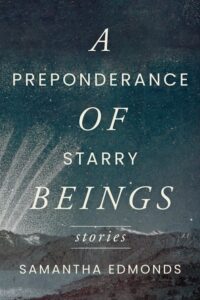 A Preponderance of Starry Beings: Stories
Samantha Edmonds
Northwestern University Press: TriQuarterly
$24.00
Publication date: June 15, 2025
Poissant: This is a gorgeous collection of intense, vulnerable stories. Some feel like stumbling into the open diary of a dear friend, while others read as fabulously constructed works of fantasy. What is the oldest story in the book, and what is the newest? And how do you feel that your style or aim as a writer has evolved over time from one to the other?
Edmonds: The oldest stories are the four featuring Ruth Emerson, the young student who has an affair with the assistant pastor at her father’s church. I wasn’t even writing this collection when I drafted those stories, and I only added them to the book later, when I began to understand this project less about “outer space” and more about “looking up”—after all, God is also a kind of starry being too, right?
By contrast, the newest story in the book is “Tastes like Raspberries, Smells like Rum,” which I didn’t write until after the manuscript had been accepted for publication. I felt the book could use a bit more unpublished material, and I thought that a collection about “starry beings” without an alien story would be missing an opportunity. A decade has passed between those stories, and in that time, I feel that my goals as a writer have stayed the same—I often think of the quote by E.B. White—all that I ever hope to say is that I love the world—but my style has evolved to allow more room for play and experimentation, especially in terms of genre and worldbuilding.
Poissant: Let’s talk about influence. Lorrie Moore (humor) and Mary Miller (grit and faith) spring to mind, but those might just be surface level. “Mama Says” feels like it’s in conversation with Jamaica Kincaid’s “Girl.” Am I right on any of these? Whose fiction really resonates with you, at any level?
Edmonds: I’m definitely a fan of Lorrie Moore and Jamaica Kincaid, so I’m flattered by any reading that puts my work in conversation with theirs. Mary Miller is new to me—but the description “grit and faith” makes me sure that I’d feel right at home with her writing. Personally, I feel my work is most influenced by fiction writers like Amber Sparks and Italo Calvino (Cosmicomics, perhaps unsurprisingly, is my favorite). I love fabulism, especially when it’s lyrical and language-driven, and I really admire the way the magic in the stories by these writers often begins at the sentence level.
Poissant: While we’re talking influence, these stories are clearly informed by a faith background. Would you care to address the topic of growing up in the church? And, if so, do you see that history as a trauma that you escaped? Or as something else?
Edmonds: Oh, now that is The Question, isn’t it? I would have a different answer for you if you had asked me ten years ago, a year ago, last week. My perspective on being raised in the church is constantly shifting, and I don’t have a clean or simple answer—these conversations are best hashed out, in my opinion, over cold drinks on a long summer night. The most honest thing I can say is that I’m coming to realize that the answer to how Christianity has shaped my experiences matters very little to me; my life instead is about the question.
Poissant: Do you think that the shadow of Evangelical Christianity will continue to show up in your work, or have you said all you wanted to say with this book?
Edmonds: I haven’t said nearly as much as I want to say. As I said, it’s the question that I find more interesting than any answer: I find meaning in the asking and reflecting and contemplating, and as these are not things that tend to lend themselves to conclusions, I think that’s why I keep returning to the subject in story after story. I might never be finished.
Poissant: This is a generous collection, seventeen stories of varying lengths (some as brief as two or three pages, one story thirty-five pages long) told in a multitude of voices from varying points of view. You never play the same song twice, which is refreshing. Were you conceiving of a collection of this kind as you wrote, or did you suddenly find that you had enough stories to fill a collection?
Edmonds: It’s a little bit of both—I’m a big believer in writing your obsession, and for a long time, mine was outer space, so I had written three or four separate stories about stars before I had the idea to create a collection. I discovered the title, A Preponderance of Starry Beings, one night when I had fallen into an online rabbit hole researching the Egyptian Book of the Dead (you know, as you do), and that’s when I started to conceive of my space stories—and others, like the ones about Ruth—as a collection that I hoped would showcase the different interpretations of a “starry being”: it means stars and moons and celestial bodies, sure, but it also means aliens and religious deities and—above all—the very human characters here on Earth.
Poissant: In terms of craft, do you find that longer stories take different shapes, in their writing, from the writing of the flash pieces, or do you approach both the same (beginning, middle, end) regardless of length? I guess I’m asking: What is your philosophy of flash?
Edmonds: With flash, I sometimes feel a freedom from plot I don’t often allow myself with longer writing. The more length a story has, the more pressure there is to make something move. Good flash should imply movement, I think, but—perhaps ironically, given the constraints of word limit—I also feel that flash allows me to slow down, to pause and consider the moment my characters are in without the added burden of contemplating their histories or futures.
Poissant: You’re a fan of alternative titles or subtitles: “Samson Collapsing, or What I Lost Falling in Love;” “Eve Choking, or How to Love Someone Who Is Uncertain;” “Magdalene Waiting, or How I Recovered (or Maybe Didn’t)” (first published in The Florida Review). When and how did your passion for such titles begin?
Edmonds: The easiest answer might just be that I love long titles. I think they’re fun. I had a writing teacher tell me once that a good title should do three things: catch the eye, evoke the plot, and enhance the meaning of the story. I added subtitles to only the Ruth Emerson stories to create continuity; since they’re scattered throughout the collection, I wanted readers to see at a glance that those four stories are connected. I also felt the first person POV in the titles added a layer of context to the stories themselves, because although the stories are in third, the titles suggest they’re being (re)constructed by a narrator—I’ve always imagined Ruth herself—who can’t help but chime in from time to time.
Poissant: Your work falls into any number of categories. Sci-fi. Fabulism. Realism. Fantasy. Do you feel like an adherent to any of these genres, or do you find such designations less useful when thinking about fiction?
Edmonds: I consider myself a fan of all these categories, and I think their influence is obvious in this collection. However, I often feel that my work doesn’t fit neatly into one genre: despite my affinity for sci-fi, for example, there are only a couple stories in the book that might be considered science fiction. I find the most meaning in the umbrella term “speculative fiction,” which I feel speaks to many of the elements I pull from when writing. I also like thinking of speculative writing less as a genre designation and more as a craft technique, and thus applicable to any category of writing: fabulism, fantasy, realism, even nonfiction.
Poissant: Do you have a favorite story in the collection, or one that feels particularly important to you personally?
Edmonds: Ah, this is hard! I have a special affinity for “Tastes like Raspberries, Smells like Rum.” This might just be recency bias, as it’s the newest one, but I had a great time writing that one. I also have a special place in my heart for “Star Stuff,” the last story in the collection, because it was the first space story I ever wrote, and the first from the book to be accepted for publication.
Poissant: You teach creative writing at my alma mater, Berry College. (Go Vikings!) What is your best craft advice for emerging or aspiring writers of any age?
Edmonds: Stay low. It’s easy to get caught up in the lofty plans of a project—all the stories you’re going to write someday, what you’ll title them, and how you’ll design the book cover—only to end up neglecting the next page, the next sentence, that needs your attention. I’m guilty of this with each new project, and I always remind myself (and my students) to keep your head down and focus only on the paragraph in front of you: Stay low. Daydreaming about a finished book is fine, sure, but I can’t get anything done with my head in the clouds. I’ll end up paralyzed by the unwritten ending, the future synopsis, the readers I imagine buying this book, and that’s not where stories start. In the words of Cheryl Strayed: “We get the work done on the ground level.” And hell yeah—go Vikings!
Poissant: What are the best books you’ve read recently?
Edmonds: I just recently read—and adored—the Emily Wilde books by Heather Fawcett: Emily Wilde’s Encyclopedia of Fairies, Emily Wilde’s Map of the Otherlands, and Emily Wilde’s Compendium of Lost Tales. They follow a wayward scholar of faerie folklore on her field research as she attempts to uncover the unstudied mysteries of faerie. The books are whimsical and cozy with a touch of the academic adventurer plot I love in Indiana Jones.
Poissant: Finally, what’s next for you? Would you care to share any details about what we might expect from you following the publication of A Preponderance of Starry Beings?
Edmonds: In addition to finally drafting new fiction (which has been so much fun!), next for me, I hope, is securing representation for my speculative memoir, currently titled A World to Hold Us All. The project shares many of the same themes as this collection—especially regarding faith and belonging—only instead of the cosmos, this time I’m featuring the invisible friends my best friend and I had when we were fifteen, which we used as a way of enriching and escaping our established reality in the Evangelical Church. (Told you I haven’t finished with that subject. In fact, I’m just getting started!)
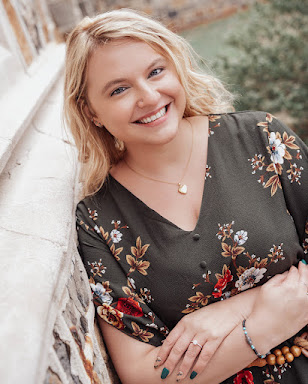 Samantha Edmonds
Dr. Samantha Edmonds is the author of the story collection A Preponderance of Starry Beings as well as the chapbooks Pretty to Think So and The Space Poet. Her work appears in The New York Times, Fourth Genre, Ninth Letter, Michigan Quarterly Review, Mississippi Review, Creative Nonfiction, and McSweeney’s Internet Tendency, among others. She’s an Assistant Professor in the creative writing program at Berry College and lives in Rome, Georgia.