» Nonfiction
The Passenger Seat
Jessica Walker
The closest parking spot to my apartment is beneath a grackle-infested tree, so I have learned to tolerate a coating of scat and pollen on my car’s paint job. This mixture serves as a primer for the layers of dust churned up by the South Texas winds. There are about forty car washes in my town, some rumored to be cartel fronts, most boasting attention-grabbing décor—neon accent lights, grandly arched entryways and colorful mascots, such as my favorite, the sunglasses-wearing duck of the Quick Quack Car Wash. But as filthy as my gray Nissan Sentra gets and as prevalent as car washes are, I resist patronizing them. There’s something unsettling about giving up control to a conveyor belt, being drawn into a dark tunnel, losing sight of everything bright and natural in the world as foam cannons, pressure washers, and lashing miter curtains brutalize the surface separating me from chaos.
When I was married, I rarely went to the car wash alone. When I went, I was almost always in the passenger seat. My ex-husband was obsessed with anything motorized—cars, boats, mopeds, jeeps, trucks, motorcycles. He would scour Craigslist and scan the roadsides in search of vehicles to restore. He was a frequent, card-carrying habitué of car washes. Automotive maintenance was entirely his department, but that all changed when the marriage ended.
The day I left, my ex was out of town to buy yet another motorized vehicle—a boat. He called to inform me of the purchase and of his plan for us and our dog to live on the boat in the Florida Keys. I had not been consulted on either of these matters.
“I’ll never set foot on that boat,” I said.
He told me he would be home the next day, we would talk then. I had been planning to leave for months, and this was my cue. I packed my belongings and the dog in the Volvo and split. My ex’s two big laments were that I absconded with the eleven-year-old sedan and our six-year-old standard poodle, Fritz. I had pondered leaving Fritz behind. I knew I would be broke, barely able to feed myself, much less a sixty-five-pound, very spoiled dog—the beneficiary of home cooked meals and $100 monthly grooming sessions. My job prospects and housing situation were uncertain. A large dog did not make things easier. But Fritz was mine. He’d been a gift from my ex, a futile attempt to make me happy, to save the marriage. From puppyhood, Fritz followed me around the house, scrutinizing my every move. I could not leave him behind any more than I could leave my shadow. So with Fritz upright in the Volvo’s passenger seat, we traveled eight hundred miles to my hometown to begin our new life.
◊
Fritz was born in Arkansas on June 4, 2011. Before the breeder shipped him at the age of eight weeks, we chatted on the phone to arrange the final details. She told me what she’d observed a few days earlier, when she was driving Fritz home from his immunizations.
“It started to rain and I turned on the windshield wipers,” she said. “He was fascinated, kept his gaze locked on them with his head moving back and forth like they did.”
This was my first image of Fritz beyond the posed photos I’d been sent—a small black-and-white puppy, face the color of coal, body patterned like a fur tuxedo, little button nose shining, sitting in the passenger seat, his head bobbling along to the wipers as water fell from the skies and rivered down the glass of the windshield.
◊
Fritz spent a lot of his life staring out of car windows. He preferred to ride in the front seat. My passenger side window was always hazy from the impression of his large snout. If left alone in the car, he would almost always take over the driver’s seat. As I pumped gas, he’d stare alertly through the windshield as if he were ready to rev the engine and race away.
Post-divorce, I logged 100,000 miles in the Volvo, thousands of those with Fritz riding shotgun. For five years we journeyed the 500 miles between grad school and my parents’ home through the rolling verdant farmland of the Shenandoah Valley, over the low mountains and foothills of Appalachia. We moved 200 miles to North Carolina for a yearlong job, then we took our longest trip ever—a 1,500-mile move to South Texas. As we sped down a desolate stretch of I-10 in Louisiana, the front passenger tire blew out. It was after midnight, and I waited an hour for the tow truck in the damp heat of night, walking Fritz in the long grass, grateful to have another being with me, worried about the vulnerability I was exposing my dog to traveling such long distances with so little money through vast stretches where I knew no one. The tow truck driver would not allow Fritz in his rig, so I cracked the window before the Volvo was lifted onto the flatbed truck. We rode to a nearby Motel Six. The whole time, I craned my neck around to look through the rear window, comforted by the sight of Fritz’s wet nose poking out of the car, breathing in the night air.
◊
This Louisiana blowout was the beginning of the Volvo’s slow death march. Its low-profile tires, in combination with a defective wheel design and my curb-hitting tendencies, made tire issues more and more common. The air conditioner needed constant, expensive repair and never seemed to work for more than a month. It occurred to me that the car could kill me and my dog, but I was tight on cash, so I clung to the Volvo’s failing body, begging the universe for it to last just one more year. I did the minimum to make it roadworthy but nothing more. I rarely cleaned the car; it seemed a waste of time to attend to the beautification of the old clunker. I spent much more time and money cleaning Fritz.
Poodles do not shed, which makes them desirable for those with allergies and aversions to hairballs. But for this perk of the breed, you have to pay a professional about 100 dollars a session to groom your dog. I purchased an electric razor and would sometimes wrestle Fritz into submission for the hours-long grooming process that would result in tumbleweeds of hair wafting through the apartment for weeks afterward. But my handiwork was shoddy, and the process was miserable for both of us. As much as I could afford, I used groomers. My cheapest and most frequent groomers were identical twins and devout members of a fundamentalist Evangelical church. They would not wear pants; I only ever saw them in jean skirts. Cutting their own hair was forbidden by their religion but cutting dog hair was not, and they made a living as operators of Classy Critters. The grooming operation was run from a house made of rocks on an old country road. Part of the appeal of the place was the name, which I found hilarious especially when pronounced by the twins in their backwoods drawl. When I saw a stack of paw-shaped car magnets by their register emblazoned with “Classy Critters,” I immediately grabbed a blue one and slapped it on the back of the Volvo, where it remained for about a year until I made a rare trip to the car wash. When I got home, I saw that the magnet had fallen off. I replaced it with an orange magnet and became vigilant about the new magnet’s survival. In the half-dozen times I took the Volvo to the car wash, I would jump out before driving onto the conveyer track to remove the magnet. The paw seemed like something worth saving, especially after the owners of Classy Critters retired and I started taking Fritz to Dippity Doo Dogs, a groomer with an even more ridiculous name but no magnets.
◊
After my first year in Texas, I was going to see my family, speeding through scrubland, high on the possibility of the open road, migrating butterflies splattering my already dirty windshield, when I heard a loud thunk. The car kept rolling for about two minutes before the uneven wobble of a blown tire interrupted my steady rhythm. I pulled over in the underpopulated stretch of ranch land and discovered I had run over a metal spike, piecing both the tire and the wheel. At that time, the newly fixed air conditioning also decided to malfunction, and the dog and I were stranded for an hour in heat of over 100 degrees. With Fritz on his leash, I waited in the shade of a small tree. I poured warm water into his travel bowl, and as he lapped it up, I pondered the perilous combination of a senior dog and an ancient car in such a brutal landscape. Several hundred dollars and six hours later, I was back on the road—tire fixed, AC still in need of a compressor and blowing tepidly. I rolled the windows down to circulate air in the sweltering vehicle. Fritz panted. I stopped at a gas station to cool him with ice water. I walked him around the parking lot, and suddenly he yelped in pain. He began limping. I raced him to the car, where blood began to soak the passenger seat of the Volvo. I found a towel and desperately tried to mop up. There was so much blood I could barely keep up, and at first I could not tell where the blood was coming from. I worried it was from an orifice, his abdomen, a rip in the soft pink flesh of his white-furred belly. I worried it was because of the heat exposure, the harsh conditions and long journey I’d exposed him to. It turned out, he had simply broken a toenail. A painful and very bloody, but non-life-threatening injury. I cleaned the car seat as best I could, and bandaged Fritz’s paw with an old T-shirt. I drove onward, nervously eying a faraway lightning storm electrifying the Gulf Coast sky.
In Katy, Texas, I stopped at a Buc-ee’s to see how Fritz’s paw was faring. The blood had slowed but had not fully coagulated. I helped him out of the car to let him go to the bathroom and saw that in his pain, Fritz—who was never prone to accidents—had soiled the passenger seat. I grabbed a bottle of cleaning solvent from the trunk of my car and scrubbed the upholstery that bore hatch-marks from his toenails. I could not entirely remove the rusty stains from the tan seat that night or ever. Fritz’s blood became part of the Volvo’s fabric.
◊
The average standard poodle’s lifespan is twelve to fifteen years. Fritz celebrated his thirteenth birthday in June 2024. The black fur around his ears was greying but his coat was glossy. His arthritis was limited to one leg and had not greatly worsened. There was still life in him, if not in the car. Fritz’s thirteenth summer, the Volvo’s radiator exploded. The engine overheated. The air conditioning condenser needed replacement. Though I was not quite financially ready, I needed to buy a car. I traded in the Volvo, now twenty years old, for $700 and bought a Nissan Sentra with ice-cold air conditioning. As I removed my belongings from the Volvo in a CarMax parking lot, I made sure to remove the Classy Critters magnet. I paused for a moment to snap a photo of the car before walking to my new car. I was grateful for the miles the sedan had carried me and Fritz since I’d left my marriage. Pieces of me, the blood of my dog, and the imprints of his toenails remained in the car, which I knew would soon be ripped to pieces and sold for parts. I affixed the Classy Critters magnet to the Nissan’s bumper and drove away. A storm broke out. I switched on the windshield wipers and drove home in the rain.
◊
I was proud of the Nissan. It was my first major post-divorce purchase. I tried to keep it clean, though I remained leery of car washes and of driving itself. The threat of a wreck, of death, of mechanical failure always feels close when I am behind the wheel of a car. I have not been in many wrecks, but the one that looms largest in memory happened on my way to a car wash. During my marriage, I rarely drove. At the car wash, I would ride through the tunnel in the passenger seat, blindly staring through the white foam, listening to the whoosh of the brushes and the hum of the air dryers, waiting to reemerge into brightness. However, one morning, my ex insisted that I take his vintage convertible Mercedes to be cleaned. I agreed to visit the Busy Bee Car Wash.
Part of my trepidation in driving to the Busy Bee was that it required a tight U-turn on Biscayne Boulevard, a highly-trafficked stretch of road in Miami, a city plagued by erratic and substance-enhanced driving. Additionally, I have issues with perceiving an object’s rate of motion. This trait made me bad at softball in my youth and as an adult often made me panic at the sight of a motorized vehicle barreling toward me. Complicating matters further was my low confidence in myself as a driver. My father, an excellent driver from a family of truck drivers, lacked the disposition to teach someone as inept at driving as me; my mother refused to get in a car with me due to extreme anxiety about teen drivers; her father was in an accident as a teenager that left a friend either dead or maimed. No one living seems to know for sure. So, on my way to the Busy Bee, I stopped at a gap in the median with no red light, trying to ascertain when I could turn into the onslaught of traffic, which my brain interpreted as high-speed torpedoes being launched at me, personally. When I thought I saw a sufficient opportunity, I stomped on the gas pedal and turned the wheel, but I was not accustomed to driving an eight-cylinder turbo-charged car. I put too much force into the turn. The Mercedes spun a complete 360; the oncoming car honked its horn but managed to maneuver around me. I could not regain control. The car hit the pole of a bus shelter, where a woman with a white skunk streak in her jet-black hair sat. We stared at each other through the windshield. I did not damage the bus shelter. Thankfully no one was standing at the curb. I was unharmed other than a bruise on my chest where the seatbelt had been. The car was totaled. The responding police officer just shook his head at me. My ex came and called AAA. It was clear the car was totaled, done, dead. After the Mercedes was towed away, I sat in a Starbucks trembling while my ex ran errands, my mind spinning with irrational associations, a cacophony of what-ifs. All this to wash a car. Risk of death to wash a car.
But despite the death paranoia car washes evoke in me, as the new owner of a relatively new Nissan Sentra, I did my best to cast my neuroses aside. Every three or four months, I’d roll up to a car wash, making sure to remove the Classy Critters magnet beforehand. Inside the car, I put blankets down to keep Fritz’s paws and slobber from damaging the seats. His arthritis had advanced enough that he often needed help climbing into the car. The passenger seat was much smaller than the Volvo’s, and there was not enough space for him to curl up comfortably, so I purchased a cover and extender for the back seat that allowed him to fully stretch out.
Just before Fritz’s fourteen birthday, his vet gave his bloodwork a glowing report. She said she’d never seen a poodle of his age and size doing so well. To celebrate, I threw him a birthday party at my mother’s house, complete with pizza, a sheet cake, party hats, and streamers. My sister and her family traveled an hour to attend, my uncle came from across town, and Fritz indulged us as we briefly strapped a conical blue hat on his head and sang happy birthday. At this point my uncle, who at times has owned as many as twenty pets simultaneously and who once became so concerned about his animals’ fate that he inked a will naming me and my sister as the inheritors of his menagerie, said, “This is going down a weird path.”
As hypocritical as he was, he was right. I had become a middle-aged, unmarried, childless woman celebrating her dog with the type of fanfare reserved for toddlers and school kids. I shrugged and plated a piece of cake. I planned to repeat the affair for Fritz’s fifteenth birthday.
◊
That summer, the dreams began. They were always a variation of Fritz running from me as I futilely screamed his name and tried to track him down. I chased him through suburban streets, twisted hallways of unfamiliar houses with garish wallpaper, forest and farmlands, never sighting him much less catching him. Just as summer slipped into fall, I had my most unnerving dream. We were walking, and Fritz escaped his leash and disappeared through a gap in a chain-link fence much smaller than his body. I was aware he could see me, he could hear me, and he chose to ignore my calls. He wanted to be somewhere else, away from me. I woke in a cold panic to find Fritz sleeping peacefully in his usual spot at the foot of the bed.
In September, Fritz began to urinate around the apartment no matter how many times I took him out. I bought diapers, made an appointment with the vet. He had a urinary tract infection, not his first, but otherwise his bloodwork was fine. I medicated him for the UTI. I upped his arthritis meds at the suggestion of the vet. He recovered in a week and became springy. He played with toys for the first time in years. On a night walk a bull javelina came out of nowhere and charged us from behind, swerving away at the last minute. I raced back to the apartment. The javelina charged again, again veering off course feet before making contact. He stared at us yards away as I rushed Fritz, who ambled along slowly, thoroughly unfazed, to safety. Online I researched javelina deterrents—air horns, synthetic coyote urine, Louisville Sluggers. I would keep my dog alive despite nature’s vile intentions.
◊
On a weekend in late September, things began to malfunction. My computer mouse stopped working. My toaster oven sputtered and died. Fritz remained in fine form. He pestered me for food. Had no accidents. Struck a play pose for the first time in years. I considered donating the rest of the diapers to my vet. We watched television, his long, elegant body draped across his half of the couch, one eye always trained on me.
I awoke on Sunday to find Fritz sluggish and soaked in his own urine. I coaxed him off our bed and found him unsteady on his feet. I tried to take him outside, but he urinated just before we reached the door. I could not get him to eat—not even offerings of cheese or hot dogs enticed him— but he drank water. And he swallowed his prescription arthritis pills. I pondered my options. There are only two emergency veterinarians in my town, and none are open on Sunday. The nearest emergency vets were two hours away. Fritz was responsive and alert. I had an appointment in the morning to follow up on the UTI. So, I waited and watched. We stayed in bed all day, Fritz frequently raising his head to track my location. It mattered to him that I was there. I only left his side to go to the bathroom and to make food. I tried to heat a tortilla in my new toaster oven but was so preoccupied with the dog that the tortilla caught fire. I threw salt on the flames hoping to smother the fire. When that failed, I wrested the tray from the oven and doused the fire in the sink. The apartment filled with smoke. Fritz hated smoke. By evening he stopped drinking water. He fell, his back legs splayed out, pink belly on the cold floor, and as I lifted him to his feet, he excreted a large bowel movement. That night, I put Fritz on his dog bed, and I sat on the couch. He stared at me until I carried him to the couch and placed him by my side. Satisfied, he slept, lifting his head periodically to check my nearness.
In the morning, I awoke to heaving. Fritz was on the floor, a dark puddle staining the carpet beside his mouth. His tongue lolled, and his teeth were bared with an uncharacteristic fierceness. I tried to lift him, but he was limp. I gathered him in my arms and raced to the Nissan, which was parked under the tree filled with grackles who had overtaken my birdfeeder, who Fritz loved to watch through the glass-paned patio door. As I clutched my dog in my arms, I feared dropping him more than anything else. I did not drop him. I laid him in the back seat of the Nissan. Weeping, I drove to the vet. They took him in on a stretcher. They could do tests, they could do X-rays, they said, but they couldn’t guarantee much. He was old. It was something neurological. They asked if I wanted to euthanize him.
“I know what this is,” I sobbed. “I’ve seen death before.”
I agreed to have Fritz put to sleep. He was laid out on the cold linoleum floor, still on the stretcher. I sat next to him, my hand on his chest, telling him I loved him as the blood ran slow through his veins. The vet techs inserted a catheter in his front paw, struggling to get it in because his blood pressure was so low. The vet arrived minutes later to administer the injection. But the roll of blood had slowed to nothing, and I could feel his body temperature reversing to that of the linoleum beneath us.
“I think he’s passed,” I said.
The vet checked for a pulse and found none. He was gone.
I sat alone with Fritz’s body, crying, signing forms for cremation. With his collar and blue gingham bandanna in hand, I stood and looked at his body, knowing it was the last time. No amount of calling his name, no amount of searching would summon him to rise and bound over to me. I drove my Nissan home, parked it under the grackles, canceled a meeting, and took to bed.
Later that night, I surveyed my apartment and noticed signs in my living room that Fritz had wandered around the night before he died. A few fragments of hard, grainy excretions littered the rug. I could not identify if they were vomit or feces. I could only see they were signs of suffering, signs I’d missed as I slept. In the month that followed, my dreams centered around Fritz’s death. I encountered his zombified body in the attic of my childhood home as he lunged aggressively at me through cobwebs and battered boxes. I carried him for endless miles through a desert as the sun baked the life from him, as his skin went gray with agony. I vainly tried to mop blood that gushed from his body, soaking the earth until all was red. I could never find the wound. It would only disappear upon waking, when my eyes traveled to the foot of the bed, where Fritz once lay, slumbering, twitching with dream.
I traveled. I took up sketching, mostly scribbling long-nosed, fluffy-eared dogs. I made plans. I reached out to friends. I tried to keep my life on track. In November, a month and a half after Fritz’s death, I decided to get my car washed at Aqua Express Car Wash, a state-of-the-art establishment with a cathedral-like stone façade and arched entrance. I paid eleven dollars for a basic wash, and as always, I struggled to get my car onto the track. After I had managed to get my driver’s side front tire aligned with the conveyer belt, I realized that I had forgotten to take the Classy Critters magnet off the back of the Nissan. I grew frantic, thought of jumping out, taking my chances with the attendants and their ability to handle a woman highly emotional over a palm-sized magnet. It’s just an object, I told myself, it doesn’t matter. But it did. It was the only thing that mattered. As the gray miter curtain whipped the hood of my car, I grew frantic with desperation. I imagined the paw detaching from the Nissan, its destruction on the damp, dirty floor of the car wash, where it would be run over by countless vehicles until it was reduced to smithereens. I remembered Fritz, his black, weathered paws, the cold linoleum floor of the veterinarian’s office, his final night when he roamed the apartment alone as I slumbered, ignorant of his final movements before he disappeared forever, all washed away like dust. As soon as the dryers beat air on my car, I shifted the transmission into drive, parked by the vacuums, and jumped out to examine to the bumper. The magnet was there. I placed my hand on the orange paw, still wet from the wash, but clinging to the surface of the car. We are all dust, but not everything washes away.
I drove home, parked under the grackle-infested tree, and went inside, where I’d built a small altar around Fritz’s elevated food bowls. Flowers, candles, his toys, his leash, and the collar and blue gingham bandanna he died in were piled atop the memorial along with a small bowl of his hair, just tufts I’d found wafting around the apartment in the weeks since his passing. Beneath the bowl, in a small cardboard box, were his ashes, light and yet-to-be scattered.
Jessica Walker
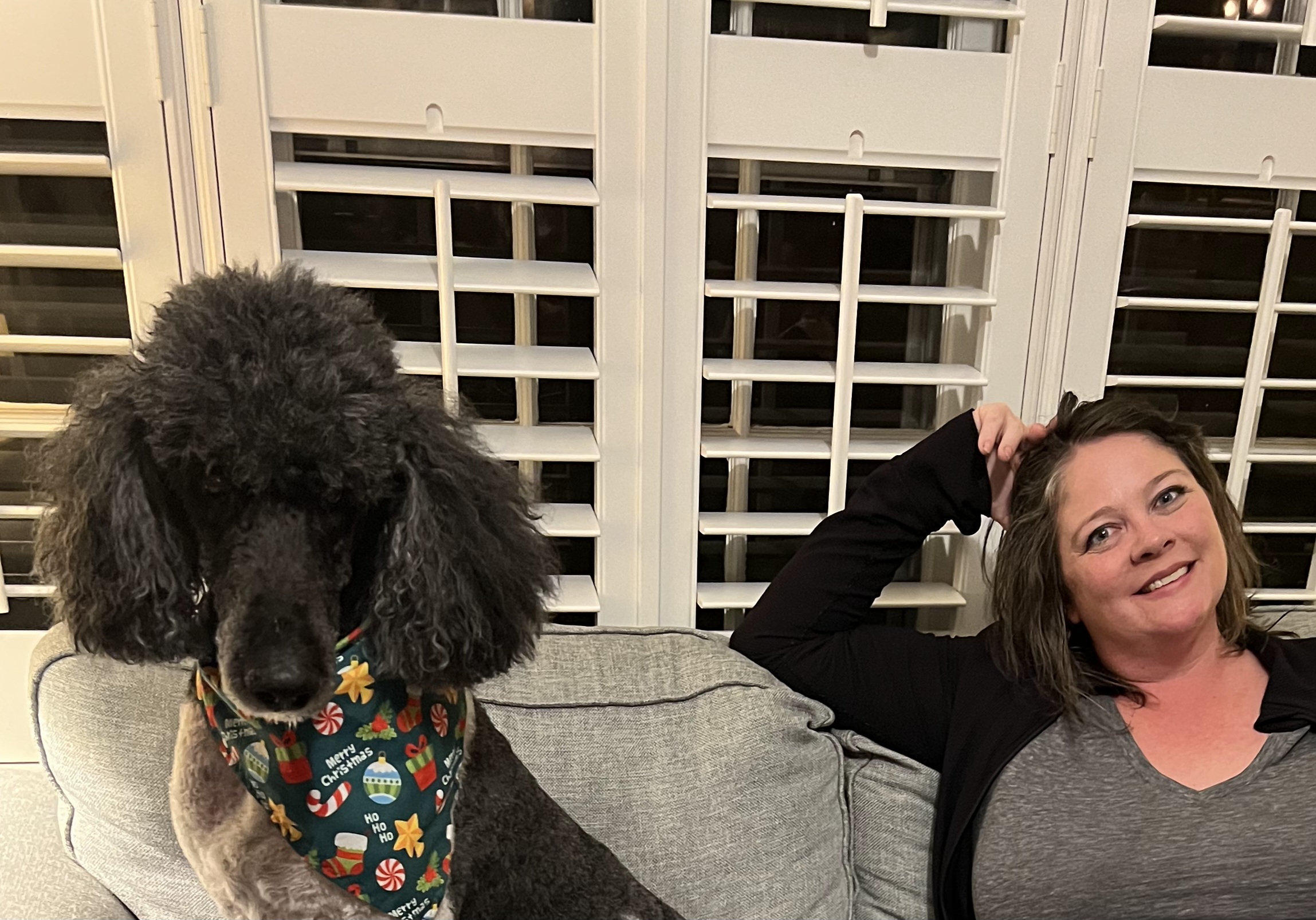
| Jessica Walker’s creative writing has been published or is forthcoming in Permafrost, New Letters, Witness, The American Scholar, The Indiana Review, Kenyon Review Online, Black Warrior Review, and elsewhere. She was the winner of Bayou’s James Knudsen Prize and Witness’ Literary Award for Creative Nonfiction. She has received the support of the Bread Loaf Writers Conference, the Elizabeth George Foundation and the Sewanee Writers Conference. Her work has been anthologized in Best Small Fictions and Livingston Press’s Tartts Eight. She holds an MFA from the University of Virginia. |