» Interview
Getting Away with Murder: A Conversation with Lydia Millet
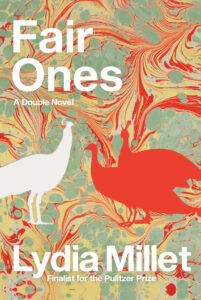
Fair Ones: A Double Novel
Lydia Millet
W. W. Norton & Company
$29.99
October 6, 2026
Michael Costaris: The obvious question—because this book is billed as a double novel Fair, from Mara’s point of view, and Ones, from Jen’s point of view—is what drew you to that structure?
Lydia Millet: I have an aversion to writing long books. Most of mine are slim or, at most, average length; I generally dislike doorstoppers. But I do like remaining within the same fictional world. In my story collections, characters tend to be connected and reappear across stories. My first collection had a thematic throughline—celebrities and animals—while the two since have centered on dispersed communities. This was another version of that impulse: I wanted the story to contain multiple perspectives without resorting to omniscient narration. The older I get, the more presumptuous third-person feels. Omniscient third, that is. It seems increasingly full of pitfalls to pretend at omniscience.
Costaris: In what way?
Millet: I mean, as the term suggests, you’re playing God writing in that voice, right? You’re a panopticon. And it started to seem more and more preposterous to me over time, for myself. A subjectivity, a narrative voice, that somehow sees everything? And yet still has a distinct personality? I mean it’s absurd, isn’t it? Seeing everything and having a distinct personality don’t really go together. So it was going to be first person, two first persons, and that’s how I got to this setup. We ended up calling it a double novel because every other term we considered seemed pretentious.
Costaris: Was it ever going to be two books?
Millet: I mean I would encourage readers to treat them as distinct experiences: read Fair, put it down for a few days, and then return to Ones later.
Costaris: So why not just two novels, released separately?
Millet: Well, publishing them separately would make them more expensive. And I didn’t want folks to read just one of them. They make up a story together.
Costaris: Did that change anything late in the game structurally? I noticed that Ones begins with a recap of what happened previously which is necessary for two books but less so if a reader takes it all in one sitting.
Millet: It’s very brief but even that small amount of recap is probably my least favorite part now. So you’re wise to ask. It’s a tradeoff between spending too much page space on something you aren’t interested in relitigating and, on the other hand, presenting it in too much shorthand. That can be difficult to navigate if you’re trying to allow for the possibility that readers might take a break between the books. I think the trick to getting away with exposition—which one doesn’t always, of course—is in the voice and authority and not being too direct. But you know, now that you mention it, I think maybe, since we did this as a single volume, I should have cut that.
Costaris: It’s funny how long you can continue thinking about a book after it’s been published, or after a story has gone to print.
Millet: That’s true. If you didn’t let go of it, you could worry about its flaws forever.
Costaris: The novel’s other major formal choice is its reliance on dialogue. I’ve seen it described as a novel told in dialogue, which isn’t fully accurate. It’s not written like a play, where there is no interiority, or description, but the novel is definitely driven by dialogue. What drew you to that approach?
Millet: Dialogue is incredibly efficient, and that efficiency makes it increasingly compelling to me. It can be glib or remain on the surface, but when it’s paired with interiority, you can achieve both surface and depth. The way a character talks reveals not only who they are but how they are. It’s also just fun to read: fast, accessible, and close to our natural idiom. Physical descriptions of landscapes or people rarely engage me. You might find something like “She had brown hair and blue eyes” in work from my twenties or early thirties, but generally not now. Faces don’t occur to me, bodies even less. And other media already handle visual kinds of description quite elaborately.
Costaris: Are you referring to television and movies?
Millet: Everything. All the dominant media are visual, and I don’t think literary fiction needs to create word pictures in that literal way anymore. At least, I’m not interested in reading or writing that way. Just as photography changed how fiction writers and poets approached their work, so has the ascendance of these newer visual forms. I think we should lean into what words do best—use language to accomplish what pictures are less suited to express.
Costaris: But that creates a formal challenge in that these are all characters who are similar in age, cultural backgrounds, socially, and yet, they need to be distinct.
Millet: Yes. If you’ve had a friend for a long time, you begin to mimic and echo each other. You develop shared tropes and almost reflexive tics of language, gesture, and mannerism. You remain distinct individuals, but you also acquire a common history and lexicon. I wanted these two narrators to have recognizable voices while still speaking from within that common language. Which produces an interesting tension—the characters must sound different enough that readers can usually tell who is speaking without attribution, but similar enough that the novel doesn’t feel like a transcription of actual speech. That would be boring. Real people speak in radically different ways, which is fine for reality, but a novel requires greater coherence. It needs an authoritative voice and consistent tone that sustain suspension of disbelief and create a kind of delicious tension. Dialogue has to be different and the same at once.
Costaris: How do you achieve that on a craft level?
Millet: I suspect critical opinions may differ on how successfully I accomplished that, but craft-wise, there’s some nipping and tucking during revision for the sake of clarity.
Costaris: Like Jen would say this word but Mara would say that?
Millet: I did do that. I created a basic vocabulary list before revision. I don’t remember the specific terms, but there were perhaps ten or fifteen instances in which Jen would use one word and Mara another for the same thing. But that’s not the driving force. For the most part I’m drawing on remembered dynamics—between me and someone else or between two other people. For example, I learned French from a young age but rarely have opportunities to speak it anymore. The last time I went to Paris, I found that after a couple of days I could converse again, even though my French now sucks. The words have gone away, but the accent hasn’t. I think the brain preserves conversational dynamics in a similar way: it retains a memory of rhythm and play, and that helps distinguish one character from another. That’s the fun of dialogue: you get to play with dolls.
Costaris: I was thinking of that during some of the speeches the characters make—you let your characters go off. It was fun as a reader and I imagine, too, as a writer. Dialogue offers the ability to make a point that, if presented in the narration, might be attributed more directly to yourself.
Millet: Censorship has very long arms these days, from the left as well as the right. But you can get away with murder in dialogue, including didacticism and lecturing. That’s another freedom dialogue gives you. You can present various positions, and you can also be rude. It isn’t only about political content. Characters can say things you wouldn’t ordinarily say, or things increasingly banned from speech. It doesn’t have to be you standing on your own personal pedestal as the author; you can put characters on pedestals and listen to them bloviate. It’s much more enjoyable to read a bloviation than to be subjected to one. In real life you have to offer emotional reassurance, or at least laugh at the supposedly funny parts. The beauty of reading is that you don’t have to produce any response you don’t feel like producing.
Costaris: An interesting aspect of this book is that it is, in a way, a murder mystery. If Fair was Jen’s book, it would have definitively been one, but by filtering it though Mara, you kind of obscured that aspect of the plot. Was that a conscious choice?
Millet: The first book was initially more overtly a murder mystery, but the second book—Jen’s point of view—wasn’t. It didn’t have a specific genre, unless you consider general fiction or literary fiction its own genre, which you could. I pulled back what had been an overt murder-mystery structure in the first version. I made it less in-your-face but kept it present because those were still the bones of the story.
Costaris: Can I ask what some of those cuts were?
Millet: In the previous version, Mara and Jen collaborated more in trying to determine what had happened. It was more overtly a whodunit—or at least a “whydunit,” as they called it. There was a line in which they acknowledged that it was a whodunit, so the book was more self-consciously meta. I removed that material and tried to push the mystery further into the background. I made it Jen’s project, burbling along in the background of Mara’s life, rather than a joint venture they had undertaken. That also made more sense in terms of character. Jen would be the one fixated on parsing what happened, while Mara would be more reactive and focused on keeping herself afloat.
Costaris: When you summarize the plot —two women dealing with the violent death of their best friend—it doesn’t necessarily sound like it would be a funny book. But this is one of the funniest books of the year. When did humor make its way into the novel?
Millet: It’s never really a decision to include humor. If anything, it works in the inverse: I’ve only rarely decided not to include it. I can’t speak for readers, but in my experience of writing, I’m usually trying to make myself laugh. There’s almost no subject that isn’t a candidate for comedy. I’m with comedians on that point: there are good jokes and bad jokes, but I don’t think any subject should be off-limits. The fact that this book contains crime and violence never made me think it shouldn’t also contain humor. There are subjects about which I personally feel humorless. Extinction doesn’t make me smile. Climate change doesn’t make me smile. But that doesn’t mean those subjects contain no possibility for humor.
Costaris: New York felt like an essential component to this novel. Was it integral to set it there rather than Los Angeles, which you’ve written about quite a lot?
Millet: Los Angeles has always fascinated me. In Leonard Cohen’s formulation, the best and worst of America have been situated there, and Los Angeles has often served as a proxy for that in my books. But it’s no longer emblematic of the United States. California is almost another country now. I chose New York because I still think of it as one of the best places in America to be social. It’s much more social than Los Angeles, where I’ve also lived. Of course, there are enormous parties in Los Angeles, but it’s also alienating. It’s organized around car culture, whereas New York is a pedestrian culture. This was always going to be a highly social novel. That’s part of the reason it’s so dialogue-heavy. It’s closer to standard domestic realism than most of my books and is more outwardly oriented—more preoccupied with the dynamics within this group than with their philosophies or subjectivities in a more abstract sense. By my standards, it’s a concrete social novel. And although it’s a fairly matter-of-fact portrait, it does also hearken back, to some extent, to the city as it was when I lived there. The characters remember the New York where you could actually go onto rooftops without working for a hedge fund. There’s some nostalgia in the book as well.
Costaris: The novel kind of complicates that nostalgia. In older depictions—I’m thinking of Taxi Driver and Midnight Cowboy—New York’s a dangerous place, but mainly because of street-level crime. Without spoiling anything, Claire’s death initially appears to belong to that world, while Jase, the hedge fund manager, represents a more contemporary threat. In modern New York it feels like the Jases of the world are far more likely to hurt you than the muggers.
Millet: That’s absolutely true. Jase is obviously far more dangerous. Jase is running the country now.
Costaris: That’s where I was heading. How consciously was Jase a stand-in for contemporary America’s leaders? Or can you just not write authentically about America without depicting a Jase?
Millet: My editor, Tom, is always getting on my case—not in a negative way, but fondly—about the depictions of men in my books and the way I lampoon masculinity. Jase is obviously an iteration of that. But the fact is that you can’t write successful satire in the United States right now because everything has already been satirized. Reality itself is a satire. The book was deliberately set—and written—during Biden, which was a curious period of relief, but there was still fear. Jase isn’t unbelievable in any way because he’s simply a fact. Far worse than Jase is a fact. What might once have seemed like a caricature of maleness now feels, if anything, like a diminished version of what you see on the news. He’s actually a “lite”—L-I-T-E—version of your RFK Jrs., your Elon Musks, and all the rest of them. All the president’s men.
 Lydia Millet
 is the author of more than twenty books, including A Children’s Bible, a finalist for the National Book Award and one of the New York Times “10 Best Books” of the year in 2020, and a story collection called Love in Infant Monkeys that was a finalist for the 2010 Pulitzer Prize. Other books have won awards from PEN-Center USA and the American Academy of Arts and Letters. Millet works at the Center for Biological Diversity and lives outside Tucson, Arizona.