» Book Review
Review: Women in Tampa Talking about Alligators by Heather Sellers
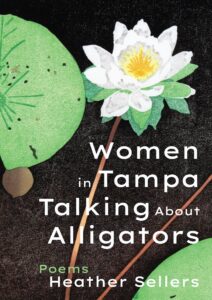
Review: Women in Tampa Talking About Alligators
by Heather Sellers
Lynx House Press; $18.95; paperback
June 23, 2026
Review by: Susan Lilley
Heather Sellers’ atmospheric new book deserves your attention.
After all, women in Florida do talk about alligators. Alligators are a fact of life in a state where the wild meets the manufactured in every subdivision and palm-lined avenue. The title poem highlights a litany of sightings and reports, from a close call between a snack-sized dog with a “granddaddy” gator to the unspeakable outrage of a foolish northern transplant feeding whole chickens to the creatures, a sure sign of dangerous ignorance. Sellers’ book swims the uneasy line between paradise and danger, as hurricanes and droughts disrupt the vision of Florida seen in postcards and brochures.
Talking is prevalent in this collection, and not just about oversized reptiles. In “On Ellsworth Road,” our speaker resigns herself to a humdrum conversation with a neighbor that “will be a church service, dull during but so good after,” adding, “It’s like listening to jazz.” The talking and listening precedes the miracle of sudden rain after a long drought, and the women celebrate the heavy raindrops on the driveway rather than run for cover. You can almost smell the petrichor rising from the dry lawns and dying jasmine.
The powers and vulnerabilities of nature are explored in poems of dread and ecstasy. Birds appear as diverse in personality and habits as humans. “Tuesday with Oars” follows a harrowing canoe trip reminiscent of Wordsworth’s frank contemplation of the dangers inherent in the natural world in a section of The Prelude. In Sellers’ poem, the intrepid speaker reaches safety, hoists her paddle, and howls, claiming to live “under the eaves of the storm, without sail or safety or certainty.” In another poem, “Kayak at Low Tide with Sunset Obscured by Pink Hotel,” two friends paddle amid familiar evidence of humankind’s violence. Observing pieces of detritus, discarded sunglasses, and plastic bags, they come upon a dying wood stork, hopelessly marooned and entangled in “laces of fishing line.” The fading light mirrors the knowledge and grief of the paddlers as they point “with such little hope toward home.” In a dramatic suite of poems, Sellers describes hurricane trauma in rich, imagistic detail, from the preparation stage to the shocking aftermath, when everything looks “inside out.” Never are we more aware of how close we live to wildness than when in the path of a monster storm like the one Sellers leads us through. At one point in “After the Streets Flooded,” our speaker returns to her house, terrified of what will happen when she opens the door.
The seasons roll on in these poems, including the thrill of a winter cold snap—a phenomenon so welcome and familiar to overheated Floridians. Falling banyan leaves “ring like soft bells” on the patio, a setting for burgeoning life, where even an inanimate manufactured object will “self-wild” over time. Sensory experience veers magically into synesthetic details. A speaker smells the wildness of a low-flying hawk grazing her hair; she listens to the growth of green seedlings in black dirt, “visibly humming.” In “Suburban Journal,” Sellers argues, with observations that extend the book’s ongoing metaphorical counterpoints between human life and the natural world, that suburban homes (like birds’ nests) look so very much alike in order to help “contain the chaos of living.”
Sellers’ knack for storytelling provides an easy, navigable path for readers. But slowing down to listen to the music in her lines is essential. Sonic pleasure is everywhere, as demonstrated narratively in “Understanding Poetry,” in which a few friends read poetry aloud in a driveway. A passing neighbor somehow knows it’s poetry they’re speaking, and with her dog, comes close to hear. I don’t blame her—such moments are irresistible. And so is the whole of Women in Tampa Talking About Alligators.