» Interview
The House Itself: A Conversation with Bret Anthony Johnston
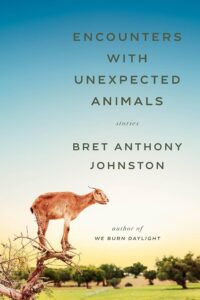 Encounters with Unexpected Animals: Stories
Bret Anthony Johnston
Random House
$28.00
Publication date: February 24, 2026
Petit: Before we dive into the book, what are some influential works (prose, visual art, music, etc.) or events that you might say contributed to the creation of Encounters with Unexpected Animals?
Johnston: First and foremost, thank you for taking an interest in the book and for reading it so closely, so kindly; I’m really grateful.
More than any specific work, most of the influence came from writers and artists I admire. A grossly incomplete list of people whom I wish would have more influence on my work might be: Amy Hempel, Jorie Graham, Ethan Canin, PJ Harvey, Edward P. Jones, Chekhov, Willie Nelson, Lyle Lovett, Jack Gilbert, Toni Morrison, Flaubert, Tolstoy, and Tim McIlrath. There are countless others, but these artists come immediately to mind.
There are also myriad experiences, but in hopes of not boring everyone to death, I’ll just offer two: Years ago, on a skate trip to Houston, I walked into a hotel and there were hundreds of clowns in the lobby. They were there for an annual clown convention, and I spent much of the weekend attending their panels and presentations. Then, much more recently, a buddy of mine thought a snake had slithered under his refrigerator, so he called me over to search for it. Both of those experiences gave rise to stories in the new collection.
Petit: This collection enjoys an outstanding title. I felt that each story pursues an answer to the title’s meaning. At what point in the writing process did this title come about? What does the phrase “encounters with unexpected animals” mean to you?
Johnston: Thank you! I’d always liked the title of that story, but it wasn’t until we were putting the collection together that it distinguished itself as the right one for the book. As for what it means, lordy, I have no idea. That’s just not the way my mind works or engages with language. I can say, though, that it matters to me that it’s not the encounters that are unexpected but how the characters, and perhaps the readers, ultimately define the concept of what is or isn’t animal.
Petit: With each story, I quickly acclimated to its sense of place, space, and time. Place can be tough for beginning writers. In terms of craft, as an instructor of writing, do you advise your students to establish setting early in a story. If so, how?
Johnston: For me, place determines the story. Setting is far more than window dressing; it’s a force that compels the characters, their actions, the story itself. I feel as though we undergo the places we inhabit, and they move through us as much as we move through them. I don’t know that there’s a one-size-fits-all approach to establishing place in a narrative; rather, it feels like it permeates the story in the same way voice does. As a reader and writer, I’m always seeking the detail that suggests a hundred others. I’m dowsing for the image or description that will animate the place in the reader’s imagination.
Petit: In “Paradeability,” a child surprises his father with the wish to become a rodeo clown instead of a football player. This generates a way for the two to grieve the loss of the child’s mother. When writing, do you plan for these synchronicities, or do you imagine your way into the narrative and let the characters surprise you?
Johnston: If a story doesn’t surprise me, no one will ever read it. Everything I write—from a sentence to a novel—is an act of chasing surprise. When I’m deliberating if I want to commit to writing something—knowing how miserably slow I am as a writer—I’ll usually begin with an image of a character doing something. With “Paradeability” it was the image of a father and son driving at night with the interior light on in the cab of the truck. Once I figured out the kid had the light on because he was reading, I wanted to know he was reading. Then, once that answer emerged, I wanted to know where they were going. The surprises are nested in the details and actions, and ultimately—if I do my job and if I’m lucky—reveal the characters.
Petit: In “Palomino,” Mr. Haslam has delusions of being a cowboy and buying a horse; in reality, he buys an ’86 Chevy Silverado from someone mourning a past relationship. Here, as in other stories, you navigate difficult themes like love, loss, and grief, but you bind them to cars and cowboys and unexpected Texas touchstones. How do you balance the universal with the mundane?
Johnston: The writer David Mitchell should be added to my list of influences above, not least because I remember him saying that if you try to write about the universe, you’ll never write about the brick wall in front of you; however, if you write about the brick wall in front of you, you’ll inevitably write about the universe. I wouldn’t know where to begin a story about love or loss or grief; those subjects feel abstract and slippery to me, and because writing is already so obnoxiously difficult, I’m not in the business of making it harder. On the other hand, a story of a man having second thoughts about selling an old truck? Sign me up! I’ll write hundreds of pages just to find out why he’s sabotaging the sale, and I’ll write hundreds more about an old timer who calls a rusted-out Chevy a palomino.
Petit: In “Dixon,” the titular character’s wife, Trish, is confused when Dixon uses the aphorism, “He didn’t think the creek would rise.” Other stories grapple with misunderstandings. Do you think there is a certain power in writing from a point of misunderstanding?
Johnston: What an interesting question! Thank you. To my way of thinking, misunderstanding is a consequence, and consequences are endlessly revelatory. What I’m most interested in, I suppose, is what leads to the consequence of misunderstanding which might be described as the characters not being fluent in the language of their hearts. They’re trying to articulate their pain, their struggles and loves, but they lack sufficient vocabulary and syntax. Like all of us, they’re longing to connect, and it’s in those misunderstandings where, I hope, we see their vulnerabilities, their fight against lonesomeness and isolation.
Petit: Teenagers feature prominently throughout. Teens experience a transitory period (puberty, the liminal space between child and adult), and exhibit behaviors their parents aren’t expecting. In media, teenagers are often the focal points of the coming-of-age story, the bildungsroman. In this collection, the parents are often the ones coming of age or bildungsroman-ing. Why did you find it important to center parents in this way in this book?
Johnston: A lot of these stories were written while I was writing We Burn Daylight. Every time the novel would try to kill me, I would sulk off and start a short story. Then, when the story tried to kill me, I’d return to the novel. The novel is told from the perspectives of two teenagers, so when one of the stories started gravitating toward characters around that age, I found myself exploring their stories and contexts through different lenses than in the novel. Maybe another way to say this is that if the teenagers were the light that illuminated the novel, then in the stories I was more drawn to the shadows that the kids’ cast or that the adults cast upon them.
Petit: My first encounter with this collection was with “Time of the Preacher” in the 2025 edition of The Best American Short Stories (Mariner). Congratulations, by the way! In the contributors’ notes, you mention that the story draws inspiration from the pandemic—a time when folks yearned for connection. How did the pandemic shape you as a writer, and has it changed your writing?
Johnston: Thank you! I’m so deeply grateful to Nicole Lamy and Celeste Ng at BASS, and Allison Wright and Paul Reyes at VQR, for giving the story such a nice home.
For the myriad ways the pandemic shaped all of us, I don’t know that it impacted my writing. I’ve always been pretty disciplined, and I was lucky to feel safe enough during that time in our lives to continue working at my normal (miserably slow) pace. In many ways, that my writing life remained unchanged was a kind of saving grace, a precious gift.
Where I did notice a change was in workshop. On the surface, writing workshops appear tailor-made for remote learning; we can still discuss the fiction the students have made and engage with published work in meaningful and productive ways. The pandemic, though, revealed in no uncertain terms how urgent and vital our being at the same table is. We need to share physical space with each other; we need to be able to walk to dinner together after workshop because that’s where the real communion—with our peers and the work itself—occurs. I think we returned to the workshop table with renewed commitment and a far deeper sense of shared enterprise.
Petit: “Young Life” is set amid the Satanic Panic of the 1980s. Here the “unexpected animal” appears to be a teenager whose vulnerable inner life contrasts with a rugged exterior. In exploring the social dynamics of this place and time period, did you find yourself drawing from lived experience, the experiences of others, or from imagined lives amid these circumstances?
Johnston: All of the above! I once “babysat” a boa constrictor and would let her sunbathe in my yard, and I remember my neighbor having an Ozzy Osbourne poster and being afraid to look at it. (Irony aside: I grew to love Black Sabbath, and I was unexpectedly sort of gutted when Ozzy died.)
The story really started, though, when I heard about someone stealing wheelchairs from a store. It seemed like such a callous act that I wanted to understand who would do such a thing and why. Ultimately, it’s a pretty inconsequential element in the story, but that’s where it began. Everything else in the story, including all the characters, proceeded from that seed of dark curiosity.
Petit: The collection features stories that take place in the 1980s, the early 2000s, and during the COVID-19 pandemic. What attracted you to these decades and moments in history?
Johnston: The details, I suppose. I’ve never planned anything I’m going to write. I never start with any kind of agenda or even intention, but rather I try to follow the breadcrumbs of the details through the maze that the story is establishing through those same details. If I’m imagining a kid in his neighbor’s house crank-calling his buddy from a phone on a nightstand, I know we’re not in the era of cellphones. If I’m imagining a woman scolding her ex because he’s not using a medical-grade face covering, it’s clear we’re in the depths of the pandemic. I guess what I’m trying to say is that the images and details aren’t the décor of a house, there it’s foundation and roof; they’re the house itself.
Petit: What are some of the best books, movies, or art forms you’ve enjoyed recently?
Johnston: How much time do you have? Colm Toibin has an extraordinary new collection of stories, The News from Dublin, and I loved Jorie Graham’s most recent book of poems. I’ve been returning to Toni Morrison’s novels more and more. As for visual art, I love anything by Michael Sieben, Peter Sacks, Andy Goldsworthy, and April Gornick. That said, working with all the geniuses at the Michener Center for Writers, I spend a lot of my time reading their work—the brilliant pages that have yet to be published or produced but will be soon. They’re such extraordinary writers that I feel like I’m being given a sneak preview of some of the most important work that’s just over the horizon. Right now I’m reading a thesis that will, I have zero doubt, be published within the next few years and shape the cultural conversation. For all the fears that I have for the planet and society and basically every living thing, I have full confidence in the literature that is being made today for tomorrow’s readers.
Petit: You’ve now published two novels, two story collections, and a book on the craft of writing. Would you be interested in sharing any current projects or plans for publication following the release of Encounters with Unexpected Animals?
Johnston: I’m inching into what I hope will be a short novel, and I’ve got a few stories that are starting to shape a new collection. A dear friend of mine and I are toying with the idea of co-writing a book about skateboarding. I’m curious as to where the projects will lead, how they’ll surprise me and how often they’ll try to kill me. I feel immensely lucky that, as difficult and taxing and slow as this work is, there’s almost nothing I’d rather do.
 Bret Anthony Johnston
Bret Anthony Johnston is the internationally bestselling author of the books Encounters with Unexpected Animals, We Burn Daylight and Remember Me Like This and the award-winning Corpus Christi: Stories, as well as the editor of Naming the World: And Other Exercises for the Creative Writer. His work has appeared in The New Yorker, Esquire, The Paris Review, Thrasher Magazine, The Best American Short Stories, and elsewhere. A recipient of a Guggenheim Fellowship, a National Endowment for the Arts Literature Fellowship and the Sunday Times Short Story Award, he was born and raised in Texas and is the director of the Michener Center for Writers at the University of Texas at Austin.