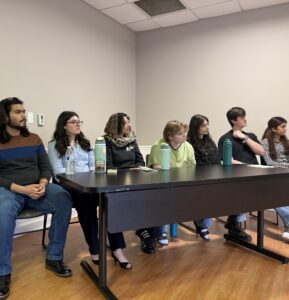
Students and faculty from the University of Central Florida’s Philosophy Department gathered during Academic Showcase Week for an interactive panel. Led by Assistant Department Chair Dr. Christy Flanagan-Feddon, the discussion featured current students reflecting on their academic experiences and how their studies are preparing them for future careers. During the panel, students highlighted the practical skills they develop through their coursework, including critical thinking, writing and communication.
“I’m much better at arguing and writing, better at thinking and making distinctions,” one student said, noting that the discipline also helped them grow as a public speaker and communicator.
Students said their studies encourage them to examine complex social questions, consider diverse perspectives and better understand the cultural and ethical systems that shape people’s lives. For those interested in fields such as medicine or law, they said the ability to analyze ideas and understand human experiences can be especially valuable.
“Religion makes up people’s lives,” one student said. “Studying religion helps you understand people more and can be helpful if you’re going into medical school because you gain a deeper understanding of your patients.”
Experiential learning opportunities also play a major role in the programs. Internship experiences allow students to apply philosophical and ethical concepts in real-world settings, including local museums and hospitals.
One student described an internship with AdventHealth, where they shadowed the Chaplaincy department and interacted directly with patients, gaining insight into the role empathy and ethical reasoning play in healthcare environments.
Students also shared their experience with other enriching activities, including serving as teaching assistants, completing honors undergraduate theses and creating student organizations. One new initiative is the “The Philosophy for Children Organization,” which connects UCF students with local K–12 schools and introduces philosophy to younger audiences.
Courses such as Feminist Theory, Ancient Philosophy and the Problem of Evil were among the favorites mentioned by students, who said these classes challenge them to analyze power structures, ethical dilemmas and human behavior from multiple perspectives.
Graduates of the program pursue careers in law, education, nonprofit organizations and business, among other fields. Flanagan-Feddon says the critical thinking, communication and cultural awareness students develop in philosophy courses are among the most valuable skills employers seek. Thus, philosophy remains essential in a world increasingly shaped by technological and scientific change. As innovations continue to reshape society, philosophical inquiry helps address the ethical and cultural questions that accompany those developments.
“Philosophy asks the big questions,” stated Flanagan-Feddon. “What is real? What is the good life? What are our moral obligations? Those questions will always matter because we will never stop being human.”
The department will bring these discussions to the public during UCF Celebrates the Arts 2026, through their event, A.I. and Ethics. This interactive event will question the increasing use of A.I. for expressions of care and its implications for the future of personal relationships.
UCF’s Philosophy Department offers major and minor programs in Philosophy, Religion, and Humanities and Cultural Studies, as well as a minor in Cognitive Sciences. Students may also pursue certificates in Interfaith Dialogue, Medical Humanities, and AI, Big Data, and Human Impacts, along with Graduate Certificates in Theoretical & Applied Ethics and Cognitive Sciences—therefore it is an academic hub for studying the artistry of mankind.