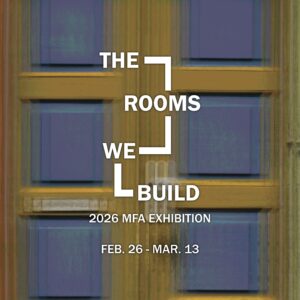
The Rooms We Build: 2026 MFA Exhibition Showcase presents the thesis work of six Studio Art & Design MFA candidates from the UCF School of Visual Arts and Design. Each artist explores personal identity through distinct perspectives — the unique “rooms” they have built throughout their lives.
For example, Stacie Becker’s practice dissects the struggle between internal and external expectations of womanhood, while Nelson Garcia’s paintings examine the gap between queerness and traditional masculinity. Though each artist’s work is deeply personal, together they reflect a wide range of lived experiences and upbringings.
In the following Q&A, the artists share insights into their work, what this exhibition means to them and how their experience as SVAD graduate students shaped their growth.
Q&A with MFA students
What does the title The Rooms We Build mean to you in relation to your work?
“I view the title as a metaphor for the self. The rooms we build vary depending on our experiences. The room I build today will look very different from the rooms I build in the future. We are made up of many small rooms, each shaped by the season of life we’re in.” — Stacie Becker
“I experiment with construction-based materials like wood and caulk, which are literally used in the creation of ‘the rooms we build’. My practice also aims to build new ideas of masculinity — new rooms to inhabit that allow for less restrictive expressions of identity.” — Nelson Garcia
“I think of this exhibition as what we keep inside the room versus what we keep outside. A lot of the show addresses the walls of stereotypes we build as a society to understand how the world functions around us. Those walls kick most individuals out, and this exhibition questions and transforms those stereotypes into more realistic perspectives. A common thread explores what is within the room: comfort found in family. My work feels like an in-between of these spaces, reducing stigma of mental health while also comforting others.” — Kenyari Gil Rosario
“In relation to my work, the title of the show reflects how we create personal spaces from memory and experience. My work becomes a space that holds longing and belonging, and where recollections of family and identity can live.” — Alberto Alonso
How has being a graduate student in SVAD shaped your growth as an artist, both creatively and personally?
“Creatively, I’ve been held accountable to my artistic choices and research at a professional level. I’ve learned not only how I make my work, but why it needs to exist as it does. This has fed my personal growth, as I’ve had to rapidly and independently maintain those professional standards, becoming largely self-reliant in directing my artistic practice.” — Nelson Garcia
“This MFA program shaped how I create and think about my work in its entirety. With a background in commercial illustration, I’d never considered the impact my art could make on the topics I care about. This experience made me a better professional, scholar and communicator.” — Kenyari Gil Rosario
“Being a graduate student at SVAD pushed me to think critically and be more intentional with my concepts. Faculty, critiques and research helped me trust my instincts while developing a stronger sense of purpose.” — Alberto Alonso
How does this thesis exhibition represent a turning point or culmination in your artistic practice?
“It’s a visual representation of my growth over the last five years. It’s vulnerable and honest, and a closing chapter in my life. Definitely a bittersweet turning point.” — Angelina Palmisano
“Seeing our work on the gallery walls feels like the realization of one goal and the beginning of another. It feels transformative and like a necessary step toward the next phase of life. In one way, it’s an ending, and in another, it’s a new beginning. I’mreally proud of what our cohort has accomplished.” — Stacie Becker
“This body of work pushed me to question my beliefs about art and move beyond the traditional canvas. It’s the culmination of three years of research, art-making and personal growth.” — Alissa Burch
What conversations do you hope your work continues beyond the walls of this exhibition?
“By being open about exploring my own masculinity, I hope others feel encouraged to examine theirs. I want the audience to ask: Where is your masculinity now, and how can it lead you someplace more joyous, open, and true?” — Nelson Garcia
“I hope my work continues conversations of mental healthcare needs and the impact of participatory art. Through a collaboration with Providing Autism Links and Support (P.A.L.S.), over 100 community members contributed to a mural for neurodiversity awareness and helped me reach my fundraising goal for P.A.L.S. If I, as one person, can accomplish these goals and help create impact, many others can, too.” — Kenyari Gil Rosario
“I hope my work evokes dialogue around home and belonging, and what it means to carry memories with you. These shared emotional experiences connect us across different backgrounds and cultures.” — Alberto Alonso
“I hope my work encourages conversations about authenticity and societal expectations surrounding gender roles, family dynamics, romantic relationships and autonomy. I want viewers to see and communicate with those around them as individuals with their own experiences, rather than as echo chambers.” — Stacie Becker
“I hope my work sparks conversations about what art could be, and how video games can be used as a new medium to make art.” — Alissa Burch
“Honestly, I want my art to make people feel good in the moment. I’m more concerned with evoking a visceral reaction and literal dopamine being released in their brains, than delivering a specific message.” — Angelina Palmisano
Join the artists for the opening reception of The Rooms We Build: 2026 MFA Exhibition on February 26 at the UCF Art Gallery from 6 to 8 p.m. Register here!