Author: Rhiannon O’Neil

  • Through the Looking Glass – Revealing the Untold Story of the History of Glassmaking

    Through the Looking Glass – Revealing the Untold Story of the History of Glassmaking

    Bella Watson // AMH 4110.0M01 – Colonial America, 1607-1763

    Glass has always been a mystery to me. Where does it come from? How is it made? Is it significant? From my research, I have discovered several customers purchased glass items in the 1760-1761 ledger from the Glassford and Henderson store in Colchester, Virginia. This discovery motivated me to dig deeper into the mystery of glass and reveal the unanswered questions.

    An illustration depicting how a Jamestown glassblower might craft his wares. From the National Park Service.

    History behind the Glass: With the opportunity to prosper in the New World, colonists needed to produce profitable goods. After all, the New World was abundant with raw materials needed for glassmaking: sand, wood, and ashes.[1] In England, glass was in high demand; however, the country lacked the appropriate resources to create glass. Although the colonists had the resources, they originally had no talented artisans to make the glass.[2]

    Production in Jamestown: In 1608, the Virginia Company sent Dutch and Polish artisans to Jamestown, Virginia, as craftsmen to create various products, including glass. Within the year, the manufacturing of glass was established. After the “Tryal of Glasse” (samples of glassware that were produced) was sent over to England, the production in Jamestown was halted due to a population decrease.[3] Thanks to a nearby swamp, starving conditions and repeated epidemics created the need for a constant replenishment of new colonists.[4] In 1621, four Italian artisans were among a new shipment of colonists sent to Jamestown. These four men were to restart glass production. This venture was organized by Captain William Norton.[5] He created a well-organized plan that would ensure success in the glassmaking industry, however it did not start out as smoothly as he hoped. The production of glass was halted in 1622 because of bad weather, disease, and conflicts with Native Americans, though efforts would not completely cease until 1624.[6]

    The Process: At Jamestown, glass was produced from silica in sand on the shores of the James River and alkali from limestone and potash.[7] After these materials were gathered, they were cleaned by either washing or extreme heating. The freshly cleaned materials were then liquefied in the furnace, which was fueled by wood from the surrounding area. These furnaces reached up to 2,080 Fahrenheit which enabled the silica and alkali to form into crystals. It was then melted into a molten material ready to be blown into a finished piece.[8]

    Evidence: In the ledger, William Haden purchased “1 pint Glass Decanter” in 1761.[9] A decanter is “a bottle of…cut glass, with a stopper, in which wine is brought to the table, and from which the glasses are filled.”[10] The question that rose from these findings was: Where did this glass come from? Henderson ordered various glass instruments from Glasgow, Scotland, including 2 dozen pint glass decanters, 2 dozen quart glass decanters, and looking glasses.[11] From this, it appears that glass production in Scotland may have been more successful than colonial production.

    On July 2, 1761, William Haden purchased a “pint Glass Decanter” (folio 111D).
    A 1765-1775 glass decanter. Image courtesy of the Winterthur Museum Collections,  1976.0165A, B.

    The Northern Attempt: In 1739, Caspar Wistar, a brass button entrepreneur from Germany, travelled to Pennsylvania and established a glass factory in Alloway, New Jersey. Wistar and his son, Richard, used two furnaces, two flattening ovens, several pottery mills, and a cutting house to operate their factory for forty years.[12] Wistar’s glassmaking venture became the first successful glassmaking factory in America. Besides his massive production of bottles, he also began to produce window glass. In addition to his production of Waldglass (green-yellowish color) style items like bottles, Wistar added the production of a clearer colored glass to his body of work.[13]

    Making Connections: Though Wistar was extremely successful in his brass button making business – it is said to have totaled almost 700 pounds at his death – and though he had success in making window glass and bottles, there were other forms of glass making that he did not venture into.[14] One of these was glass buttons. According to one of the accounts from Colchester, in November, 1761, James Edwards bought a dozen glass buttons along with 2 dozen “mettle” buttons. Purchasing both types of buttons may have meant Mr. Edwards had a higher social standing. The glass buttons were more expensive than the metal ones by half a shilling or six pence.[15]

    James Edwards was among the colonists who purchased buttons of both the glass and “mettle” varieties (folio 019D).

    Much like it is today, glass in the eighteenth century was a versatile material, able to craft a variety of goods. Though some manufactures, such as window glass, were relatively inexpensive to buy, others, such as decanters, drinking vessels, and buttons, seem to be more reflective of a higher social standing.[16] The availability of these goods at the Colchester store in 1760-1761 stands as a testament to the materialism that would shape colonial identity for years to come.


    [1] National Park Service, “Jamestown Glasshouse,” Historic Jamestowne: Glasshouse, last modified April 12, 2012, accessed March 23, 2017, https://www.nps.gov/jame/planyourvisit/glasshouse.htm.

    [2] NPS, “Glasshouse.”

    [3] NPS, “Glassmaking at Jamestown,” Historic Jamestowne, last modified February 26, 2015, accessed May 25, 2018, https://www.nps.gov/jame/historyculture/glassmaking-at-jamestown.htm

    [4] Alan Taylor, “Virginia, 1570-1650”, in American Colonies: The Settling of North America (New York: Penguin Books, 2001), 130.

    [5] NPS, “Glassmaking.”

    [6] Ibid.

    [7] Thomas L. Purvis, Colonial America to 1763, Almanacs of American Life (New York: Facts on File, 1999), 107.

    [8] Purvis, Colonial America, 107.

    [9] Alexander Henderson, et. al. Ledger 1760-1761, Colchester, Virginia folio 111 Debit, from the John Glassford and Company Records, Manuscript Division, Library of Congress, Microfilm Reel 58 (owned by the Mount Vernon Ladies’ Association).

    [10] “decanter, n.,” OED Online (Oxford University Press) http://www.oed.com/ezproxy.net.ucf.edu/view/Entry/48019?rskey=upZsGT&result=1&isAdvanced=false, accessed May 25, 2018.

    [11] Alexander Henderson, Charles Hamrick, and Virginia Hamrick, Virginia Merchants: Alexander Henderson, Factor for John Glassford at His Colchester Store, Fairfax County, Virginia, His Letter Book of 1758-1765 (Athens, Ga: Iberian Pub. Co, 1999).

    [12] Purvis, Colonial America, 107.

    [13] Ibid.

    [14] Insa Kummer, “Caspar Wistar established the first successful glass manufacturing business in North America,” Immigrant Entrepreneurship, last modified September 25, 2014, accessed May 25, 2018, https://www.immigrantentrepreneurship.org/entry.php?rec=1.

    [15] Henderson, et. al. Ledger, 1760-1761 folio 19 Debit.

    [16] David Dungworth, “The Value of Historic Window Glass,” The Historic Environment: Policy and Practice 2, No. 1 (June 2011): 41, DOI 10.1179/175675011X12943261434567.

  • Decisive Destruction: Firearms in North America, 1492-1776

    Decisive Destruction: Firearms in North America, 1492-1776

    Edwin Velez // AMH 4110.0M01 – Colonial America, 1607-1763

    Firearms played a pivotal role in the maintenance and defense of the North American colonies. After a slow start, guns became more common in colonial households and would come to play a crucial role in the American Revolutionary War.[1] Guns were first introduced to America by the Spanish in the initial conquest of the late fifteenth and early sixteenth centuries. Superiority in firepower allowed these colonists and conquerors to dominate trade in coastal areas, intimidating Native Americans, whose stone weapons were no match for the awesome firepower of the Spanish arquebuses. However, firearms in general were quite scarce at this point, with most soldiers relying on steel swords or crossbows.[2] When invading Tenochtitlan in 1520, Spanish conquistador Hernan Cortés brought with him 12 gunmen to fight against the Aztecs. During the conquest of the Incas in 1533, Francisco Pizarro brought only three.[3] Their technological superiority would eventually allow the Spanish to dominate and to decimate Aztec, Mayan, and Incan populations.

    Native American tribes, when hunting for food, originally relied on bows and arrows or spears. However, as trade with Europeans increased over time, firearms became more common among coastal tribes, which eventually came to present a threat to the security of European colonists and rival tribes who had limited access to coastal trade networks.[4] Native Americans in northern colonies would typically offer wampum, a craft composed of shell beads, in exchange for firearms and other goods. In southern colonies, they would offer items such as deer skins and other animal pelts.[5]

    After 1607, when the British colony at Jamestown was first established, firearms played a pivotal role in Indian-English conflicts. Like the Spanish, the English used their superior firepower to intimidate and make an example of the Algonquians of Virginia, hoping to command the trade, respect, and fear of neighboring tribes. In turn, the Native Americans in the area learned the value of firearms as a resource and often accepted Jamestown deserters who brought such munitions with them.[6]

    This trade musket could be an example of the firearms that Native Americans traded animal pelts and wampum for in colonial America. From the Colonial Williamsburg Foundation, Acc. No. 1981-5.

    The first serious battle between Native Americans and English settlers was the Pequot War of 1636, which took place in modern-day Connecticut. In this conflict, the Pequot tribe fought against the English, who were aided by the Narragansett and Mohegan tribes, historical rivals of the Pequot people. A combination of arson and gunfire was utilized to massacre the Pequots.[7]

    The process of manufacturing firearms required specialization in a variety of skills, such as woodworking and blacksmithing. However, there were no gunsmiths in the colonies during the contact period. Firearms were mostly imported, crafted by European gunsmiths and delivered to the American colonies on ships across the Atlantic.[8]

    In October and December of 1760, and again in November of 1761, James Halley Junior purchased various amounts of powder and “shott” from the Colchester store in Virginia, making him a likely candidate of gun ownership (folio 48D).

    Upon inspection of the Glassford and Henderson Colchester store ledger from 1760-61, it is apparent that firearms were a component to life in the Virginia colony in the eighteenth century and ammunition required occasional restocking. Among the many purchases, powder and “shott” are somewhat common, usually measured in pounds and purchased together. Powder was purchased 92 times in 1760-1761, while shot was bought 93 times.[9] These goods usually appeared once per account, though sometimes twice, suggesting that the initial purchase lasted for some time before requiring restocking. For example, James Halley Junior bought powder and shot twice in 1761: March and November.[10] Less common was gunflint, the primary component to lighting the gunpowder necessary to fire the weapons. This good was purchased only 34 times.[11] The purchases were made towards the end of summer and the beginning of autumn, implying that settlers were possibly preparing for the upcoming hunting season. In 1738, the Virginia House of Burgesses passed “An Act, for the better preservation of the breed of Deer; and preventing unlawful Hunting”, which stipulated that bucks could only be hunted from the beginning of August to the beginning of December, and that does and fawns could only be hunted from the beginning of November to the end of December.[12] Though colonists were likely hunting animals other than deer, this law shows that hunting practices were moderated and those who disobeyed were punished.

    A powder horn made around 1758-1760 in the colonies, used to store gunpowder. From the Colonial Williamsburg Foundation, Acc. No. 2011-5.

    In all cases, actual purchases of firearms in 1760-1761 were virtually absent from the ledgers, suggesting that guns were purchased elsewhere or were already part of a household by that point. However, the frequency of ammunition purchases show the relative importance of firearms in colonial America as hunting tools, a far cry from the purpose of the first firearms brought to the New World.


    [1] Richard L. Legault, Trends in American Gun Ownership (New York, LFB Scholarly Publications, 2008), 15.

    [2] Alan Taylor, American Colonies: The Settling of North America, Vol. 1 (New York: Penguin Books, 2002), 56.

    [3] M.L. Brown, Firearms in Colonial America: The Impact on History and Technology, 1492-1792 (Washington D.C.: Smithsonian Institution Press, 1980), 41.

    [4] Taylor, American Colonies, 98.

    [5] Ibid., 94, 230.

    [6] Ibid., 132-133.

    [7] Ibid., 195.

    [8] Ed Crews, “The Gunsmith’s Shop,” Colonial Williamsburg Foundation, accessed May 30, 2018, http://www.history.org/foundation/journal/autumn00/gunsmith.cfm.

    [9] History Revealed, Inc., Object Index 1760-1761, unpublished.

    [10] Alexander Henderson, et. al. Ledger 1760-1761, Colchester, Virginia folio 48 Debit, from the John Glassford and Company Records, Manuscript Division, Library of Congress, Washington, D.C., Microfilm Reel 58 (owned by the Mount Vernon Ladies’ Association).

    [11] History Revealed, Object Index.

    [12] William Waller Hening, The Statutes at Large: Being a Collection of all the Laws of Virginia from the First Session of the Legislature, in the Year 1619 (Richmond, Virginia: Franklin Press – W.W. Gray, Printer, 1819), Vol. 5, Ch. XIV, 60-61, accessed May 30, 2018, http://vagenweb.org/hening/vol05-04.htm.

  • Rum and Its Consumption

    Rum and Its Consumption

    Noelle Robison // AMH 4110.0M01 – Colonial America, 1607-1763

    Alcohol, rum specifically, was consumed regularly and at all times of the day in the British colonies of North America. The Colchester store ledger from 1760-1761 in Fairfax, Virginia, shed light on this observation. Almost every account listed in the folios have entries regarding the purchase of rum. For example, in Valinda Wade’s and William Turner’s accounts, there are several entries with rum purchased by the quart and a few by the gallon.[1] Other folios, such as Benoni Halley’s account, show several gallons purchased in a short period of time.[2] William Scott also purchased many gallons.[3] In summation of the thirteen folios reviewed, a pattern of high rum purchases and consumption was realized. Rum was the alcohol of choice in the colonies largely due to its proximity to the sugar plantations in the Caribbean. It is estimated that the average colonist consumed 3.7 gallons annually.[4]

    In June and July of 1760, Mrs. Valinda Wade purchased multiple gallons of rum from the Colchester store (folio 19D).
    In December of 1760, William Turner purchased 3 and a half gallons of rum from the Colchester store (folio 22D).

    Though widespread, alcohol consumption was often regulated by both legal constraints and social expectations. Anyone wishing to sell alcohol and provide other service to townspeople and travelers alike were required to secure licenses for their establishments. These taverns or inns, otherwise known as ordinaries, were common throughout many of the colonies. Licenses were needed as early as the mid-1600s in some places.[5] In Colchester, many licenses were granted during the town’s short history, though the most important was likely the Colchester Inn, or the Fairfax Arms Tavern, owned by Peter Wagener and managed by Charles Tyler.[6] Under licenses, taverns or ordinaries were often restricted by how long they could be open each day, how much alcohol they could sell, and who they could serve.[7] These legalities were coupled with social expectations. One was expected to control oneself, and this meant no drinking to excess. In the most extreme cases, those in violation of social norms or the law would find themselves publicly humiliated or fined.[8] In these ways, the everyday consumption of alcohol, including rum, was ensured against excess and attempts were made to regulate it for the common good.

    Metal tankards from ca. 1730-1745, possibly like ones used in ordinaries and taverns. From the Colonial Williamsburg Foundation, Acc. No. 1954-940.
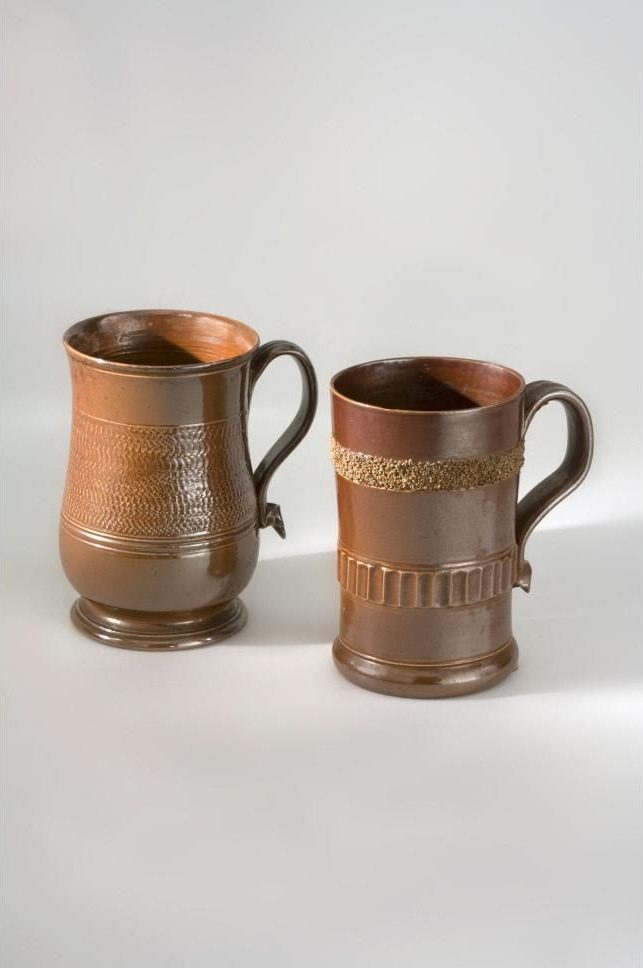
    Stoneware tankards dating from 1740-1780 that could have been similar to those used in colonial ordinaries or taverns. From the Colonial Williamsburg Foundation, Acc. No. 1973-231.

    Additionally, while the consumption of alcohol was high, so was its opposition. Religious tolerance was common amongst the British colonies. However, some of these religious groups were extreme in their practices against alcohol. They condemned alcohol and many attempted to prohibit the sale and consumption of it. This disdain for alcohol was highlighted in a recent interdisciplinary journal article by Utah Valley University professor, regarding the interactions between Quakers and Native Americans in the mid 1700s. The article states, “Indian and Quaker revivalism intersected through a shared concern for moral purity and regulating alcohol consumption.”[9] This article goes further stating, “For colonists rum generated profit as well as anxieties about its potential disorder.”[10] Meanwhile, sugar plantations in the Caribbean were supplying the foundation for the highly successful rum market. There is no doubt that the rum trade brought wealth to investors and producers. However, this caused concern in towns and religious sanctuaries. This article elaborates on alcohol consumption in the same time period as the Colchester ledgers, providing a broader view and context of the folio pages analyzed.

    While rum was an extremely popular drink and part of the culture surrounding the British colonies, it was also heavily regulated by both laws and norms, as well as deemed intolerable by some religious groups. Sugar as a cash crop was extremely beneficial financially to investors and planters. Its versatility made it so, including its importance in the production of rum. Successful sugar plantations were essential for colonial profit while also encouraging the creation, and in turn, the consumption of rum. Thus, sugar plantations and rum consumption created a complex web of interdependencies among various peoples living in the colonies.


    [1] Alexander Henderson, et. al., Ledger 1760-1761, Colchester, Virginia folio 19, 22 Debit, from the John Glassford and Company Records, Manuscript Division, Library of Congress, Washington, D.C., Microfilm Reel 58 (owned by the Mount Vernon Ladies’ Association).

    [2] Henderson, et. al. Ledger 1760-1761 folio 23 Debit.

    [3] Ibid., folio 24 Debit.

    [4] Ian Williams, Rum: A Social & Sociable History of the Real Spirit of 1776 (New York: Nation Books, 2005), 166.

    [5] Alice Morse Earle, Stage-Coach and Tavern Days (New York: Macmillan Co, 1900), 2, https://archive.org/details/stagecoachtavern00earluoft.

    [6] Edith Moore Sprouse, Colchester: Colonial Port on the Potomac (Fairfax, Va: Fairfax County Office of Comprehensive Planning, 1975), 61, https://archive.org/details/Colchester_201704.

    [7] Mark Harrison Moore and Dean R. Gerstein, eds., Alcohol and Public Policy: Beyond the Shadow of Prohibition (Washington, D.C.: National Academy Press, 1981), 132.

    [8] Moore and Gerstein, Alcohol and Public Policy, 137.

    [9] Michael Goode, “Dangerous Spirits,” Early American Studies, An Interdisciplinary Journal 14, no. 2, 260.

    [10] Goode, “Dangerous Spirits,” 262.

  • Joseph Jackson: The Man of Many Stitches

    Joseph Jackson: The Man of Many Stitches

    Christopher José // AMH 4110.0M01 – Colonial America, 1607-1763

    To find answers from the past, historians search endlessly through documents of all types, even store ledgers. These answers result in the researcher being able to glimpse into the past and learn from it. In the end, we better understand the culture and methods of those who came before us. This blog will explore one client of the Glassford & Henderson Colchester Store in 1760-1761, Joseph Jackson’s purchases and his method for buying, along with the mystery that surrounded this man’s profession.

    Jackson seemed to be quite an enigma when my initial research began. His purchases were what I presumed very similar to that of a tailor. I discovered his purchases often consisted of a mix of items such as pins, thread, and “duffils.”[1] These items drew me into exploring what this man truly intended to do with these objects.

    Joseph Jackson purchased materials necessary for making clothing during the cold month of December (folio 117D).

    Now, it was no surprise that needles and threads could be used by a tailor, but duffil, or duffle, was a foreign fabric type with which I was not previously familiar. I researched the word and discovered what it was. I found duffle’s origin derives from the name of a Belgian town that crafted the fabric. It is a heavy, wool fabric that was first manufactured during the seventeenth century.[2] With this in mind, it led me to think about the use of the material.

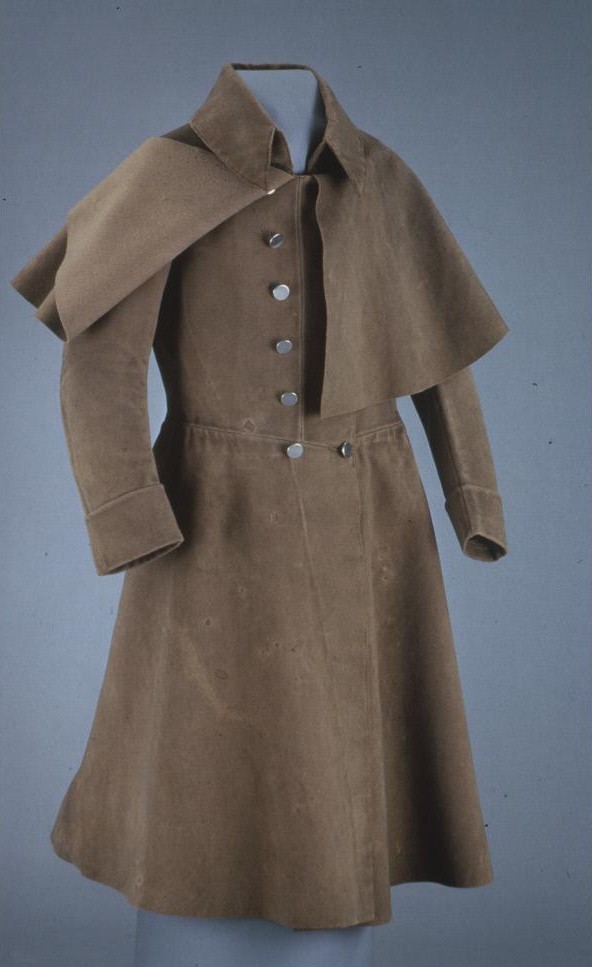
    A coat made of broadcloth, a heavy wool not unlike duffle. Joseph Jackson could have made a coat similar to this. From the Colonial Williamsburg Foundation, Acc. No. 1954-1041.

    Since Jackson bought the heavy fabric in December, it is possible he could have used the material to make a coat for himself or for another person to keep warm during the winter. The purchasing of duffle was not exclusive to one kind of trade and therefore did not provide conclusive proof of his profession. Moreover, these items could also have been purchased for another person, even a family member. The fact remained that if Jackson was not a tailor, then what (or who) were these purchases specifically for?

    I realized that it was imperative to continue my investigation of Jackson’s purchases to discover the truth behind his identity. As I continued my analysis of Jackson’s account, I attempted to compare documents with another customer that I stumbled across. This individual, like Jackson, acquired similar items. This person was John McIntosh who was more likely to be a tailor based on how he paid his accounts – in the creation and repairs of clothing for Alexander Henderson (the Colchester store manager) and those enslaved by the store.[3]

    John McIntosh also purchased materials for clothing, creating a link between his account and Jackson’s (folio 34D).

    Through McIntosh, I saw some similar purchases: needles and duffle. Knowing that McIntosh purchased his materials at the same store that Jackson did made me wonder if there were any connections. Given the similarity in purchases, perhaps Jackson was a tailor not yet employed, or perhaps he was an apprentice for a tailor and associated with McIntosh on some level. Yet, it was not enough evidence to surmise Jackson’s profession and it continued to be unknown to me. Whatever profession Jackson pursued was not clearly identified by his purchases alone and would take additional research to learn.

    John McIntosh paid his balance at the Colchester store in 1760-1761 by making various items of clothing. Clearly, he was some sort of tailor (folio 34C).
    Compare how Joseph Jackson paid his account with McIntosh (above). By paying with tobacco, and not with a service such as tailoring, it becomes evident that Jackson followed some other profession (folio 117C).

    By looking at Jackson’s payments to the Colchester store, it became clear he was not a tailor at all.[4] He may have been connected to Marmaduke Beckwith (a landholder in the western part of Fairfax County) as Jackson’s credits came from selling tobacco notes originally belonging to Beckwith. Was Jackson a tenant of or farm manager for Beckwith? Although I couldn’t confirm what Jackson’s profession may have been by looking at his purchases, by continuing to look at Jackson’s accounts in full, I learned I was wrong in my initial interpretation of him as a tailor based on his fabric purchases and that sometimes it is hard work being a historian!


    [1] Alexander Henderson, et. al. Ledger 1760-1761, Colchester, Virginia folio 117 Debit, from the John Glassford and Company Records, Manuscript Division, Library of Congress, Washington, D.C., Microfilm Reel 58 (owned by the Mount Vernon Ladies’ Association).

    [2] “Duffle coat,” Encyclopedia of Clothing and Fashion, accessed March 23, 2017, http://angelasancartier.net/duffle-coat.

    [3] Henderson, et. al. Ledger 1760-1761, folio 34 Debit.

    [4] Ibid., folio 117 Credit.

  • Nice Threads

    Nice Threads

    Jordi Pelayo // AMH 4110.0M01 – Colonial America, 1607-1763

    Clothing is a status symbol. If you have the nicest pants on the block, chances are they were expensive, and you bought them to show off. The clothing people buy tells us about who they are and for what purpose the clothing is intended. Cotton is undoubtedly one of the most well-known fabrics for clothing, and throughout history it has been used in a variety of ways. Cotton was used in sails, towels, fishing nets, and bookbinding in addition to clothing.[1] Using the accounts from the John Glassford and Company store in Colchester, Virginia, from 1760-1761, as well as conducting my own research, I have been able to uncover some information about what the fabrics of the time said about the people who wore them.

    Henry Taylor purchased both muslin and printed cotton at the Colchester store in September of 1760 (folio 090D).
    The portrait of Elizabeth Buckner Smith, painted ca. 1745-49. The sheer material at her neck is muslin. From the Colonial Williamsburg Collections, Acc. No. 1951-577,A&C.

    In the eighteenth century, cotton came in many forms, each with its own distinct functions. Muslin was a form of cotton that was made in India. Although it could be manufactured into varying degrees of softness, it was well known for being fine.[2] The most popular use for muslin—a fabric similar to gauze—was as a dress material. The people who bought muslin came from a higher tier of society, and were either women or purchasing it for women. At the Colchester store, I found an example of this in the account of Henry Taylor when he bought some women’s gloves and muslin, possibly for his wife.[3] Portraits of wealthy women show them dressed in muslin attire.[4]

    Another specific kind of cotton was known as printed cotton. This fabric was often decorated with floral designs and was used for multiple purposes, such as home décor and quilts in addition to clothing. In the early eighteenth century, both England and France had placed bans on printed cotton for domestic production because it quickly became a competitor for imported silks, but by mid-century these bans had been lifted and printed cotton became more widespread on the continent. The American colonies, however, had always had a large market for this kind of cotton.[5] At the Colchester store, I found that mostly men bought printed cotton. William Turner bought two yards, Leonard Dozer six yards, and Henry Taylor one and a half yards.[6]

    A 1765-1775 woman’s printed cotton gown, featuring the popular floral patterns of the time. From the Colonial Williamsburg Foundation, Acc. No. 1954-67,1.

    However, a few women also purchased this fabric, such as Elizabeth Pierce and Elizabeth Fallen, who bought one and a half yards and seven yards, respectively.[7] Each customer at the Colchester store who bought this particular kind of cotton paid a range of prices, from as little as 1 shilling 1 pence for half a yard to as much as 1 pound 15 shillings for 14 yards, with variations in between even for similar amounts.[8] Using a sample of purchases of printed cotton and comparing them to the few instances of muslin being purchased, it is clear that printed cotton was slightly more affordable than muslin. For example, one and half a yards of the former sold for 7 shillings 1½ pence, whereas the same amount of muslin went for 10 shillings.[9]

    Each of these specific types of cotton was worth more than the parent fabric. The purchases of both muslin and printed cotton show that customers at the Colchester store were searching for visible ways to express their wealth, or even to give the impression they had more wealth than was the reality. Just like today, appearances mattered.


    [1] Julian Roche, The International Cotton Trade (Cambridge, England: Woodhead Publishing Ltd., 1994), 4-5.

    [2] Roche, International Cotton Trade.

    [3] Alexander Henderson, et. al. Ledger 1760-1761, Colchester, Virginia folio 90 Debit, from the John Glassford and Company Records, Manuscript Division, Library of Congress, Washington, D.C., Microfilm Reel 58 (owned by the Mount Vernon Ladies’ Association).

    [4] James Gillray, Advantages of Wearing Muslin Dresses!, February 15, 1802. British Cartoon Prints Collection, Library of Congress, Washington, D.C.

    [5] Melinda Watt, “Textile Production in Europe: Printed, 1600-1800,” in Heilbrunn Timeline of Art History (New York: The Metropolitan Museum of Art, 2000-), accessed May 18, 2018, http://www.metmuseum.org/toah/hd/txt_p.htm.

    [6] Henderson, et. al. Ledger 1760-1761 folio 20, 49, 90 Debit.

    [7] Ibid., folio 42, 122 Debit.

    [8] Ibid., folio 8, 20, 22, 23, 24, 29, 38, 42, 48, 49, 52, 68, 79, 90, 122, 131, 141, 147, 150, 153 Debit.

    [9] Ibid., 11 Credit, 122 Debit.

  • Facebook of the Eighteenth Century

    Facebook of the Eighteenth Century

    Joel McCrickard // AMH 4110.0M01 – Colonial America, 1607-1763

    Among the many items bought and sold at the Colchester store (1760-1761) in Fairfax County, Virginia, was a rather timeless piece, an almanac.[1] Almanacs were yearly books that kept records of the special events happening each year, of statistical or important information, and of weather patterns. For this reason, an almanac from 1760 would prove to be extremely enlightening to certain aspects of colonial American life. Each colony had its own almanac tailored to its specific region and communities. Virginia’s almanac written in 1760 for the year 1761 was put together by Theophilus Grew, and printed and sold by William Hunter.[2] Not much is known about the writer, but we do know some about Hunter.

    William Hunter lived in Williamsburg, Virginia, was the official printer for the colony of Virginia, and published the Virginia Gazette—a popular newspaper. He was also a deputy British postmaster for all the North American colonies. In an effort to rebuild the postal system of the colonies, Hunter worked with the famous founding father Benjamin Franklin, Pennsylvania’s postmaster. Soon after Hunter printed the almanac for 1761, he died after being  sick with fever for many years.[3] The more I read the almanac and its contents, the more it seemed like the Facebook wall of the colonial period.

    An almanac page showing weather patterns of September. Theophilus Grew, The Virginia Almanack for the Year of Our Lord God 1761, 13.

    Although the weather was a good chunk of the first half of the almanac, there were plenty of small pockets of information riddled within each page and even full paragraphs on a wide array of topics from food and drink, to analogies, and even a poetic verse on how the writer wanted his wife to be like an almanac and change yearly. On the second page of the almanac, it gave a depiction of the anatomy of the human body in relation to the zodiac signs – the same signs still used today and shared on social media platforms like Facebook. Much of the important dates in the almanac revolved around religious holidays and holy days, but there were a few dates that stuck out as odd. In January, it reminded its readers that on the 30th of that month in 1649, King Charles was beheaded. In April, it showed that they had an April Fool’s day, just like today. Another similarity to Facebook was that each of the month’s pages started with a short poem or proverb like memes often shared by those whom find them to their liking. In September, one of the poems was: “The happiest man that ever breath’d on earth, with all the glories of estate and  birth, had yet some anxious care to make him know, no grandeur was above the reach of woe.”[4]

    After all information regarding weather for the year was included, the author went into statistical information for the local courts of Virginia and how far the towns in the colony were from each other, not only in Virginia but also other colonial centers. Advertisements were another important aspect of almanacs. Just like in newspapers and Facebook feeds, businesses were promoted to the public, from jewelers to book binders. Almanacs also included the “life-hacks” of the time and recipes for food items and drinks. The almanac discussed what types of clothing to wear when traveling and what accessories to bring to be prepared for any  weather. Another life-hack involved adding shavings of green hickory wood to your common beer to make it taste better than fine ale, all while costing virtually nothing. The articles continued with titles like, “Methods for preserving the virtues of lemons and oranges for years” and “LIQUOR made from Indian Corn.”[5] These types of titles suggest that people, just like today on Facebook, were looking for simple tips and tricks to improve life and how-to guides. While  back then, they did not have the same avenues to share information like we do today, the almanac proved to be a fascinating and diverse publication to be used in a variety of ways: to inform, to explain, or to entertain.

    Major Peter Wagener’s account (folio 59D) shows the purchase of an Almanack on December 16, 1761; it was the only almanac purchased at the Colchester store from 1760-1761.


    [1] Alexander Henderson, et. al. Ledger 1760-1761, Colchester, Virginia folio 59 Debit, from the John Glassford and Company Records, Manuscript Division, Library of Congress, Washington, D.C., Microfilm Reel 58 (owned by the Mount Vernon Ladies’ Association).

    [2] Theophilus Grew, The Virginia Almanack for the Year of our Lord God 1761 (Williamsburg, [Va.]: Printed and sold by William Hunter, 1760), 1, http://opac.newsbank.com/select/evans/8610.

    [3] David Rawson, “William Hunter (d. 1761),” Encyclopedia Virginia, accessed March 23, 2017,
    https://www.encyclopediavirginia.org/Hunter_William_d_1761#start_entry.

    [4] Grew, The Virginia Almanack for the Year of our Lord God 1761, 13.

    [5] Ibid., 25-26.

  • Measure for Measure: Units of Measure in the Eighteenth Century

    Measure for Measure: Units of Measure in the Eighteenth Century

    Katie Miesner // AMH 4110.0M01 – Colonial America, 1607-1763

    The eighteenth century was truly a time of cultural melding in the colonies. People from various parts of Europe with aspirations for a better life came to Virginia, largely because of its flourishing economy. For immigrants, Virginia offered refuge from religious persecution, poverty, and social oppression. Shopkeeper Alexander Henderson operating the John Glassford & Company store in Colchester, Virginia,  was an example of a colonist who came to America seeking more opportunities.

    When analyzing Henderson’s shop ledger for 1760-1761, I was initially thrown off by the various units of measurements found in the accounts.[1] Certain units such as inches, yards, and pounds sounded familiar while other words such as ells, fathoms, and hundredweights required a fast search into the project’s glossary for clarification. I soon learned that a hundredweight (abbreviated cwt) is a unit of weight, a fathom is a measurement of length described as outstretched arms, and an ell was also used for length, typically in Scotland and England, gauged by the length of a forearm.[2] I began pondering how Henderson was able to keep track of all of these different units of measurement. In order to be successful in his line of work, he must have learned to be patient and adaptive to numerous cultures  and find ways to get around language and social barriers that come with dealing with lots of people from various backgrounds. To succeed in business, he must have had to do a lot of improvising in terms of consolidating fair trade prices to reflect the various units of measurement depending on the item sold. The more I pondered these scenarios, the more I realized that the various units of measurement are synonymous with the colonists themselves.

    A customer at the Colchester store purchased ells of roles and best osnaburg, two types of fabric (folio 131D).
    Another customer purchased rope by the fathom at the Colchester store (folio 131D).

    The United States Customary Unit system’s origin is similar to the British Imperial system. Both systems trace their roots back to Roman and Anglo-Saxon units of measure.[3] As I reviewed the accounts, I found that the most common type of length measurements used in the ledger were inches, yards, and fathoms. What’s interesting about these types of measurements is that they are all units based on anatomy and dimensions of the human body. According to Russ Rowlett, a professor from the University of North Carolina at Chapel Hill, “the inch represents the width of the thumb, [and] in many languages the word for inch is also the word for thumb.”[4]

    Da Vinci’s Vitruvian Man poses as an example of various anatomy-based measurements: light blue for fathom, dark blue for yard or half-fathom, and purple for ell. Original image from LeonardoDaVinci.net.

    The foot is often thought of as being the length of a human foot, and the fathom as previously stated is a person’s wingspan. The yard can also be interpreted as being the total distance from the end of the middle finger of an outstretched hand to the nose, or half of a fathom.

    What this says about the eighteenth century is that because of the lack of similar backgrounds and common education, units of measurement that relied on anatomy were easier to use than those dependent on math, numbers, or previous knowledge. This idea predates the eighteenth century, but was revisited as a means to find commonality to overcome language barriers.

    Although there wasn’t an official decree in terms of a unit of measurement in the United States until the Metric Conversion Act of 1975 by President Ford, a need for a practical system of measurements was certainly a priority for shopkeepers such as Alexander Henderson in eighteenth-century colonial Virginia.[5] The adaption of colonial shopkeepers to numerous cultures as seen in the ledger proves that, while everyone has different origins,  money and goods are a universal necessity.


    [1] Alexander Henderson, et. al. Ledger 1760-1761, Colchester, Virginia folio 131 Debit, from the John Glassford and Company Records, Manuscript Division, Library of Congress, Washington, D.C., Microfilm Reel 58 (owned by the Mount Vernon Ladies’ Association).

    [2] History Revealed, Inc., Glassford and Henderson Transcription Glossary, unpublished.

    [3] Russ Rowlett, Dr, How Many? A Dictionary of Units of Measurement (New York, NY: University of North Carolina Chapel Hill, 1999).

    [4] Rowlett, How Many?.

    [5] “Metric Conversion Act of 1975,” US-Metric Association, accessed March 23, 2017, http://www.us-metric.org/metric-conversion-act-of-1975/.

  • Absalom Reid: Exploration into a Store’s Customer

    Absalom Reid: Exploration into a Store’s Customer

    Sarah Ryschkewitsch // AMH4110.0M01 – Colonial America, 1607-1763

    When it comes to colonial America, most people do not know the life of an average colonist. People learn about the American Revolution, all the battles fought so the colonies could break away from England, the people that made the American Revolution a success for the colonies, and the people that got their names into the history textbooks. What is left out of these textbooks are the average colonists who made a living by working for a minimal wage, those who were not seen as key figures in the Revolution. By looking at the ledger (1760-1761) from the Glassford and Henderson Colchester, Virginia, store there is a way for people to get a glimpse into the daily life of an average, middle class colonist.

    On April 19, 1727, Joseph Reid and Elizabeth [Hampton] Reid had a son, Absalom, in Overwharton Parish in Stafford County, Virginia.[1] Joseph Reid was in immigrant from Glasgow, Lanark, Scotland, and Elizabeth Hampton was from Truro Parish, Prince William, County, Virginia.[2] Joseph and Elizabeth Reid had six children: Absalom, Jane, Sarah, John, Elizabeth, and Ann.[3] Absalom Reid was the oldest. He married Sarah Simpson in Fairfax, Virginia, on January 29, 1750. They had eight children by the time of Absalom’s death: Jean, Elizabeth, Mary, Susannah, Sarah, Joab, John, and Margaret.[4]

    Absalom Reid shopped in the Colchester store, located in Fairfax County, Virginia.[5] Based on Reid’s purchases, it was evident he belonged to what was known as the middling sort then, or the middle class today. From 1760-1761, Reid bought 40 yards of osnaburg, a felt hat, three pairs of damaged stockings, a pair of thread stockings, a pair of worsted stockings, a pair of leather breeches, and women’s gloves.[6] Along with clothing supplies, Reid also bought sewing supplies, such as thread, cotton, and buttons.[7] Other purchases included rum, and he also paid several hundred pounds of tobacco to the sheriff and parish collector to pay his taxes and tithes. To pay for his purchases, Reid either provided cash or tobacco–with a total of 1,085 pounds of tobacco in August worth six pounds, seven shillings, and three pence. Though he made his purchases in the store in 1760 and 1761, he didn’t pay in full by the end of the ledger year and his debt carried to the following year (1762) via Liber C.[8]

    Absalom Reid’s varied purchases at the Colchester store in 1760-1761 (folio 79D).
    Absalom Reid paid with 1,085 pounds of tobacco in August of 1761, and in November, but it didn’t pay off his account which carried over to the next year (folio 79C).

    When evaluating the debit and credit ledgers, it is evident that Absalom Reid would travel to Colchester and buy the supplies he needed, as he rarely shopped more than once a month. As can be seen on the debit page of his account, most of the purchases were made in August 1761, when he also paid on his account in tobacco. Reid, as a tenant on property owned by James Scott, was able to farm his own tobacco, even if it wasn’t his own land.[9] Making many purchases at once was most likely because he wanted to ensure he had most of what he needed so he didn’t have to travel over twenty miles each way to the store and home more than necessary.[10]

    A depiction of how far Absalom Reid (top left, red square) had to travel to reach Colchester (bottom right, lined triangle). “An Interpretive Historical Map of Fairfax County Virginia in 1760” – © Beth Mitchell – Published by Office of Comprehensive Planning, County of Fairfax, 1987.

    Based on Absalom Reid’s frequency at the Colchester store in 1760-1761, what he was purchasing, how he paid, and the circumstances under which he had to travel, a rough outline of his life appears out of the scrawling ink of the account ledger. A man of modest enough means, Reid likely was part of what we know of as the middle class. His account at the store leaves us evidence about average life in colonial America.


    [1] Overwharton Parish was designated sometime between 1664 and 1667 and was located in the Woodlawn/Mount Vernon area of present-day Fairfax County. In 1730, the Virginia National Assembly decided to create a new parish in order to serve the people better. A church was built on the banks of the Occoquan River, near what would become Fairfax, Virginia, and became known as the “church above Occoquan Ferry.” In 1732, there was a further split and Truro Parish was created. Truro Parish included the church above the Occoquan. Today that church is known as the Pohick Church. Larry Brooks, “Stafford, ‘This Land is Ours’,” Stafford County, VAGenWeb, accessed May 31, 2018, http://vagenweb.org/stafford/tricent.htm; William Waller Hening, The Statutes at Large: Being a Collection of the Laws of Virginia from the First Session of the Legislature, in the Year 1619 (Richmond, Virginia: Franklin Press – W.W. Gray, Printer, 1819) Vol. 4 Ch. XVIII, 304, accessed June 5, 2018, http://vagenweb.org/hening/vol04-15.htm; Philip Slaughter, History of Truro Parish in Virginia (Philadelphia: George W. Jacobs & Company, 1908) 5, accessed June 5, 2018, https://archive.org/details/historyoftruropa00slau_0.

    [2] Donald S. West and Lola E. Lindsey, “Descendants of Joseph Reid and Elizabeth Hampton,” Descendants of Joseph Reid (1702-1749) and Elizabeth [Hampton], published 1997, accessed June 5, 2018, http://www.tbgen.com/west/reidbook.html.

    [3] West and Lindsey, “Descendants.”

    [4] Ibid.

    [5] Alexander Henderson, et. al. Ledger 1760-1761, Colchester, Virginia folio 79 Debit, from the John Glassford and Company Records, Manuscript Division, Library of Congress, Washington, D.C., Microfilm Reel 58 (owned by the Mount Vernon Ladies’ Association).

    [6] Henderson, et. al. Ledger 1760-1761 folio 79 Debit.

    [7] Ibid.

    [8] Henderson, et. al. Ledger 1760-1761 folio 79 Credit.

    [9] Beth Mitchell and Donald M. Sweig, Fairfax County, Virginia in 1760: An Interpretive Historical Map (Fairfax County, Virginia: Office of Comprehensive Planning, 1987).

    [10] Henderson, et. al. Ledger, 1760-1761 folio 79 Debit.

  • Straight from the Horse’s Mouth

    Straight from the Horse’s Mouth

    Jennifer Markowitz // AMH 4110.0M01– Colonial America, 1607-1763

    Examples of 18th century snaffle bridles. From the Encyclopedia of Diderot and d’Alembert, Natural Gait Plate XXVI: Riding, Various Instruments Used to Train Horses, Continued,
    http://hdl.handle.net/2027/spo.did2222.0001.564

    Bridles, a device still used on horses today, played a huge role even in colonial times. Horses were the fastest source of land transportation during colonial times, which meant that bridles were extremely important to help control and direct the horse. Essentially, everyone who owned a horse had to have a bridle, so it was a uniting factor and a common good to identify in the accounts of the Glassford and Henderson Colchester store (1760-1761) in Fairfax County, Virginia. One type of bridle sold was a snaffle bridle, which is a bridle with a bit “consisting of two bars joined at the center, as by a joint.”[1] Typically, a snaffle bridle is a more gentle and general bridle, able to be used on all types of horses.

    Another item sold was a man’s saddle and bridle, rather than a bridle alone. Similarly, a woman’s saddle and bridle were also for sale; like the men’s saddle and bridle, it was simply sold as a set rather than separately.

    One really interesting factor was seeing who purchased the bridles.  James Hardage Lane bought both a man’s saddle with curb bridle (October 2, 1760) and a woman’s saddle, including a slip cover of blue cloth and a bridle (May 19, 1761). Purchasing a woman’s saddle shows that he likely had a woman as part of his household who rode horses – perhaps a wife, a sister, or a daughter.[2]

    James Hardage Lane bought both a man’s and a woman’s saddle from the Colchester store in 1760-1761 (folio 020D).

    One other factor I noticed in the accounts, which I found very interesting, was the fact that the bridles were often purchased by men.[3] Even bridles that were intended to be used by women and sold with women’s saddles were sold primarily to men. Sadly, no account showed a pattern regarding the occupations of the men, but it can be assumed that the men buying saddles had some wealth as they owned a horse.

    Overall, the bridle was an interesting item that we can use to look at the people who purchased it. The snaffle bridle was the most common to be sold, although it was common to sell it with a saddle as well.

    [1] American Heritage Dictionary of the English Language, “Snaffle Bridle,” accessed March 23, 2017, https://www.thefreedictionary.com/snaffle+bridle.

    [2] Alexander Henderson, et. al. Ledger 1760-1761, Colchester, Virginia folio 20 Debit, from the John Glassford and Company Records, Manuscript Division, Library of Congress, Washington, D.C., Microfilm Reel 58 (owned by the Mount Vernon Ladies’ Association).

    [3] Henderson, et. al. Ledger 1760-1761, folio 20, 22, 23, 40, 41, 46, 48, 51, 90, 111, 116, 129, 147, 148, 156 Debit.

  • Horsing Around: The Cost of Horse Ownership in 1760 Virginia

    Horsing Around: The Cost of Horse Ownership in 1760 Virginia

    Rhiannon O’Neil // AMH 4110.0M01 – Colonial America, 1607-1763

    Throughout much of their domesticated history, horses have been considered expensive animals to own. Many societies considered the animal as a mark of status.[1] That was true even in British colonial America. Not native to the American continent, horses were introduced by Europeans who ventured across the ocean. In the early years of the colonies, horses were a visible manifestation of wealth, but by the first half of the 1700s, they had become commonplace and most people owned at least one horse.[2] By the 1760s, horses were likely a normal sight across the countryside. Based on the 1760-1761 ledger for the Glassford and Henderson store ledger for Colchester, Virginia, the number of people purchasing various pieces of horse tack attests to the size of the local equine population. However, even with a large number of the population owning horses, feeding and working them continued to be an expensive venture.

    Bay quarter horse, a common type of horse in Virginia. From kcbarquarterhorses.com.

    Shoes, feed, saddles, bridles, curry combs: all of these things made at least a handful of appearances in Alexander Henderson’s 1760-1761 account ledger, bought by 30 different individuals over some 161 pages of transactions.[3] Henderson himself was the caretaker of at least four different horses: a gray, a black, a roan, and a bay.[4] He spent £70 on the horses themselves and an additional £18 on feed for them from October 1760 to December 1761 alone.[5] He paid for shoeing the horses on a regular basis, usually every two to three months. The shoes protected the horses’ hooves from painful stones. In addition, Henderson also paid for horse feed—mostly hay and oats, but none of the other account holders seem to have paid for feed through the Colchester store.[6] Perhaps this was because they all either worked on or owned land where their horses could freely graze.

    Land was important, because land meant wealth, which meant you would be better able to care for at least one horse, sometimes more. Though the most common equine item bought from Henderson’s store was the snaffle bridle, the most expensive was the “Womans Saddle with Slip Cover of Blue Cloth” at £8.[7] (Buying a bridle at the same time added another 10 shillings to the cost.) When compared with the next most expensive item—the men’s saddles at about one to two pounds—it becomes apparent that the women’s saddles were one of two things: a luxury good, or simply more costly to make. Given the time period and the social views on horses at the time, the latter seems more likely. This becomes even more evident when reviewing James Hardage Lane’s account as he purchased both a men’s and a woman’s saddle in the space of five months.[8]

    Saddles sold to James Hardage Lane at the Glassford and Henderson Colchester Store (folio 20).

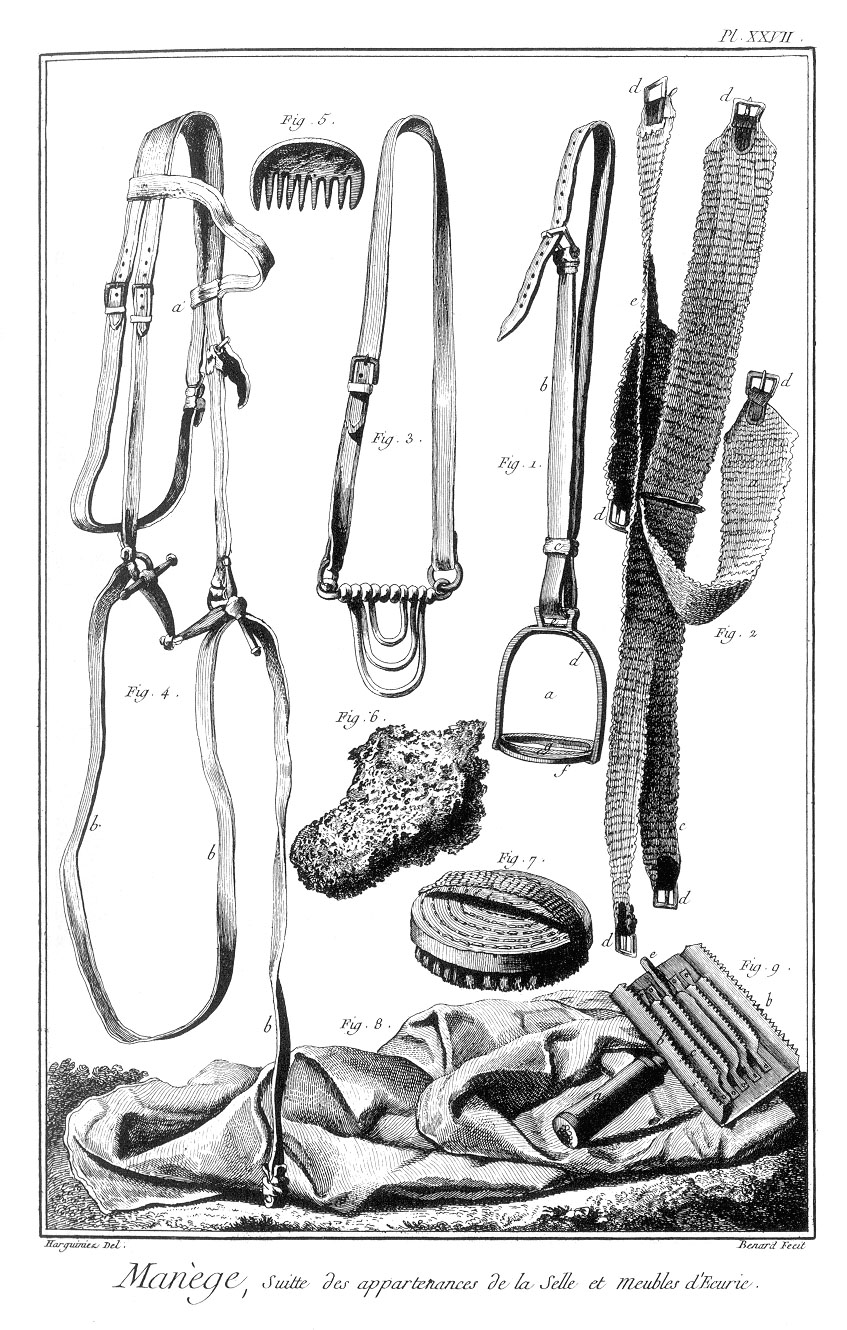
    As mentioned above, snaffle bridles were the most common good purchased in regard to horses. Snaffle bridles differed from other bridles, such as the half-curb, because of the type of bit used. Bits are metal pieces that go into a horse’s mouth and rest between the front cropping teeth and the back grinding teeth.

    Fig. 4 is an example of an 18th century snaffle bit. Fig. 7 is a curry comb. From the Encyclopedia of Diderot and d’Alembert, Natural Gait Plate XXVII: Riding, Parts of the Saddle, Continued, and Stable Equipment,
    http://hdl.handle.net/2027/spo.did2222.0001.564

    Snaffle bits in particular are very easy on a horse’s sensitive mouth, and even today are the most common bits used by equestrians.[9] Because of their high occurrence in the pages, it is easier to detect a price pattern. Of the 16 snaffle bridles purchased, six of them sold for 3 shillings 9 pence, three of them for 4 shillings 6 pence, and the rest ranged from 4 shillings 3 pence to 1 shilling 10 pence in price.[10] The frequency of these purchases further shows the widespread ownership of horses.

    Another important factor in keeping horses is that they need to be groomed. Grooming is done using a certain kind of brush called a curry comb. Though there are only three incidences of curry combs being bought from Henderson’s store, all for 3 shillings 6 pence, Henderson ordered “1 doz. Curry Combs & brushes” on three separate occasions from 1759-1760 from his employer.[11] This is another example of how many people must have owned horses, despite their cost, because Henderson likely would not have ordered more than he had thought he could sell.

    Overall, horses were expensive to keep in the eighteenth century, much as they always have been. Though the account pages do not list many occurrences of horse feed, the other expenses add up. While horses were likely used for work, such as to plow fields and transport goods to market, most of the evidence shows that people rode their horses, whether for business, pleasure, or sport. Indeed, aside from one’s own two feet, horses were the main form of transportation of the time. It makes sense that people would invest such a large amount of money in their transportation—not unlike today with our cars.


    [1] Ross MacPhee and Sandra Olsen, “Wealth and Status” and related subsections, AMNH, accessed April 19, 2017, http://www.amnh.org/exhibitions/horse/how-we-shaped-horses-how-horses-shaped-us/wealth-and-status.

    [2] Mary R. M Goodwin, Wheeled Carriages in Eighteenth-Century Virginia (Williamsburg, Va.: Colonial Williamsburg Foundation Library, 1959), http://research.history.org/DigitalLibrary/View/index.cfm?doc=ResearchReports%5CRR0181.xml#p1.

    [3] Alexander Henderson, et. al. Ledger 1760-1761, Colchester, Virginia folio 4 Debit and Credit, 20, 22, 23, 25, 40, 41, 43, 44, 46, 48, 51, 61, 67, 88, 90, 111, 116, 129, 131, 136, 141, 147, 148, 156, 161 Debit from the John Glassford and Company Records, Manuscript Division, Library of Congress, Washington, D.C., Microfilm Reel 58 (owned by the Mount Vernon Ladies’ Association).

    [4] Henderson, et. al. Ledger 1760-1761 folio 4 Debit and Credit.

    [5] Edith Moore Sprouse, “Commercial Activities,” in Colchester: Port on the Potomac, (Fairfax, Va: Fairfax County Office of Comprehensive Planning, 1975), 45.

    [6] Henderson, et. al. Ledger 1760-1761 folio 4 Debit and Credit.

    [7] Ibid., folio 141 Debit.

    [8] Ibid., folio 20 Debit.

    [9] Katherine Blocksdorf, “How Snaffle Bits Work – Horse Equipment,” The Spruce, accessed March 23, 2017, https://www.thespruce.com/how-snaffle-bits-work-1886099.

    [10] Henderson, et. al. Ledger 1760-1761 folio 22, 23, 40, 41, 46, 48, 51, 90, 111, 116, 129, 147, 148, 156 Debit.

    [11] Ibid., folio 51, 61, 67 Debit; Charles Hamrick and Virginia Hamrick, Virginia Merchants: Alexander Henderson, Factor of John Glassford at his Colchester Store, Fairfax County, Virginia, His Letter Book of 1758-1765, (Athens, Georgia: Iberian Publishing Co, 1999), 13.