Tag: Clothing

  • A Mile in the Shoes of the Atlantic World: Calamanco Shoes

    A Mile in the Shoes of the Atlantic World: Calamanco Shoes

    Danielle Roper // AMH 4112.001 – The Atlantic World, 1400-1900

    Calamanco shoes were a women’s shoe in the 18th century that were often purchased and worn by members of the upper class. Calamanco is a glossy woolen cloth that is checkered on one side. Lower class women’s shoes would be made of a more durable leather, whereas upper class women’s shoes were made of materials like silk, satin, or calamanco. They were less sturdy than those shoes made of leather and would not be able to withstand a significant amount of rigorous activity. This would make sense given that upper class women would be more likely to afford servants to do their house work for them. Women of the lower class needed shoes that could withstand the many household chores they had to accomplish.[1]

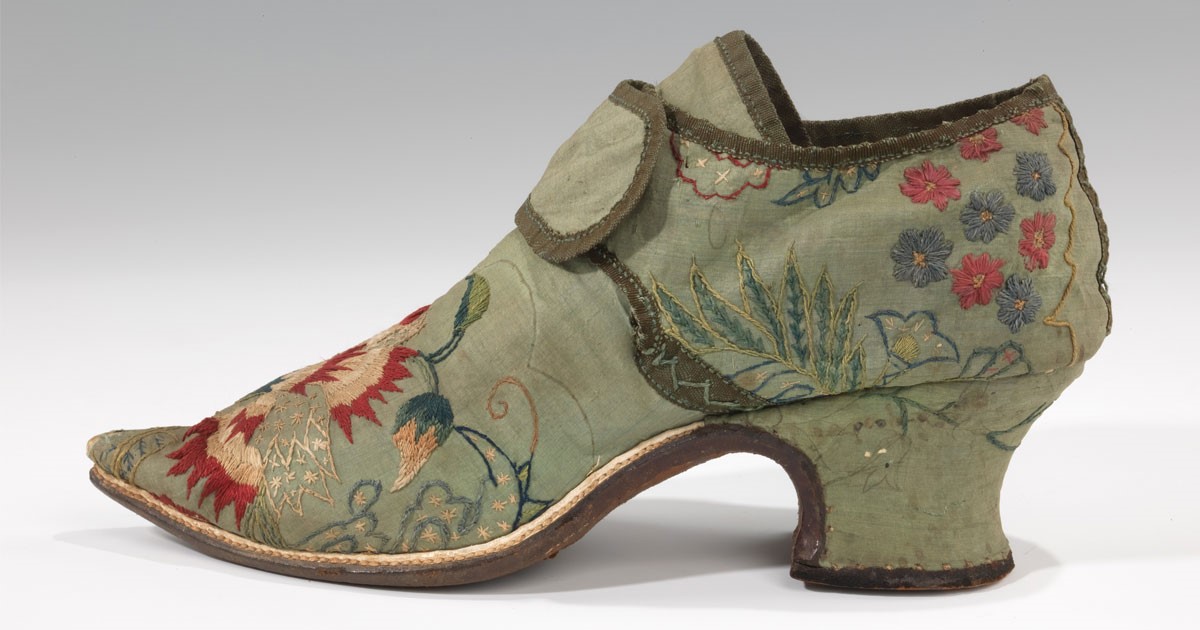
    Women’s 18th Century Calamanco Shoes. Image from 18th-Century Notebook.

    Shoe sizing in the eighteenth century was less precise and consistent so many of the wealthy would send sketches of their feet to special order their shoes.[2] Buckles were often purchased alongside these Calamanco shoes and would be used as a symbol of one’s status and wealth.[3] This can be seen in the ready money accounts of Glassford and Henderson’s Colchester store (1760-1761), when Mrs. Jean Turley purchased one pair of Calamanco shoes along with two pairs of buckles, ribbon, and stays.[4] These purchases could possibly reflect that Mrs. Turley was planning to attend some sort of social event, perhaps a ball.  Looking through the shoe purchases in the Ready Money accounts, Calamanco shoes were rarely bought with cash, only being purchased four times.[5] However, regular women’s shoes were purchased twenty-two times.  Mrs. Turley paid only four shillings and four pence for her pair of Calamanco shoes; however, the price in the Ready Money accounts was nearly double that at seven shillings and six pence (with one pair being as much as eight shillings). A ‘woman’s shoe’ in the Ready Money account was valued around five shillings and six shillings. Rather than indicating the luxurious nature of the calamanco shoe, this trend may demonstrate the fact that shoes were simply just generally expensive during colonial times, especially when paid for with cash.

    On May 2, 1761, Mrs. Jean Turley purchased “1 Pr. Callamanco Shoes” from Glassford and Henderson’s Colchester, Virginia store. (folio 131).

    Infographic on Calamanco Shoes

    [1]   Linda Baumgarten. Eighteenth-Century Clothing at Williamsburg. (Williamsburg, Va: Colonial Williamsburg Foundation, 1986).; Giorgio Riello and Peter McNeil. “Walking the Streets of London and Paris: Shoes in the Enlightenment” in Shoes: a History from Sandals to Sneakers. Edited by Peter McNeil and Giorgio Riello. (Oxford ; New York :Berg, 2006).

    [2] Ibid.

    [3] Ibid.

    [4] Alexander Henderson, et. al.  Ledger 1760-1761, Colchester, Virginia folio 131 Debit, from the John Glassford and Company Records, Manuscript Division, Library of Congress, Washington, D.C., Microfilm Reel 58 (owned by the Mount Vernon Ladies’ Association).

    [5] Henderson, et. al., Folio 10-13 Debit/Credit.

  • The Longest Living Fashion Statement: The Women’s Pump

    The Longest Living Fashion Statement: The Women’s Pump

    Vincent Ventola // AMH 4112.001 – The Atlantic World, 1400-1900

    In the past, women as well as men and children wore pumps, or shoes; these pumps are very similar to what we know as pumps or heels in the 21st century.[1]  In the 18th century, pumps were also worn during special occasions, just like they are today. However, they were crafted in a different manner than today.  They used materials such as silk, glass, and metal.[2] Where as today it is mostly out of leather and modern materials. When looking at the Metropolitan Museum of Art’s shoe collections, you find many different variations of shoes produced during the 18th century.[3]  Floral patterns, as well as very colorful patterns, were very common for women of this period. Some pumps had a buckle as well as some with rhinestones, to show wealth and class.  Pumps were worn in very social settings, so mostly women that could afford shoes for form over functionality were the main ones wearing pumps in the 18th century.

    Women’s Silk Pumps from the mid-1700s. Image from the Metropolitan Museum of Art.

    You aren’t able to tell much what the pumps looked like from Glassford and Henderson’s Colchester store’s 1760-1761 Ready Money ledgers.[4]  Because the pumps were sold at a store, they were unlikely to be made-to-order shoes, but more likely represented the most current fashions from Glasgow or London.  According to the Ready Money accounts in November, 1760, only five pairs of pumps (described a as single or double channeled or boys) were bought. On one occasion buckles were also purchased which may have been acquired to complement the pumps.[5]  In November 1760, only four additional pairs of shoes were purchased in the same month, all of which were less expensive than the pumps.

    Examples of Pump purchases in the November 1760 Ready Money Pages of the Colchester store of Glassford and Henderson (folio 10).

    Women, just like today, loved wearing heels to show off to others.  They obviously wanted the most decorated and classiest pump for their special event.  Pumps were basic fashion for women in the 18th century and it correlates to the women of today.  There was a sense of fashion back then, especially since their pumps were handmade.

    Infographic on Pumps

    [1]Elisabeth McClellan. “Women’s Dress 1700-1800.” Historic Dress in America 1607-1800. N.p.: GeorgeW. Jacobs, 1904. pp. 391.

    [2] The Metropolitan Museum of Art, Shoes, 1760-79, Accession Number: 11.60.198a, b, http://www.metmuseum.org/art/collection/search/98056 (Accessed 5 December 2016).

    [3] Ibid.

    [4]Alexander Henderson, et. al.  Ledger 1760-1761, Colchester, Virginia Folio 10-13 Debit/Credit, from the John Glassford and Company Records, Manuscript Division, Library of Congress, Washington, D.C., Microfilm Reel 58 (owned by the Mount Vernon Ladies’ Association).

    [5] Henderson, et. al.  Ledger 1760-1761, Colchester, Virginia Folio 10 Debit/Credit.

  • Imitation Scottish Linen

    Imitation Scottish Linen

    James Wilson // AMH 4112.001 – The Atlantic World, 1400-1900

    After looking through the Ready Money account (1760-1761) of Glassford and Henderson’s Colchester store in Virginia, there were a few items that stuck out to me because I had no idea what they were. One of which was Osnaburg, having never heard of this, I decided to look more into it what it was because I saw it being purchased quite a few times in September, 1761.[1] What was the item? What was it used for?

    Osnaburg was purchased many times in September 1761 at the Colchester store of Glassford and Henderson (folio 13).

    These questions were much easier to find answers to than I thought they were going to be. Osnaburg was a form of linen that was particularly coarse that was originally made in Osnabrück, Germany, which is where the name is derived. Osnaburg was used for quite a few things from napkins, to upholstery, to clothing.[2] The fabric doesn’t seem to have been a luxury item because it was used to make clothing for everyone, including slaves. In a 1761 slave advertisement from the Virginia Gazette, a runaway slave named Joe had been captured and was being held in the public jail in Williamsburg, Virginia, his only clothing described as ‘a ragged Oznabrigs Shirt’.[3]

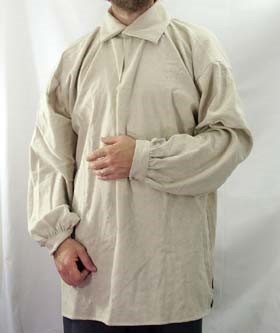
    An example of an 18th-century Osnaburg man’s work shirt. Image courtesy of Jas Townsend & Son, Inc.

    Something of interest that I found was the probability of where this linen came was made. Osnaburg was originally imported to England from Osnabrück, Germany. By the 1730s, Scotland, which was attempting to become a larger economic power and trader in her own right, started to craft their own version of Osnaburg fabric.[4] The Edinburgh Linen Copartnery even sent one of their executives to Germany to learn how to properly make authentic Osnaburg, which the people particularly wanted.[5] Given the wars in Germany from 1756-1763, which caused their exports to go down, Scotland became the better choice for many nations to buy their fabrics from.[6]

    This revitalization of the economy paid off, after all was said and done, with the work done by the many of the fabric companies, Scotland provided millions of yards of linen that was exported to England and other parts of Europe. This piece of linen that was bought in a small shop was actually a piece of economic revival for Scotland based off of copying a form of linen created by a town in Germany.


    Infographic on Osnaburg

    [1]Alexander Henderson, et. al.  Ledger 1760-1761, Colchester, Virginia Folio 13 Debit, from the John Glassford and Company Records, Manuscript Division, Library of Congress, Washington, D.C., Microfilm Reel 58 (owned by the Mount Vernon Ladies’ Association).

    [2] C. E. Davis. “Inventory of Col. Bridger’s Estate.” The William and Mary Quarterly 22, no. 2 (1942): 186-87. http://www.jstor.org/stable/1925299; Alastair Durie. “Imitation in Scottish Eighteenth-Century Textiles: The Drive to Establish the Manufacture of Osnaburg Linen.” Journal of Design History 6, no. 2 (1993): 71-76. http://www.jstor.org/stable/1315959.

    [3] James Galt. “Runaway Announcement.” Virginia Gazette (Hunter), Williamsburg, January 16, 1761.  http://www2.vcdh.virginia.edu/gos/search/relatedAd.php?adFile=rg61.xml&adId=v1761010146, Accessed December 5, 2016.

    [4] Durie, Alastair. “Imitation in Scottish Eighteenth-Century Textiles: The Drive to Establish the Manufacture of Osnaburg Linen.” Journal of Design History 6, no. 2 (1993): 71-76. http://www.jstor.org/stable/1315959.

    [5] Ibid.

    [6] Ibid.

  • Shalloon Useful and Unknown

    Shalloon Useful and Unknown

    Christian C.deBaca // AMH 4112.001 – The Atlantic World, 1400-1900

    Shalloon, a fun name to come across when learning about life in colonial Virginia, but what is it?
    As found in the Glassford & Henderson 1760-1761 ledger at the Colchester, Virginia store on January 16, 1761, Humphrey Peake purchased 9 yards of Shalloon along with various other fabrics, buttons, and thread.[1] Based on the associated items and its unit price, one could assume that Shalloon was a type of cloth.

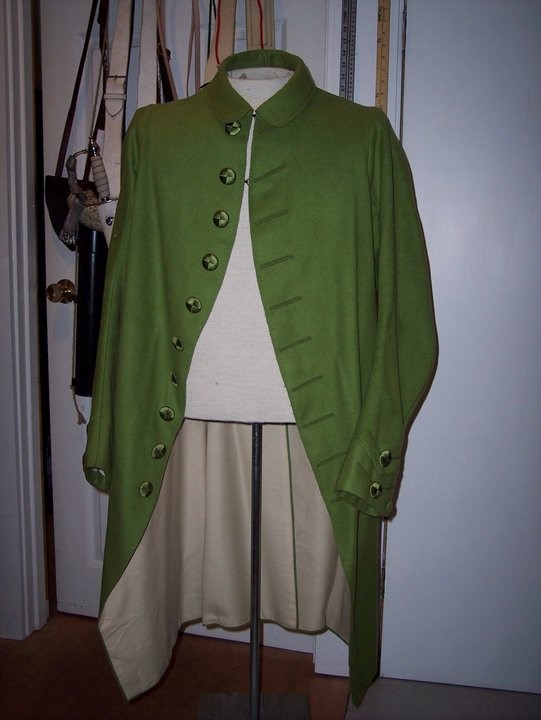
    Civilian coat reconstructed by Joel Bohy. Coat of Golsing Green Superfine body and Buff Superfine Shalloon lining. Image courtesy of Historical Textiles (Kochan and Philips Historical Textiles, England).

    What type of cloth was shalloon?  Did it have a specific function?  Who were the general consumers of it? Shalloon was a common fabric in the 18th century that was a thin twill, made of worsted wool, and primarily used for the lining of coats. When considering that it was used for the lining of coats, it comes as no surprise that it was not a common purchase, unless you were crafting your own clothing or needed to replace the lining of your existing coat. The author J. H. Clapham states that Shalloon was a fabric that was worn “by the lower classes of females” but it was also widely used in coats of all demographics including military uniforms.[2] Since Shalloon was not thought of highly, it was affordable, while still not the cheapest fabrics. At the same time, shalloon was known for its versatility and relative ease in dyeing, making it a fashionable choice of cloth for everyone. Not only was shalloon used for clothing, it was also sometimes used in blankets and things like curtains or for the drapery around beds.

    As found in the ready money account and personal accounts in the ledger, shalloon was sold as a raw material typically bought in small quantities along with other clothing related items.  In the Ready Money accounts, of the seven purchases of shalloon, the length of fabric purchased ranged from ½ yard to 5 ½ yards.  It is possible that by comparison, Humphry Peake may have been a tailor, given his purchase was for 9 yards of shalloon. The sale of shalloon seemed to peak during the winter months when production and need for coat linings would have been at its highest.

    Shalloon was a cloth common because it could be used relatively cheaply to line coats.  With that being said, shalloon was not as commonly purchased as other fabrics, such as linen.

    Shalloon was not a cloth that was often exclusively used to make clothing. It stayed relevant for the colonial period due to its multiple uses for home décor and its ability to be dyed easily for custom work.

    Shalloon purchased by Humphry Peake in January 1761 at the Colchester store of Glassford and Henderson (folio 97).

    Infographic on Shalloon

    [1] Alexander Henderson, et. al.  Ledger 1760-1761, Colchester, Virginia folio 97 Debit, from the John Glassford and Company Records, Manuscript Division, Library of Congress, Washington, D.C., Microfilm Reel 61 (owned by the Mount Vernon Ladies’ Association).

    [2] J.H. Clapham. “The Transference of the Worsted Industry from Norfolk to the West Riding.” The Economic Journal 20, no. 78 (1910): 199. doi:10.2307/2220916.