Joseph Lolli // AMH 4110.0M01 – Colonial America, 1607-1763
When looking at any documents from the past, you must understand that the words used in their time may mean something completely different than they mean today. Depending on how far back you go, you will also have to become patient with simple things like spelling because there may not be a standardized way of writing a word, and it can be spelled many different ways by the same person, even in the same sentence. While transcribing the Colchester, Virginia store ledger (1760-1761), many entries stumped me in terms of context, until I noticed a pattern in items purchased concerning fabric goods.
Richard Henderson bought two types of shalloon at the Colchester store from 1760-1761 (folio 042D)
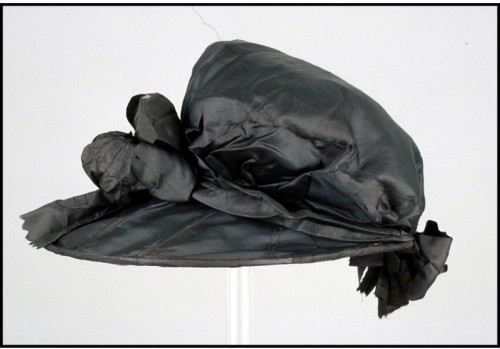
Traditional, well-known fabrics like denim, jean, linen, muslin, satin, silk, and velvet were used. Items that caused confusion due to mixed definitions were alamode, bearskin, drill, holland, and shalloon.[1] Alamode is today used to refer to ice cream with pie, though its origin is the French saying a la mode meaning “in the fashion of.” To the craftsman of the eighteenth century, it was a lightweight silk fabric used for scarves and hoods.[2] Bearskin was not literally referred to as the skin of a bear, but instead it was a thick, woolen cloth often provided to slaves as outerwear.[3] Drill is not an electronic power tool used in construction; drill in the accounts was a strong, twilled cotton often used for summer clothing.[4] Ask most people what holland is and they will tell you it is a country. Ask the shopkeeper in Colchester, and you will be supplied with a linen fabric which got its name from where it was made.[5] Something like shalloon would sound foreign to the average American, though it was a very common, cheap, wool cloth used for lining clothing and pockets.[6]
Mrs. Elizabeth Fallen purchased “striped holland” in January 1761 at the Colchester store (folio 042D).Black alamode woman’s hat, ca. 1770-1780—Colonial Williamsburg Foundation., Acc. No. 1993-335.
If you take a good look through the Glassford and Henderson ledger from the mid-eighteenth century, you’ll find that the usual fabrics from today and the more unusually titled fabrics explained here were bought in similar volumes and similar frequency. When you find something shocking, strange, or at odds with your modern perspective during research of an era past, fear not. There is likely a very simple explanation when you look into the context and add a little more digging into your research.
[1] Alexander Henderson, et. al. Ledger 1760-1761, Colchester, Virginia folio 52, 59, 158 Debit, from the John Glassford and Company Records, Manuscript Division, Library of Congress, Washington, D.C., Microfilm Reel 58 (owned by the Mount Vernon Ladies’ Association).
[2]Dictionary.com, “Alamode,” accessed March 23, 2017, http://www.dictionary.com/browse/alamode.
[3] Gaye Wilson, “Slave Clothing,” Thomas Jefferson’s Monticello, accessed March 23, 2017, https://www.monticello.org/site/plantation-and-slavery/slave-clothing.
[4]Dictionary.com, “Drill,” accessed March 23, 2017, http://www.dictionary.com/browse/drill.
[5] Linda Baumgarten, “Looking at Eighteenth-Century Clothing,” Colonial Williamsburg Online Resources, accessed March 23, 2017, http://www.history.org/history/clothing/intro/clothing.cfm.
[6] Peter Earle, Making of the English Middle Class: Business, Society, and Family Life in London (London: Methuen, 1991), 288.
Sarah Green // AMH 4110.0M01 – Colonial America, 1607-1763
For most, silks are a fabric associated with the finer things. Silk is a rich, luxury fabric by today’s standards but what about in eighteenth-century America? Silk was as favored back then as it is now.
While examining ledger pages from the Glassford and Henderson Colchester store (1760-1761) in Fairfax County, Virginia, silk is mentioned more than once. People bought silk in many different forms.[1] Silk garters, for example, were used to hold up stockings and to prevent them from rolling down. As garters were essentially the eighteenth-century version of suspenders, both men and women used them.
Alexander Henderson’s account showing several purchases of silk in various different forms (Folio 8 Debit).
Cultivated for thousands of years, silk commonly came from China, Italy, and France. The English wanted to rival the French and Italians in the production of silk, but the damp and cold English climate was not agreeable with its production. In 1603, King James sent silkworm eggs and mulberry seeds to America.[2] However, silk was produced inconsistently until the middle of the 1700s and by then, the American colonies were far better at producing cash crop like tobacco.
Woman’s dress of lustring (taffeta) silk that was originally crafted in the 1750s and remade in the 1770s, courtesy of the Colonial Williamsburg Foundation, Acc. No. 1975-340,2.
Trading, for the American colonies, was rather constricted and controlled by the English crown limiting access to open trading. When it came to trading with America, goods had to pass through England as part of the Navigation Act of 1651.[3] The act put more control on the British handlings of domestic goods, placing a restraint on colonial trading and decreasing demand for imported goods; the Act of 1651 also stated that goods were required to be carried in British vessels.[4] While homespun fabrics produced in the colonies were an alternative to buying imported fabrics and textiles, silk remained a popular purchased fabric in America even with the importation restrictions.
Man’s coat possibly of lustring (silk taffeta), courtesy of the Colonial Williamsburg Foundation, Acc. No. 1970-155.
Because silk is a lightweight and breathable fabric, it provides comfort to its wearers during the hot summer months in Virginia. Wealthy white women liked to keep cool as much as possible, so they chose to dress in a silken fabric called lustring.[5] Silk was worn in many forms, year round, and not just by women, but by men too. Fabrics made of silk for men’s clothing were often a mix of fibers such as with wool to create alapeen or hairbine which was made with worsted.
While more accessible today than in the eighteenth century, silk was a statement of wealth back then, a way of feeling important as well as being functional. There were many forms to buy silk that added to fashion as well as function. Silk is a timeless fabric that has been sought after for not just for a hundred years, but thousands, and is still popular today.
[1] Alexander Henderson, et. al. Ledger 1760-1761, Colchester, Virginia folio 8 Debit, from the John Glassford and Company Records, Manuscript Division, Library of Congress, Washington, D.C., Microfilm Reel 58 (owned by the Mount Vernon Ladies’ Association).
[2] David Landry, “History of Silk,” Mansfield Historical Society, accessed April 19, 2017, http://www.mansfieldct-history.org/history-of-silk-production/.
[3] Carmen Miner Smith,”Navigation Acts (1651, 1660),” Encyclopedia of North Carolina, accessed April 18, 2017, http://www.ncpedia.org/navigation-acts-1651-1660.
[5] Linda Baumgarten, “Looking at Eighteenth-Century Clothing,” Colonial Williamsburg, accessed April 14, 2017,
https://www.history.org/history/clothing/intro/clothing.cfm.
The eighteenth century was truly a time of cultural melding in the colonies. People from various parts of Europe with aspirations for a better life came to Virginia, largely because of its flourishing economy. For immigrants, Virginia offered refuge from religious persecution, poverty, and social oppression. Shopkeeper Alexander Henderson operating the John Glassford & Company store in Colchester, Virginia, was an example of a colonist who came to America seeking more opportunities.
When analyzing Henderson’s shop ledger for 1760-1761, I was initially thrown off by the various units of measurements found in the accounts.[1] Certain units such as inches, yards, and pounds sounded familiar while other words such as ells, fathoms, and hundredweights required a fast search into the project’s glossary for clarification. I soon learned that a hundredweight (abbreviated cwt) is a unit of weight, a fathom is a measurement of length described as outstretched arms, and an ell was also used for length, typically in Scotland and England, gauged by the length of a forearm.[2] I began pondering how Henderson was able to keep track of all of these different units of measurement. In order to be successful in his line of work, he must have learned to be patient and adaptive to numerous cultures and find ways to get around language and social barriers that come with dealing with lots of people from various backgrounds. To succeed in business, he must have had to do a lot of improvising in terms of consolidating fair trade prices to reflect the various units of measurement depending on the item sold. The more I pondered these scenarios, the more I realized that the various units of measurement are synonymous with the colonists themselves.
A customer at the Colchester store purchased ells of roles and best osnaburg, two types of fabric (folio 131D).Another customer purchased rope by the fathom at the Colchester store (folio 131D).
The United States Customary Unit system’s origin is similar to the British Imperial system. Both systems trace their roots back to Roman and Anglo-Saxon units of measure.[3] As I reviewed the accounts, I found that the most common type of length measurements used in the ledger were inches, yards, and fathoms. What’s interesting about these types of measurements is that they are all units based on anatomy and dimensions of the human body. According to Russ Rowlett, a professor from the University of North Carolina at Chapel Hill, “the inch represents the width of the thumb, [and] in many languages the word for inch is also the word for thumb.”[4]
Da Vinci’s Vitruvian Man poses as an example of various anatomy-based measurements: light blue for fathom, dark blue for yard or half-fathom, and purple for ell. Original image from LeonardoDaVinci.net.
The foot is often thought of as being the length of a human foot, and the fathom as previously stated is a person’s wingspan. The yard can also be interpreted as being the total distance from the end of the middle finger of an outstretched hand to the nose, or half of a fathom.
What this says about the eighteenth century is that because of the lack of similar backgrounds and common education, units of measurement that relied on anatomy were easier to use than those dependent on math, numbers, or previous knowledge. This idea predates the eighteenth century, but was revisited as a means to find commonality to overcome language barriers.
Although there wasn’t an official decree in terms of a unit of measurement in the United States until the Metric Conversion Act of 1975 by President Ford, a need for a practical system of measurements was certainly a priority for shopkeepers such as Alexander Henderson in eighteenth-century colonial Virginia.[5] The adaption of colonial shopkeepers to numerous cultures as seen in the ledger proves that, while everyone has different origins, money and goods are a universal necessity.
[1] Alexander Henderson, et. al. Ledger 1760-1761, Colchester, Virginia folio 131 Debit, from the John Glassford and Company Records, Manuscript Division, Library of Congress, Washington, D.C., Microfilm Reel 58 (owned by the Mount Vernon Ladies’ Association).
[2] History Revealed, Inc., Glassford and Henderson Transcription Glossary, unpublished.
[3] Russ Rowlett, Dr, How Many? A Dictionary of Units of Measurement (New York, NY: University of North Carolina Chapel Hill, 1999).
We can gain some insight into the economic priorities of those living in colonial Virginia from an account ledger from John Glassford and Alexander Henderson’s Colchester store in Fairfax County dating back to 1760-1761 which contained an accounting record for the overseer, Jeremiah Thomas, of Colonel Thomas Lee’s farm.[1] At first glance, these purchases seem to be a part of the typical shopping experience with a customer buying clothing materials and household goods. It is not until after further research that we can uncover more specific usage and purpose in Thomas’ purchases of these goods. This account gives a record of the items purchased by Thomas and may shed light on the societal purpose for some of his choices.
Jeremiah Thomas’ account in the Glassford and Henderson ledgers, showing the variety of his purchases (Folio 51D).
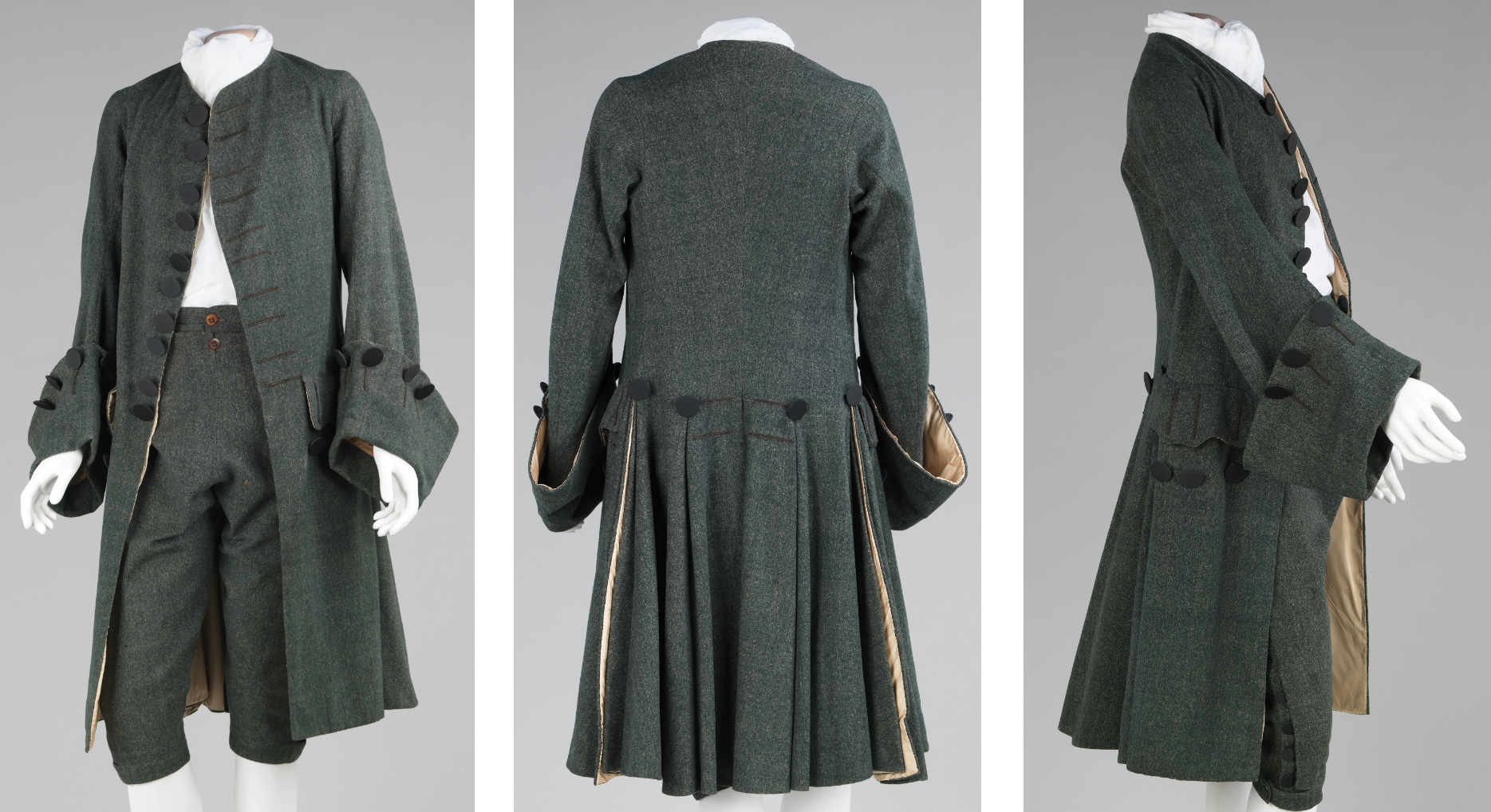
Thomas’ transactions show that various textiles were purchased with supplies such as buttons, thread, and lace with the likelihood of making clothes. The materials Thomas purchased imply he was a man concerned with his appearance and status within society. He purchased coat straps, silk handkerchiefs, and combs—things intended to keep up his appearance of wealth, even as an overseer of another man’s land. Appearances played a vital role in colonial Virginian society. This was especially the case because colonists often tried to emulate the current fashions and trends of England.[2] Mr. Thomas’s largest line items were for women’s shoes, stockings, blue wool, and an assortment of buttons. He spends significantly less on home goods like nails, salt, and sugar. Clearly, if one were trying to make it in society, one needed to make a serious commitment to budgeting for his wardrobe.
There is another aspect of Virginian life that is revealed by the textiles purchased by Jeremiah Thomas: climate. In order to pursue wealth through agriculture, Virginia colonists were willing to go through extreme temperatures throughout the year. Mr. Thomas’s purchases reflect these extremes of hot and cold. He purchased expensive cotton for its breathability in warm climates. He also purchased dufill, which is a heavy wool, frequently used in making heavy coats.[3] It is worth noting that even while Jeremiah Thomas was being practical when purchasing cotton and dufill fabrics, he purchased the “best Cotton” and a rather expensive “Blue Dufill.”[4] It seems as though his public presentation still maintained priority no matter the weather.
A wool and silk coat, ca. 1755-1765, made in England. Colonists often copied fashions of the homeland. Images courtesy of the Brooklyn Museum Costume Collection at The Metropolitan Museum of Art, Gift of the Brooklyn Museum, 2009; H. Randolph Lever Fund, 1968. 2009.300.916a, b.
Reading a ledger at first seems like a meaningless glimpse into someone’s finances. However, we can gain a deeper understanding of who Jeremiah Thomas was. He was clearly a man that chose to spend a large portion of his spending money on fashion and appearance. This shows that he pursued a social life in front of other colonists. This familiar aspect of staying up to date with the newest European trends is common to both eighteenth-century Virginia and twenty-first-century America.
[1] Alexander Henderson, et. al. Ledger 1760-1761, Colchester, Virginia folio 51 Debit, from the John Glassford and Company Records, Manuscript Division, Library of Congress, Washington, D.C., Microfilm Reel 58 (owned by the Mount Vernon Ladies’ Association).
[2] Linda Baumgarten, “Looking at Eighteenth-Century Clothing,” Colonial Williamsburg, accessed May 3, 2018, http://www.history.org/history/clothing/intro/clothing.cfm?showSite=mobile-regular.
[3] Oxford English Dictionary, “duffel, n. and adj,” OED Online, accessed May 3, 2018,
http://www.oed.com.ezproxy.net.ucf.edu/view/Entry58272?redirectedFrom=duffel#eid.
Jennifer Markowitz // AMH 4110.0M01– Colonial America, 1607-1763
Examples of 18th century snaffle bridles. From the Encyclopedia of Diderot and d’Alembert, Natural Gait Plate XXVI: Riding, Various Instruments Used to Train Horses, Continued, http://hdl.handle.net/2027/spo.did2222.0001.564
Bridles, a device still used on horses today, played a huge role even in colonial times. Horses were the fastest source of land transportation during colonial times, which meant that bridles were extremely important to help control and direct the horse. Essentially, everyone who owned a horse had to have a bridle, so it was a uniting factor and a common good to identify in the accounts of the Glassford and Henderson Colchester store (1760-1761) in Fairfax County, Virginia. One type of bridle sold was a snaffle bridle, which is a bridle with a bit “consisting of two bars joined at the center, as by a joint.”[1] Typically, a snaffle bridle is a more gentle and general bridle, able to be used on all types of horses.
Another item sold was a man’s saddle and bridle, rather than a bridle alone. Similarly, a woman’s saddle and bridle were also for sale; like the men’s saddle and bridle, it was simply sold as a set rather than separately.
One really interesting factor was seeing who purchased the bridles. James Hardage Lane bought both a man’s saddle with curb bridle (October 2, 1760) and a woman’s saddle, including a slip cover of blue cloth and a bridle (May 19, 1761). Purchasing a woman’s saddle shows that he likely had a woman as part of his household who rode horses – perhaps a wife, a sister, or a daughter.[2]
James Hardage Lane bought both a man’s and a woman’s saddle from the Colchester store in 1760-1761 (folio 020D).
One other factor I noticed in the accounts, which I found very interesting, was the fact that the bridles were often purchased by men.[3] Even bridles that were intended to be used by women and sold with women’s saddles were sold primarily to men. Sadly, no account showed a pattern regarding the occupations of the men, but it can be assumed that the men buying saddles had some wealth as they owned a horse.
Overall, the bridle was an interesting item that we can use to look at the people who purchased it. The snaffle bridle was the most common to be sold, although it was common to sell it with a saddle as well.
[1]American Heritage Dictionary of the English Language, “Snaffle Bridle,” accessed March 23, 2017, https://www.thefreedictionary.com/snaffle+bridle.
[2] Alexander Henderson, et. al. Ledger 1760-1761, Colchester, Virginia folio 20 Debit, from the John Glassford and Company Records, Manuscript Division, Library of Congress, Washington, D.C., Microfilm Reel 58 (owned by the Mount Vernon Ladies’ Association).
Throughout much of their domesticated history, horses have been considered expensive animals to own. Many societies considered the animal as a mark of status.[1] That was true even in British colonial America. Not native to the American continent, horses were introduced by Europeans who ventured across the ocean. In the early years of the colonies, horses were a visible manifestation of wealth, but by the first half of the 1700s, they had become commonplace and most people owned at least one horse.[2] By the 1760s, horses were likely a normal sight across the countryside. Based on the 1760-1761 ledger for the Glassford and Henderson store ledger for Colchester, Virginia, the number of people purchasing various pieces of horse tack attests to the size of the local equine population. However, even with a large number of the population owning horses, feeding and working them continued to be an expensive venture.
Bay quarter horse, a common type of horse in Virginia. From kcbarquarterhorses.com.
Shoes, feed, saddles, bridles, curry combs: all of these things made at least a handful of appearances in Alexander Henderson’s 1760-1761 account ledger, bought by 30 different individuals over some 161 pages of transactions.[3] Henderson himself was the caretaker of at least four different horses: a gray, a black, a roan, and a bay.[4] He spent £70 on the horses themselves and an additional £18 on feed for them from October 1760 to December 1761 alone.[5] He paid for shoeing the horses on a regular basis, usually every two to three months. The shoes protected the horses’ hooves from painful stones. In addition, Henderson also paid for horse feed—mostly hay and oats, but none of the other account holders seem to have paid for feed through the Colchester store.[6] Perhaps this was because they all either worked on or owned land where their horses could freely graze.
Land was important, because land meant wealth, which meant you would be better able to care for at least one horse, sometimes more. Though the most common equine item bought from Henderson’s store was the snaffle bridle, the most expensive was the “Womans Saddle with Slip Cover of Blue Cloth” at £8.[7] (Buying a bridle at the same time added another 10 shillings to the cost.) When compared with the next most expensive item—the men’s saddles at about one to two pounds—it becomes apparent that the women’s saddles were one of two things: a luxury good, or simply more costly to make. Given the time period and the social views on horses at the time, the latter seems more likely. This becomes even more evident when reviewing James Hardage Lane’s account as he purchased both a men’s and a woman’s saddle in the space of five months.[8]
Saddles sold to James Hardage Lane at the Glassford and Henderson Colchester Store (folio 20).
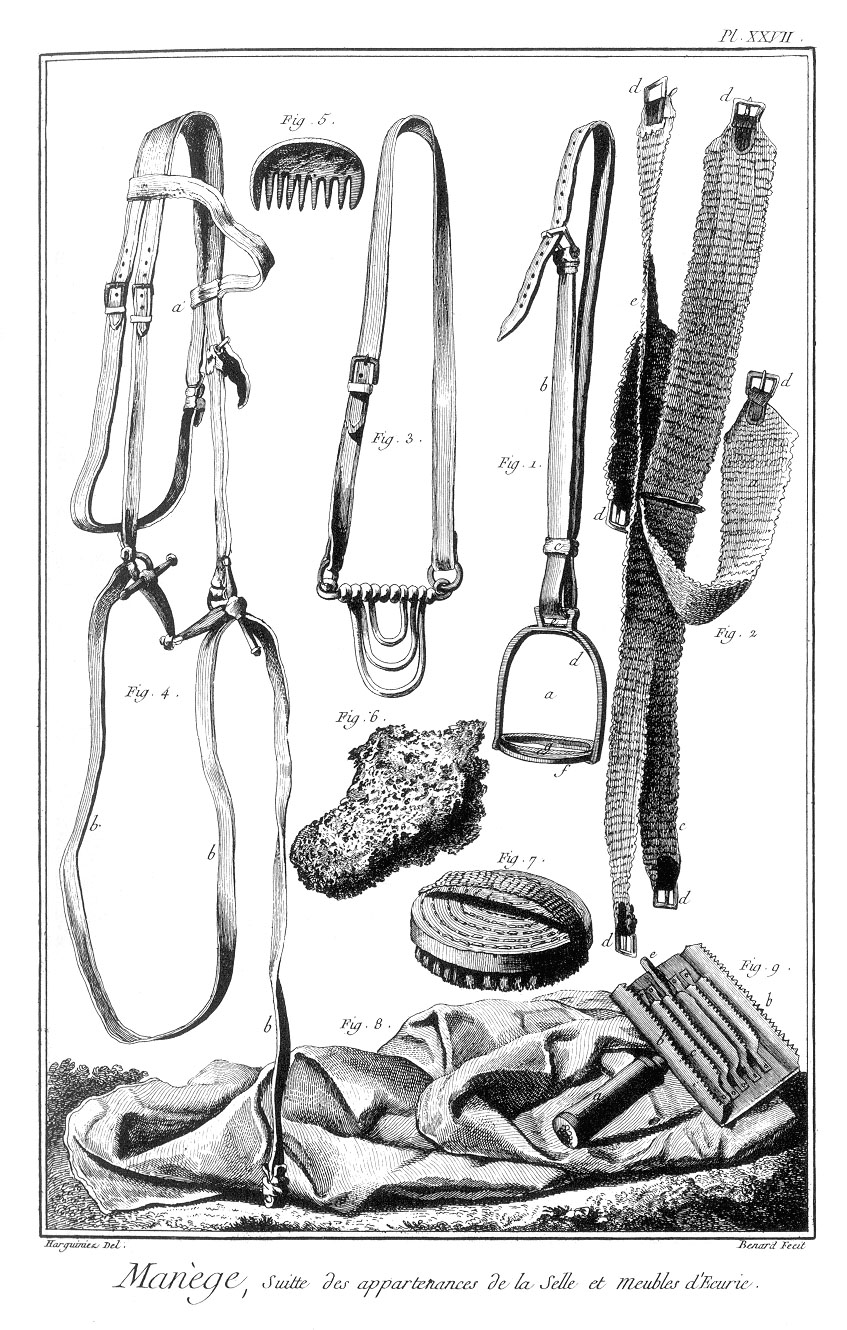
As mentioned above, snaffle bridles were the most common good purchased in regard to horses. Snaffle bridles differed from other bridles, such as the half-curb, because of the type of bit used. Bits are metal pieces that go into a horse’s mouth and rest between the front cropping teeth and the back grinding teeth.
Fig. 4 is an example of an 18th century snaffle bit. Fig. 7 is a curry comb. From the Encyclopedia of Diderot and d’Alembert, Natural Gait Plate XXVII: Riding, Parts of the Saddle, Continued, and Stable Equipment, http://hdl.handle.net/2027/spo.did2222.0001.564
Snaffle bits in particular are very easy on a horse’s sensitive mouth, and even today are the most common bits used by equestrians.[9] Because of their high occurrence in the pages, it is easier to detect a price pattern. Of the 16 snaffle bridles purchased, six of them sold for 3 shillings 9 pence, three of them for 4 shillings 6 pence, and the rest ranged from 4 shillings 3 pence to 1 shilling 10 pence in price.[10] The frequency of these purchases further shows the widespread ownership of horses.
Another important factor in keeping horses is that they need to be groomed. Grooming is done using a certain kind of brush called a curry comb. Though there are only three incidences of curry combs being bought from Henderson’s store, all for 3 shillings 6 pence, Henderson ordered “1 doz. Curry Combs & brushes” on three separate occasions from 1759-1760 from his employer.[11] This is another example of how many people must have owned horses, despite their cost, because Henderson likely would not have ordered more than he had thought he could sell.
Overall, horses were expensive to keep in the eighteenth century, much as they always have been. Though the account pages do not list many occurrences of horse feed, the other expenses add up. While horses were likely used for work, such as to plow fields and transport goods to market, most of the evidence shows that people rode their horses, whether for business, pleasure, or sport. Indeed, aside from one’s own two feet, horses were the main form of transportation of the time. It makes sense that people would invest such a large amount of money in their transportation—not unlike today with our cars.
[1] Ross MacPhee and Sandra Olsen, “Wealth and Status” and related subsections, AMNH, accessed April 19, 2017, http://www.amnh.org/exhibitions/horse/how-we-shaped-horses-how-horses-shaped-us/wealth-and-status.
[2] Mary R. M Goodwin, Wheeled Carriages in Eighteenth-Century Virginia (Williamsburg, Va.: Colonial Williamsburg Foundation Library, 1959), http://research.history.org/DigitalLibrary/View/index.cfm?doc=ResearchReports%5CRR0181.xml#p1.
[3] Alexander Henderson, et. al. Ledger 1760-1761, Colchester, Virginia folio 4 Debit and Credit, 20, 22, 23, 25, 40, 41, 43, 44, 46, 48, 51, 61, 67, 88, 90, 111, 116, 129, 131, 136, 141, 147, 148, 156, 161 Debit from the John Glassford and Company Records, Manuscript Division, Library of Congress, Washington, D.C., Microfilm Reel 58 (owned by the Mount Vernon Ladies’ Association).
[5] Edith Moore Sprouse, “Commercial Activities,” in Colchester: Port on the Potomac, (Fairfax, Va: Fairfax County Office of Comprehensive Planning, 1975), 45.
[11] Ibid., folio 51, 61, 67 Debit; Charles Hamrick and Virginia Hamrick, Virginia Merchants: Alexander Henderson, Factor of John Glassford at his Colchester Store, Fairfax County, Virginia, His Letter Book of 1758-1765, (Athens, Georgia: Iberian Publishing Co, 1999), 13.
Nowadays, we say that money doesn’t grow on trees. In colonial Virginia it didn’t grow on trees either, but it did grow on gold-green shrubs. As can be seen in the Glassford and Henderson accounts, clients to the Colchester store (1760-1761) overwhelmingly used tobacco to purchase
their goods and services, far more so than cash. In fact, it has been estimated that by the time of the American Revolution, a full two-thirds of the population of the Tidewater and Piedmont regions of Virginia grew tobacco, even after a move to grow more wheat.[1] The people of colonial Virginia, both in the Tidewater and Piedmont regions, were literally growing their own money. So pervasive was the use of tobacco as currency that one observer in 1740 stated that “they have not the least occasion for paper money.”[2]
A depiction of the enslaved preparing a hogshead of tobacco. From The New York Public Library, UUID: fb320ec0-c600-012f-ed2b-58d385a7bc34.
Today we pay for goods and services with cash, but don’t really pay any attention to how exactly that cash is minted or printed. So, how did they grow their money? First things first, it was a very labor intensive process requiring many workers, usually enslaved, at very specific times throughout the growing season. The first step was to germinate the plants in small seedbeds until the plants were big and strong enough to transplant into the fields. Before the tobacco plants could be planted, field hands had to build earthen mounds about a foot or two high and approximately three to four feet apart. This task was the most time consuming and labor intensive since the mounds often required being rebuilt several times throughout the season. After ensuring that the seedlings wouldn’t be choked by weeds, the growing plants would have to be “primed,” meaning the lowest hanging leaves were removed to improve overall tobacco quality. Tobacco had to be constantly monitored for pests and disease, as it is highly susceptible; field hands went out daily to check for tobacco worms.[3]
Assuming the tobacco survived all of these growing challenges, the harvesting season usually occurred in late summer during the dog-days of August and September. The problem was that each individual plant would be ready at a different time, meaning hands had to go out to the fields many times and gather up all the plants ready for harvest. However, if they waited too long, an early frost might kill whatever plants were left in the field. After the plant was cut, it was taken to a barn or similar place and hung up to be “cured.” In the very early days, the farmers would simply leave the tobacco on the ground and cover it with hay or straw, but they quickly learned that hanging the leaves was far more effective. The process of curing took about a month to complete, assuming that it was done properly and mold didn’t damage any of the tobacco. It was then “prized,” or put into large casks called hogsheads. A hogshead’s weight varied slightly but was officially 1000 pounds of tobacco.[4] It is at this point that the tobacco would have been inspected and a tobacco note issued. This note would have been given to Henderson, or one of his employees, for store credit.
Benoni Halley’s credit account, which he used to pay his debts with four hogsheads of tobacco (folio 023C).
These hogsheads of tobacco were what were used as currency in just about any store in the colonial Chesapeake region. The credit pages of Glassford and Henderson’s ledgers abound with information on the various weights of the hogsheads. For example, a customer of the Colchester store, Benoni Halley, paid the store a total of 4 hogsheads for purchases in the store – that’s roughly 2 tons of tobacco![5] Henderson gave him a little over £22 sterling worth of credit.[6] To put this into perspective, the annual income of American colonists was £15.6, which means that Mr. Halley would have been able to live quite comfortably off of his tobacco for that year.[7] With his credit, Mr. Halley was able to buy goods ranging from cloth to rum to gunpowder.[8] It is safe to say that people throughout the colonial Chesapeake were growing their own money.
Benoni Halley used his four hogsheads of tobacco to purchase various goods, such as different fabrics, alcohol, and gunpowder, as well as items such as women’s shoes, combs, and bridles (folio 023D).
[1] Drew A. Swanson, A Golden Weed: Tobacco and Environment in the Piedmont South (New Haven: Yale University Press, 2014), 20.
[2] William Keith, “A Discourse on the Medium of Commerce,” in Collection of Papers and Other Tracts, Written Ocasionally on Various Subjects: To Which Is Prefixed,
by Way of Preface, an Essay on the Nature of a Publick Spirit (London: Printed by and for J. Mechell, 1740), 209,
http://galenet.galegroup.com.ezproxy.net.ucf.edu/servlet/Sabin?dd=0&locID=orla57816&d1-
SABCP01767900&srchtp=b&c=19&df=f&d2=1&docNum=CY3802082052&b0=tobacco+planting&h2=1&vrsn=1.0&b
1=0X&db=Title+Page&d6=1&ste=10&stp=DateAscend&d4=0.33&n=10&d5=d6.
[3] “Tobacco: Colonial Cultivation Methods,” National Park Service Historic Jamestown, last modified unknown, accessed March 20, 2017, https://www.nps.gov/jame/learn/historyculture/tobacco-colonial-cultivation-methods.htm.
[4] National Park Service, “Tobacco: Colonial Cultivation Methods.”
[5] Alexander Henderson, et. al. Ledger 1760-1761, Colchester, Virginia folio 23 Credit, from the John Glassford and Company Records, Manuscript Division, Library of Congress, Washington D.C., Microfilm Reel 58 (owned by the Mount Vernon Ladies’ Association).
In the mid-eighteenth century, several stores in Fairfax County, Virginia, were owned by two men, John Glassford and Alexander Henderson. Their store ledgers contain vast amounts of information about their customers, their credit, and the goods they bought. One interesting case within the ledger for the Colchester store (1760-1761) was Benjamin Hawkins, who purchased rum frequently from October 13, 1760, to June 8, 1761.[1] His purchases were a product of the changing economic environment that occurred around this period.
For colonists in the Chesapeake, alcohol was an important part of life. Colonists consumed alcohol at every meal, during church, at social gatherings, and on numerous other occasions.[2] Early in the eighteenth century, colonists acquired alcohol through producing it at their household or buying it from planters and taverns.[3] By the mid-eighteenth century, the colonial economy expanded as a result of its connection to Britain and the rest of its empire.[4] Goods, such as alcohol, became cheaper and diverse. Colonists could purchase new variants of alcohol that were impossible or hard to create in the colonies.
One of these was rum. A great source of rum came from Scottish traders.[5] Previously, Scottish traders could not operate in the colonies because Britain limited colonial trade through the Navigation Acts of 1663.[6] The Navigation Acts forced colonists, among other things, to export profitable goods, such as tobacco and sugar, only to Britain.[7] In 1707, England and Scotland united, allowing Scottish traders to sell their goods in the colonies. In fact, this uniting provided John Glassford, who was Scottish, to become so successful in the Chesapeake through his numerous stores. Rum became increasingly popular with the lower classes with many of the lower classes enjoying rum for its fortitude in the hot Chesapeake climate and its cheap price. Rum, along with other alcohols, also lessened servants’ dependence on planters for drink.[8]
As mentioned earlier, the majority of Hawkins’ purchases were rum. His account shows that he purchased rum every couple of days through the month of November 1760. Hawkins mostly purchased rum one quart at a time, but there was an exception on November 4, 1760. On that day, Hawkins purchased a gallon of rum. The gallon of rum, according to the credit side of the account, was paid for in cash, although not in its entirety as the rum cost 6 shillings and Hawkins only provided the store 5. Hawkins returned the next day and purchased only “1/4 [one quart] Rum.”[9]
Benjamin Hawkins’s purchases at the Colchester store, 1760-1761, folio 43D. Alcohol purchases are underlined.
In all, he purchased seven gallons and two quarts of rum between October 13, 1760, and March 13, 1761. In addition to rum, Hawkins purchased brandy on several occasions (January 10, January 17, and February 5, 1761), a bridle (October 13, 1760), silk stockings (April 15, 1761), and a tin canister (June 8, 1761). The tin canister was the last purchase he made at the Colchester store in 1761.[10]
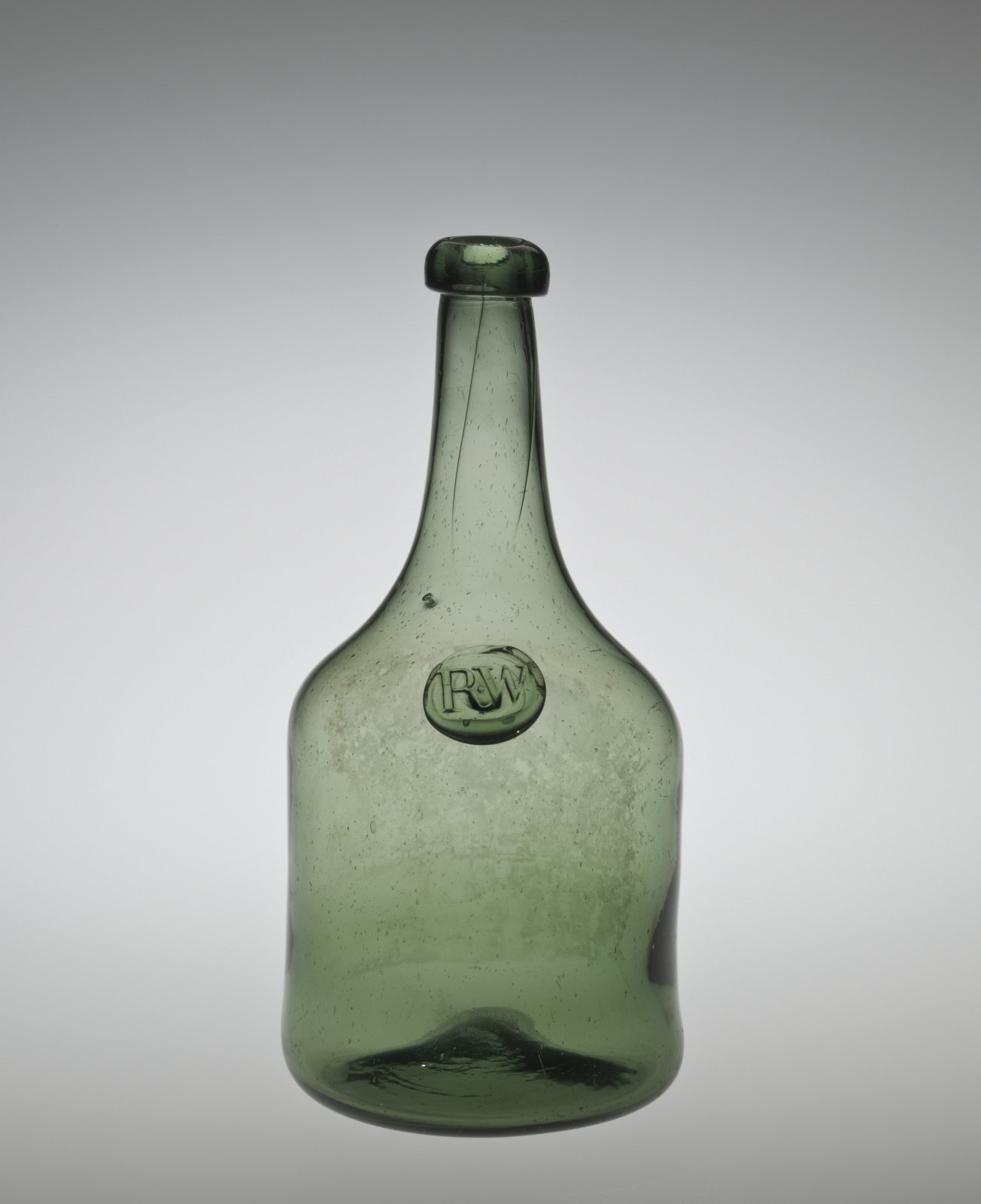
An example of what might have been a rum bottle, made by Richard Wistar between 1745-55. Image from the Corning Museum of Glass, Acc. No. 86.4.196.
An interesting element that came up during research was Hawkins’s involvement in several court cases. It seems that Hawkins legally quarreled with a man named Hugh Guttray. Hawkins was a defendant in an injunction case in opposition to Guttray.[11] An injunction is a court order that a person is either allowed or not allowed to do something. He was also involved as a plaintiff in a chancery suit.[12] A chancery suit entails a matter of equity, such as a dispute over land or individual status.[13] These court cases occurred after the period when Hawkins purchased his rum from Glassford and Henderson’s store, but were the disputes a reason for Hawkins’s drinking? It is difficult to tell whether his drinking was exacerbated by the court cases. After a hiatus in his account, it resumed in January 1765. Now living in Augusta, Virginia, Hawkins had to pay court fees to Prince William County (adjacent to Fairfax County). On the credit side, it showed that the payment was moved “By Ballance to Liber F,” which meant Hawkins accrued the fees as a debt. Hawkins did not buy alcohol during this period.[14]
Benjamin Hawkins’ constant purchase of rum illustrates the changes that occurred in the colonial economy. Rum, and other accessible goods, became affordable to the colonists. His constant purchases of rum would have been inconceivable several decades earlier. The colonial economy was going through a “consumer revolution,” which facilitated the purchase of diverse goods at cheaper prices.[15]
[1] Alexander Henderson, et. al. Ledger 1760-1761, Colchester, Virginia folio 43 Debit, from the John Glassford and
Company Records, Manuscript Division, Library of Congress, Washington, D.C., Microfilm Reel 58 (owned by the
Mount Vernon Ladies’ Association).
[2] Sarah H. Meacham, Early America: History, Context, Culture : Every Home a Distillery : Alcohol, Gender, and
Technology in the Colonial Chesapeake, (Baltimore: John Hopkins University Press, 2009), 6.
[11]Fairfax Court Order Book 1756, page 572, March 18, 1761, Fairfax Circuit Court Historic Records Center,
Fairfax, Va.
[12]Fairfax Court Order Book 1756, page 596, June 16, 1761, Fairfax Circuit Court Historic Records Center, Fairfax,
Va.
[13] Fairfax County, Virginia, “Historic Records Finding Aids,” accessed April 19, 2017, http://www.fairfaxcounty.gov/courts/circuit/historical-records-finding-aids.htm
[14] Alexander Henderson, et. al. Ledger 1765, Colchester, Virginia folio 38 Debit, from the John Glassford and
Company Records, Manuscript Division, Library of Congress, Washington, D.C., Microfilm Reel 59 (owned by the
Mount Vernon Ladies’ Association).
When one thinks of the world of the eighteenth century, especially related to trade and commerce, one may think of small stores with raw goods, the sale of tobacco, or gold and silver coins being scooped up by a store merchant. What one might not consider when first recalling such a time is other types of currency that circulated throughout the British colonies during the 1700s. British sterling (pounds, shillings, and pence) were, of course, prominent in the colonies but they were not the only type of currency available. Spanish pistoles, silver dollars, commodity goods, and currency from individual colonies were also distributed throughout the British colonies during the seventeenth and eighteenth centuries.
In the seventeenth and eighteenth centuries, Britain’s American colonies were thriving. However, that did not mean that there was a surplus of British sterling for them to use. When Britain founded the colonies in North America, the economic belief of mercantilism produced the idea that the colonies were there to create a surplus of goods for the mother country, not to drain the precious metal from the homeland.[1] While the British system of monetary units—such as pound, shilling, and pence—continued in the North American colonies, there was a deficit of British sterling in any of the colonies.[2] Because of this deficit, the colonies turned to other types of monetary units to use for payment.
One type of money the colonies used was foreign coins. Some examples were Spanish pistoles and silver dollars. Most of these coins were imported from the Spanish colonies of Mexico and Peru.[3] Their worth compared to British sterling fluctuated quite a bit throughout the colonies and over time. However, just like several other types of colonial currency (such as the individual paper currency of each colony) they remained less valuable than British sterling.[4] Unfortunately, the age-old problem endured. There were not enough precious metals to go around. This was due to the philosophy of mercantilism—the belief that a country should accumulate and hold as much money (precious metal) as possible.[5] As a result of this philosophy, precious metals were not as readily available in colonies belonging to any country.[6]
Another way colonists traded with each other was commodity goods. These were items such as tobacco or various animal skins that could be used within the colonies as currency.[7] Due to the unwieldy nature of commodity goods, the colonies devised another form of exchange: paper currency uniquely created by each colony.
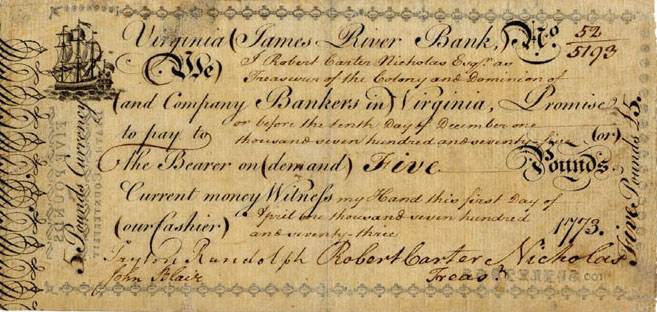
The first paper currency printed in the colonies was in December 1690. The Massachusetts Bay Colony needed to pay for military expenses from King William’s War but did not have the money to do so. Finding this to be successful, Massachusetts created legislation that would be the start of paper currency in that colony.[8] Other colonies followed suit throughout the eighteenth century, with Virginia being one of the last and most reluctant to do so in 1755.[9] The primary reason Virginia started printing money is because of the economic demands of the French and Indian War.[10] This type of exchange became prominent in all economies of the British colonies, although this locally printed paper currency was still considered less valuable than British sterling. In 1748, Virginia’s local currency had an exchange rate with British sterling of 10 to 1.[11] Here, you can see an image of a Virginian 5 pound James River Bank currency note issued in 1773.[12]
An example of Virginia currency from 1773. Image courtesy of the American Revolution Museum at Yorktown.
As the paper currency of the colonies became more widespread, it started showing up in store ledgers. The Colchester store in Virginia belonging to John Glassford and managed by Alexander Henderson was one such store where paper currency became very prominent. Merchandise was sold to customers in both Virginia currency and British sterling; customers paid for their merchandise with both forms of money, as well as commodity goods like tobacco. Below, a folio from the Colchester ledger (1760-1761) shows a client paying for all his purchases from November 1760 to March 1761 in Virginia paper currency.[13] British sterling was not included in any of his transactions. While there are many purchases in the ledger that were made in British sterling, it is obvious from this image that local currency was important to trade.
Customer paying with cash at the Colchester store November 1760-March 1761 (folio 043C).
Printed currency was an important form of payment in the British colonies. It kept trade thriving without the need of coins and allowed colonies to pay their debts and stay afloat. Of course, the colonies’ ability to create new money whenever needed was dangerous as it led to inflation, especially in times of war.[14] However, the benefits outweighed the risks as the colonies found a way to overcome the deficit of precious metals in North America. Paper currency became vital to the survival of America until the British colonies became the United States.
[1] Louis Jordan, “The Value of Money in Colonial America,” Colonial Currency, last edited February 1, 1998,
accessed March 21, 2017, https://coins.nd.edu/ColCurrency/CurrencyIntros/IntroValue.html.
[4] Ron Michener, “Money in the American Colonies,” EH.net Encyclopedia, last modified January 13, 2011, accessed March 23, 2017, https://eh.net/encyclopedia/money-in-the-american-colonies/.
[5]Encyclopedia Britannica Online, “Mercantilism,” accessed April 18, 2017, https://www.britannica.com/topic/mercantilism.
[6]Encyclopedia Britannica Online, “Mercantilism.”
[8] Louis Jordan, “The First Printed Currency – 1690,” Colonial Currency, last edited February 1, 1998, accessed March 23, 2017, https://coins.nd.edu/ColCurrency/CurrencyIntros/IntroEarliest.html.
[9] Thomas E. Davidson, “Colonial Paper Money,” American Revolution Museum at Yorktown Galleries, accessed April 20, 2017, https://www.historyisfun.org/exhibitions/collections-and-exhibitions/yorktown-victory-center-
galleries/colonial-paper-money/.
[10] Omohundro Institute of Early American History and Culture, “Paper Money in Colonial Virginia,” The William and Mary Quarterly 20, no. 4 (April 1912): 228.
[11] Omohundro Institute, “Paper Money in Colonial Virginia,” 252.
[13] Alexander Henderson, et. al. Ledger 1760-1761, Colchester, Virginia folio 43 Credit, from the John Glassford and Company Records, Manuscript Division, Library of Congress, Washington, D.C., Microfilm Reel 58 (owned by the Mount Vernon Ladies’ Association).
[14] Roger W. Weiss, “The Issue of Paper Money in the American Colonies, 1720-1774,” Journal of Economic History 30, no. 4 (December 1970): 772.
Joseph Swiderski // AMH 4110.0M01—Colonial America, 1607-1763
In colonial America, tobacco was one of the most influential crops in cultivation. Colonies like Virginia profited heavily from its agricultural success. The successful cultivation of tobacco began when John Rolfe planted South American tobacco seeds called Nicotiana tobacum in 1612. From there, “tobacco production spread from the Tidewater area to the Blue Ridge Mountains, especially dominating the agriculture of the Chesapeake region.”[1] It became such a huge commodity that the Virginia House of Burgesses made it a requirement for tobacco to be inspected, and directed the construction of warehouses and port towns where tobacco would be brought by planters.[2] As tobacco became more valuable, its uses expanded from smoking to use as currency. It was used for just about anything: purchasing indentured servants and slaves to cultivate the crop, paying taxes, or purchasing manufactured goods and items from the local store.[3]
Tobacco plants hung to dry. Image courtesy of VirginiaPlaces.org under CC3.0.
What really caught my attention was something much more interesting than the tobacco itself. While transcribing ledgers from the Colchester store accounts (1760-1761) of John Glassford and Alexander Henderson, I noticed that not all of the people paying their accounts were doing so with their own tobacco, but tobacco from other people. This intrigued me because obviously people that grew tobacco could use it as currency, but how did a random man use someone else’s tobacco as a form of currency to pay their account? The answer was that tobacco itself became a source of social currency as well as money. It became a way of paying off your accounts and a way of paying others, who then purchased items at the store using someone else’s tobacco as payment.
A payment by Daniel Laughlin to his account at the Colchester store (1760-1761) using a crop note from Joseph Stephens (folio 045C).
The picture above is an example of account credits from the Colchester store (1760-1761) of Glassford and Henderson. This account belonged to a man named Daniel Laughlin. On July 31, 1761, Laughlin credited a crop note for 1 hogshead (a barrel) of tobacco from the Pohick warehouse to pay for his account.[4] He used tobacco as payment so that he could purchase items from the store. What I found interesting was the interesting mark indicating the tobacco’s “ownership” or tobacco mark: a capitalized I, a superscripted S, and a capitalized A. It reads ISA, which was a tobacco mark that represented not Daniel Laughlin but Joseph Stephens. Tobacco marks most frequently matched the initials of the owner (in this case it would be DL which was identified as Laughlin’s mark in 1759).[5] This ledger shows that Daniel Laughlin credited the Colchester store 1 hogshead of Joseph Stephens’ tobacco; in September, 1761, Stephens paid his account with an additional hogshead of tobacco.[6]
A 1751 map cartouche depicting the inspection and shipping of tobacco hogsheads. From the Library of Congress, Geography and Map Division, LCCN 74693166.
I found no immediate relationship between these men in the ledger other than that Laughlin used Stephens’ tobacco to buy goods that he needed. As a local landowner, Stephens may have hired Laughlin for some service and paid him in tobacco. Regardless, Laughlin profited by nine pounds, 19 shillings on the transaction enabling him to purchase many different fabrics from the Colchester store: cotton, bearskin, osnaburg, roles, linen, striped Holland, German serge, shalloon, sheeting, ferrit, check, and buckram.[7]
Purchases made by Daniel Laughlin at the Colchester store from 1760-1761 (folio 045D).
Through my research I learned a lot about what eighteenth century life was like. Tobacco opened up a new world of possibilities for American colonists, and it widened the range of its uses as time passed. People not only used their own tobacco as currency, but they used that of others as well. They exchanged tobacco for goods or paid other people with the crop, who then used it as currency in the local economy for whatever they needed. Although I do not know the specific relationship between these two men, they were connected through tobacco. Tobacco brought them together in a way that was beyond currency. It went from being a cash crop to a social crop. It brought individuals, families, and communities together. In my opinion, tobacco was not only the most valuable crop monetarily, but also culturally. Tobacco became its own culture and that is what had an effect on me while doing my research. I was inspired by how this leafy green and relatively ugly looking plant took over the colonial economy and also impacted people’s lives.
Growing tobacco plants. Image under CC0.
[1] Emily Jones Salmon and John Salmon, “Tobacco in Colonial Virginia,” Encyclopedia Virginia, accessed March 23, 2017, https://www.encyclopediavirginia.org/Tobacco_in_Colonial_Virginia.
[2] William Waller Hening, ed., The Statues at Large; Being a Collection of All the Laws of Virginia from the First Session of the Legislature in the Year 1619 (Richmond: Franklin Press, 1820), Vol. 4, Ch. III, 247-271, accessed May 21, 2018,
http://vagenweb.org/hening/vol04-13.htm.
[3] Salmon and Salmon, “Tobacco in Colonial Virginia.”
[4] Alexander Henderson, et. al. Ledger 1760-1761, Colchester, Virginia folio 45 Credit, from the John Glassford and Company Records, Manuscript Division, Library of Congress, Washington, D.C., Microfilm Reel 58 (owned by the Mount Vernon Ladies’ Association).
[5] Beth Anderson Mitchell, “Colonial Virginia Business Records as a Genealogical Resource,” National Genealogical Society Quarterly 62, no. 4 (December 1974): 261.