Author: Devin Wiebelt

  • Osnaburg: A Sign of Wealth?

    Osnaburg: A Sign of Wealth?

    Jason Bernstein // AMH 4110.0M01 – Colonial America, 1607-1763

    Whenever we look back on the colonial period of American history, we always look to the relationships amongst the Native Americans, the colonial economy, and the events leading up to the American Revolution. But there are several aspects that go under the radar, such as diet, climate, and family life. One aspect of family life is how the family dressed themselves. And that’s where recognizing one of the period’s  mainstay fabrics come in. Osnaburg, a common fabric during the 1600 and 1700s, found its way into the colonies through trade imports where it was utilized in many forms. I will focus on the creation of this fabric, its uses, and its representation of colonial wealth during the eighteenth century.

    Osnaburg originated in Germany before being exported to England and later, her colonies. Woven from flax and hemp, it naturally looked brown due to weavers not bleaching it during its fabrication.[1] Eventually, Scotland began weaving this cloth to compete with other markets, and saw much  exportation to the colonies.[2]

    Osnaburg, a rough-textured cloth, was also very durable. As such, it was used for food sacks, and other assorted bags to transfer objects. However, its primary use was in clothing, particularly for slaves on plantations.[3] As an example in 1705, the Virginian government consolidated the different laws regarding slaves and indentured servants. Among them, one law stated that slaves had to be clothed, with no  other clarifications or restrictions about the clothes, “That all masters and owners of servants, shall find and provide for their servants wholesome and competent diet, clothing, and lodging…”[4] This led many slave owners to provision their enslaved with clothing that was readily available, as well as both time and cost effective. In addition to its availability and affordability, osnaburg fabric for enslaved clothing was favored for its simple construction and hardiness.[5]

    James Edwards’s account showing repeated purchases of osnaburg at the Colchester store in 1760-1761 (folio 19D).

    The amounts of osnaburg fabric purchased depended on the wealth of the consumer, and that can give us an idea of its intended use. For example, let’s examine the ledger account for James Edwards, a customer of Glassford and Henderson’s store in Colchester, Virginia, from 1760-1761. Over eleven months, he purchased thirty-one yards of osnaburg, with the cost of each purchase averaging one shilling per yard; he also purchased fourteen yards of the best osnaburg available for a total of sixteen shillings and four pence.[6]

    Another modern representation of an osnaburg work shirt. Image from Jas Townsend and Son, Inc.

    A modern recreation of what an osnaburg shirt might have looked like. Image from Jas Townsend and Son, Inc.

    What could these amounts of osnaburg been used for? We can create an idea, by looking at the rest of his purchases. Metal and glass buttons, thread, nails, and pins point to clothing fabrication.[7] Five and a half yards of the fabric would make two pairs of men’s pants, while two and a half yards would make one woman’s petticoat. Osnaburg could also have been used to make work shirts. (Other fabrics, such as cotton, shirting, and linsey would have been used to make shirts as well, along with dresses and slips.)[8] The osnaburg could also have been used as a bag for nails (you wouldn’t want a flimsy bag holding them). We know that osnaburg was inexpensive and capable of withstanding harsh and prolonged working conditions.[9] From the amount Edwards bought over the span of one year and the amount of tobacco Edwards paid for goods (two hogsheads totaling over 2000 pounds of tobacco), it’s possible that he was a slave-owner.[10] The purchases he made and how much he bought reflect his wealth, which we can understand through the purchase of a simple fabric.

    As we look back on osnaburg—a pretty simple fabric that has survived into the modern age, although made with more modern methods—shows how much the past affects us today. The creation, use, and purchasing of this cloth have given us a small insight into the wealth, culture, and production methods of the 18th century.


    [1] Katherine Egner Gruber, “Slave Clothing and Adornment in Virginia,” Encyclopedia Virginia, last modified February 4, 2016, accessed April 12, 2017,
    http://www.EncyclopediaVirginia.org/Slave_Clothing_and_Adornment_in_Virginia.

    [2] Alastair Durie, “Imitation in Scottish Eighteenth-Century Textiles: The Drive to Establish the Manufacture of Osnaburg Linen,” Journal of Design History 6, no. 2 (January 1993): 71.

    [3] Gruber, “Slave Clothing.”

    [4] William Waller Hening, ed., The Statutes at Large; Being a Collection of All the Laws of Virginia from the First Session of the Legislature, in the Year 1619 (Philadelphia: R. & W. & G. Bartow, 1823), 3:448, accessed April 10, 2018, http://vagenweb.org/hening/vol03-25.htm.

    [5] Gruber, “Slave Clothing.”

    [6] Alexander Henderson, et. al. Ledger 1760-1761, Colchester, Virginia folio 19 Debit, from the John Glassford and Company Records, Manuscript Division, Library of Congress, Washington, D.C., Microfilm Reel 58 (owned by the Mount Vernon Ladies’ Association).

    [7] Henderson, et. al. Ledger 1760-1761 folio 19 Debit.

    [8] Michael Wayne, “Slavery,” in Death of an Overseer: Reopening a Murder Investigation from the Plantation South (New York: Oxford University Press, 2001), 81, eBook Collection EBSCOhost, accessed April 12, 2018.

    [9] Gruber, “Slave Clothing.”

    [10] Henderson, et. al. Ledger 1760-1761 folio 19 Debit.
  • Sugar, Consumerism, and the Parallels between American and English Consumerism

    Sugar, Consumerism, and the Parallels between American and English Consumerism

    John Lancaster // AMH 4110.0M01 – Colonial America, 1607-1763

    Though largely grown in the West Indies, sugar became an important good for both colonial Americans and British subjects across the Atlantic. Though Virginians like Alexander Henderson—who owned a general store in Colchester—understood their climate was unsuitable for growing sugar at the same rates the West Indies could, they increasingly enjoyed the sweet addition to their diets much like the English.[1] The British writer David Hume even reflected this idea when, in 1762, he wrote, “America has sent us many good things, Gold, Silver, Sugar, Tobacco…” His words suggest a beneficial relationship between America and its mother country—a relationship heavily built around the profitable product of sugar.[2] Sugar proved to be  significantly important to the British, as evidenced by Hume placing it on the same list as gold, silver, and tobacco.

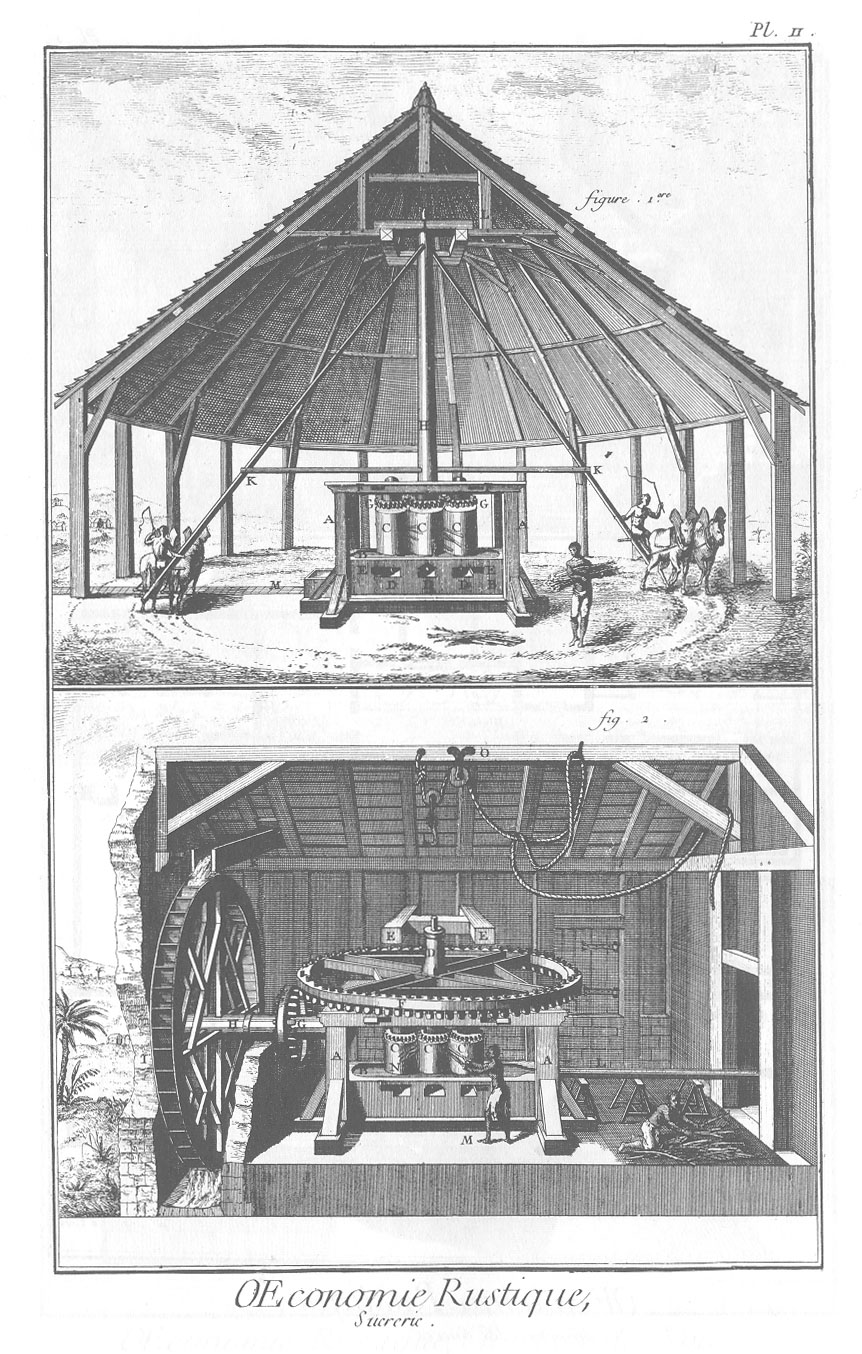
    From the Encyclopedia of Diderot and d’Alembert, Agriculture and rural economy – Sugar plantation and refining Plate II: Sugar Plantation, http://hdl.handle.net/2027/spo.did2222.0001.344.

    The West Indies first began profiting from the production of sugar in the 1640s, but it proved to be strenuous, difficult work which had to be done quickly so the sugarcane would not spoil.[3] The need for strength and speed in sugarcane production led to the introduction of slaves to the islands, whose population rose dramatically to outnumber the white population by 1660. Because of the increase in both the slave and white populations, sugar production skyrocketed through the second half of the seventeenth century so profoundly that the English West Indies produced an estimated 25,000 tons of sugar in 1700—more than the Portuguese and Dutch combined.[4] The increase in sugar production coincided with a decrease in price and with rising standards of living.[5] Because of this affordability, people of varying economic statuses could afford to buy sugar, both in the colonies and in England. The newfound accessibility to sugar had profound impacts on both British and American diets.

    A 1765 tea set with a sugar bowl (top right), which might be similar to what was used in Virginia during the time William Branaugh lived there. From the Colonial Williamsburg Collections, Acc. No. 2005-202,3.

    In 1761, for example, two pounds of sugar sold at Alexander Henderson’s store in Colchester, Virginia, for only one shilling six pence. By comparison, one quart of rum may have cost as little as one shilling three pence. This affordability allowed William Bronaugh, a frequent patron to Henderson’s store, to buy over fifteen pounds of sugar between late January and early April 1761.[6] While affordable, the bulk of sugar bought in such a short amount of time hints at the massive amounts of the sweet substance sent to both the mainland colonies and Britain through the eighteenth century. Before sugarcane grown in the West Indies could be sold to the mainland colonists, it needed to be sent to England for refinement.[7] This additional step further created bonds between the growing consumerist attitudes on either side of the Atlantic, as both places were closely linked within the processes of refinement, shipping, and importation of sugar.

    Ledger page showing the prices and quantities of sugar bought by William Bronaugh (folio 45D).

    Politically, the passage of the Sugar Act in 1764, in which the British government levied a tax on imported sugar to the colonies, proved to have a profound impact on the colonists. Though the tax would contribute to the growing resentment the colonists felt toward England throughout the middle of the eighteenth century, the decision to tax sugar proved to be an important one in regard to the parallels between English and American consumerism. The British were aware of how much money they could raise by taxing such a popular and accessible good; similarly, the American colonists quickly discovered that the tax greatly affected them, as the popularity and accessibility of sugar meant many colonists bought the product and paid the taxes.[8] These trends, happening around the same time that Henderson was operating his store in Colchester, and seen in the purchases of William Bronaugh, all culminate to form a distinct parallel between American and English consumerism in early colonial history.


    [1] Smithsonian National Museum of American History, “Living in the Atlantic World, 1450-1800: New Tastes, New Trades,” On the Water online exhibition, accessed November 1, 2017, http://americanhistory.si.edu/onthewater/exhibition/1_3.html.

    [2] David Hume to Benjamin Franklin, May 10, 1762, in The Benjamin Franklin Papers, ed. The Packard Humanities Institute, http://franklinpapers.org/franklin/framedVolumes.jsp?vol=10&page=080a.

    [3] Alan Taylor, American Colonies: The Settling of North America (New York: Penguin Books, 2001), 208.

    [4] Taylor, American Colonies, 210.

    [5] Jonathan Hersh and Hans-Joachim Voth, “Sweet Diversity: Colonial Goods and the Rise of European Living Standards after 1492,” July 4, 2009, 8-9, accessed November 1, 2017,
    https://papers.ssrn.com/sol3/papers.cfm?abstract_id=1443730.

    [6] Alexander Henderson, et. al. Ledger 1760-1761, Colchester, Virginia folio 45 Debit, from the John Glassford and Company Records, Manuscript Division, Library of Congress, Washington, D.C., Microfilm Reel 58 (owned by the Mount Vernon Ladies’ Association).

    [7] Taylor, American Colonies, 208.

    [8] “Sugar Act,” Sugar Act of 1764, https://www.landofthebrave.info/sugar-act.htm.

  • Put It in a Hogshead

    Put It in a Hogshead

    Jeremy M. Bell // AMH 4110.0M01 – Colonial America, 1607-1763

    If you had a hogshead, what would you do with it? Would you drink out of your hogshead? How about pack it full of tobacco to save for later? Would you pack it full of sugar maybe? Well, if you were living in colonial America you certainly might do any of the above.

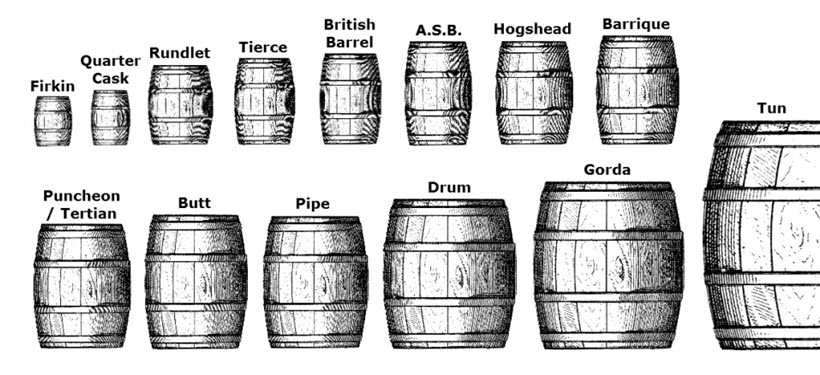
    A hogshead is a unit of measurement used more commonly in colonial times than today. And why is that? The easy answer is that the average person today does very little with barrels. In colonial times, when you entered a store one of the first things to be noticed was the number of barrels  present. Barrels were the shipping containers of their time. For ease of transport, storage, and sealable freshness, barrels were the colonial Tupperware. So, what constitutes a hogshead, and where does the term come from?

    Barrels came in various sizes. A hogshead held approximately 1000 pounds of tobacco (or 64 gallons of liquid). Photo credit: Distillerytrail.com

    In 1423, the British Parliament passed the first act to standardize barrels and their measurements.[1] A tun was set at 252 gallons. Each designation of volume would then be cut in half. So, a pipe barrel would be measured as 126 gallons, or half of a tun. Following suit, a hogshead would measure in at 64 gallons and a standard barrel at 32 gallons.[2] There were exceptions to the halving rule, and more barrel sizes, but these were the main units of measure. Dry goods, such as tobacco, sugar, or salted fish, would be packed into the barrels until the net weight matched that of the same barrel full of water, to help standardize weight measurements.[3]

    The etymology of the term hogshead was clarified by Walter William Skeat of Cambridge in 1896. The term ‘hogshead’ was traditionally believed to be derived from hog’s hide, a possible material for containers to hold wine. Skeat argued that this simply wasn’t so. Tracing the term through the Dutch, Swedish, and Danish languages, Skeat argued that in all other languages, the first part of hogshead refers to an ox, not a hog. He concluded that hogshead was a corruption of the Swedish word oxhuvud meaning both the head of an ox and a barrel.[4]

    A depiction of hogshead barrels on a map of colonial Virginia from 1751. Image courtesy of the Library of Congress, Geography and Maps Division, LCCN 74693166.

    A hogshead barrel would have been a common sight in colonial American stores like that of eighteenth-century shopkeeper Alexander Henderson, factor for John Glassford, at the Colchester store in Virginia. John Glassford was one of the most prominent Scottish tobacco lords until his death in 1783.[5] The Glassford Company was the second highest shipper of hogsheads of tobacco to Great Britain in 1774  importing 4,506 hogsheads.[6]

    It was through the transcription of the 1760/1761 Colchester ledger that I first came across hogsheads. One of the ways in which customers could receive credit was through the selling of tobacco contained in a hogshead. Tobacco was the most common form of payment in the store.

    Joseph Power’s credit account at the Colchester store, where he paid his debt with hogsheads of tobacco (folio 059C).

    Abbreviated in the ledger as Hhd or Hhds, a hogshead is still used in the wine and whiskey markets mainly for maturing alcohol.[7] While less common today, this unit of measure and the container it refers to was an element of everyday life in colonial times. From the common mercantile store to large plantations, a hogshead barrel was an essential element of life before and after its standardization by the British Parliament in 1423.


    [1] United States, Department of State, “Report upon Weights and Measures,” John Quincy Adams, Senate 119 and House 109 of 16th Congress 2nd Session, Boston Public Library (Washington: Printed by Gales & Seaton, 1821), 27, https://archive.org/details/reportuponweights1821unit.

    [2] Department of State, “Report,” 27.

    [3] Ibid., 26.

    [4] William Walter Skeat, A Student’s Pastime: Being a Select Series of Articles Reprinted from “Notes and Queries” (London, England: Clarendon press, 1996), 33.

    [5] John Francis Hackett, John Glassford and Company Records: A Finding Aid to the Collection in the Library of Congress (Washington, D.C.: Library of Congress, 2000), 4.

    [6] James H. Soltow, The Economic Role of Williamsburg (Williamsburg: University Press of Virginia, Charlottesvile, 1965), 47, Colonial Williamsburg Digital Library,
    http://research.history.org/DigitalLibrary/view/index.cfm?doc=ResearchReports\RR0066.xml&highlight=.

    [7] “Casks (barrels, hogsheads, butts),.” WhiskyInvestDirect, accessed April 20, 2017,
    https://www.whiskyinvestdirect.com/about-whisky/scotch-whisky-casks-and-barrels.

  • Colonial America’s Complicated Economy

    Colonial America’s Complicated Economy

    Kayla Davis // AMH 4110.0M01 – Colonial America, 1607-1763

    When reading about colonial life in the British colonies during the mid-eighteenth century, it is easy to think of their consumer habits as idyllic or self-reliant, as we often reference the homespun movement preceding the American Revolution.[1] Beginning in 1765, after the implementation of the Townshend Acts, this movement encouraged colonists to stop buying manufactured goods from Britain and instead produce them themselves.[2] However, as sources and account books reveal, the decades leading up to the imposition of the Townshend Acts prove the economy of the colonies cannot be relegated to the same image as that of the colonies during the Revolution as it was a little more complicated. The 1760-1761 account book from John Glassford and Alexander Henderson’s Colchester store in Virginia and varied scholarly research uncovered that the economy of colonial America was a complicated mix of imports and home-manufactured goods.

    The middle of the eighteenth century saw an increase in the size of flocks of sheep and a cultural movement towards rejection of luxury cloths for simpler wools and flax of American production; this coincided with a thriving economy in the colonies.[3] The accounts of the Colchester store in Virginia suggest commercial trade for textiles. Joseph Power bought yards of strong durable textiles and other materials which indicate he (or someone in his household) was making clothing. On October, 31, 1760, he purchased one and a half yards of cotton, nine yards of kersey, two yards of white linen, one ounce of thread, and two dozen buttons. Additionally, Power bought other fabrics such as best pleiding, checked holland, fine check, and yards of various other kinds of fabric. Fine check and checked holland cost the most, while the fabrics of osnaburg and roles were the least expensive.[4] These purchases of various fabrics—as well as the materials needed to turn fabric into clothing, such as buttons and thread—indicate that Power was buying supplies with the intent to manufacture clothes.

    Joseph Power’s account in the 1760-1761 Glassford and Henderson ledger, showing his purchases of fabrics and the materials to make clothes (folio 059D).

    At the same time, one cannot conclude that there were no luxury goods consumed during this time either; in Virginia, the account book shows us that patrons of the Colchester store did buy luxury and manufactured goods. In 1760, Joseph Power also bought a scarlet cloak, and a silk handkerchief, which would have been imported luxury goods.[5] In 1760, John Berry, an inspector at the Occoquan tobacco warehouse, purchased a silk sun cap with lace, as well as two different kinds of shoes: a pair of women’s calf pumps and a pair of Calamanco shoes.[6] In the same year, John Barkley purchased a fine beaver hat.[7] The purchase of goods like the cloak, the beaver hat, and the shoes indicates that there was an economy for manufactured goods. However, even more interesting is the purchase of silk items like the handkerchief and the cap, which indicate a  market for luxury imported items.

    John Barry purchased several luxury items from Henderson’s store in 1760-1761 (folio 046D).
    John Barkley bought a beaver hat from Henderson’s store in August 1761 (folio 046D).
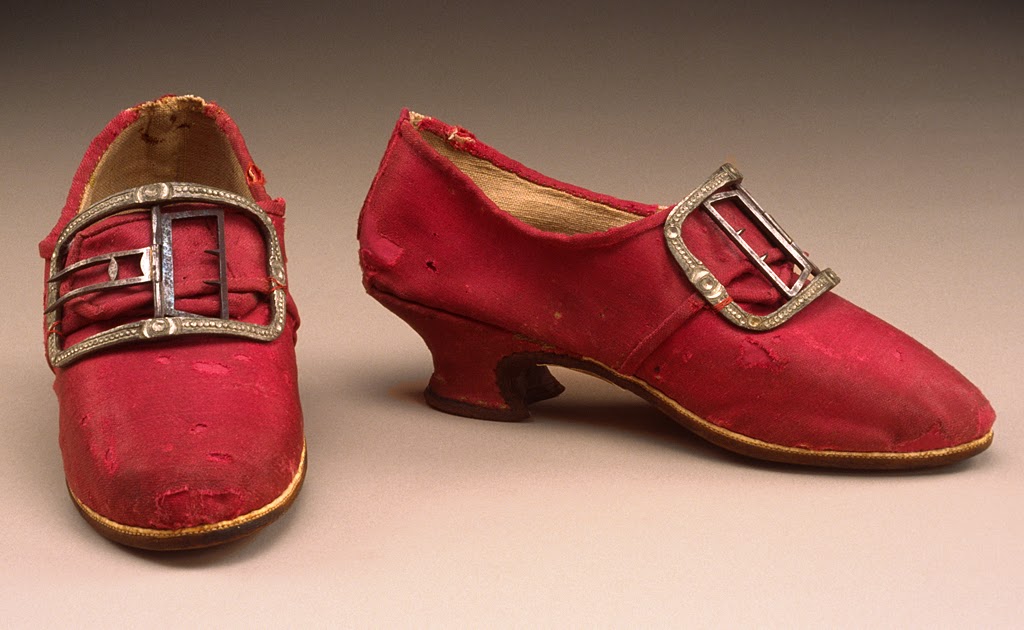
    Miss Mary Flint Spofford Wedding Shoes, English, c. 1765 Historic Deerfield; photo by Penny Leveritt, Acc. No. HD 2004.26. These shoes were made of calamanco, linen, and leather.

    What is important is the realization that the American colonies were complex, and often present to us a different picture than the quite generalized image we are given in textbooks. When shown wonderful sources such as the accounts of the Glassford and Henderson Colchester store, we see that the American colonies were a diverse and complicated group of communities with many different stories to tell.


    [1] Laurel Thatcher Ulrich, The Age of Homespun: Objects and Stories in the Creation of an American Myth (New York: Vintage Books, 2001), 177-183, accessed April 17, 2018.

    [2] Michael Zakim, “Sartorial Ideologies: From Homespun to Ready-Made,” American Historical Review, 106, no. 5 (2001): 1554.

    [3] Zakim, “Sartorial Ideologies,” 1557.

    [4] Alexander Henderson, et. al. Ledger 1760-1761, Colchester, Virginia folio 59 Debit, from the John Glassford and Company Records, Manuscript Division, Library of Congress, Washington, D.C., Microfilm Reel 58 (owned by the Mount Vernon Ladies’ Association).

    [5] Henderson, et. al., Ledger 1760-1761 folio 59 Debit.

    [6] Ibid., folio 46 Debit.

    [7] Ibid.

  • They Were Wearing What? The unusual names and materials used to make clothes in colonial America

    They Were Wearing What? The unusual names and materials used to make clothes in colonial America

    Joseph Lolli // AMH 4110.0M01 – Colonial America, 1607-1763

    When looking at any documents from the past, you must understand that the words used in their time may mean something completely different than they mean today. Depending on how far back you go, you will also have to become patient with simple things like spelling because there may not be a standardized way of writing a word, and it can be spelled many different ways by the same person, even in the same sentence. While transcribing the Colchester, Virginia store ledger (1760-1761), many entries stumped me in terms of context, until I noticed a pattern in items purchased concerning fabric goods.

    Richard Henderson bought two types of shalloon at the Colchester store from 1760-1761 (folio 042D)

    Traditional, well-known fabrics like denim, jean, linen, muslin, satin, silk, and velvet were used. Items that caused confusion due to mixed definitions were alamode, bearskin, drill, holland, and shalloon.[1] Alamode is today used to refer to ice cream with pie, though its origin is the French saying a la mode meaning “in the fashion of.” To the craftsman of the eighteenth century, it was a lightweight silk fabric used for scarves and hoods.[2] Bearskin was not literally referred to as the skin of a bear, but instead it was a thick, woolen cloth often provided to slaves as outerwear.[3] Drill is not an electronic power tool used in construction; drill in the accounts was a strong, twilled cotton often used for summer clothing.[4] Ask most people what holland is and they will tell you it is a country. Ask the shopkeeper in Colchester, and you will be supplied with a linen fabric which got its name from where it was made.[5] Something like shalloon would sound foreign to the average American, though it was a very common, cheap, wool cloth used for lining clothing and pockets.[6]

    Mrs. Elizabeth Fallen purchased “striped holland” in January 1761 at the Colchester store (folio 042D).
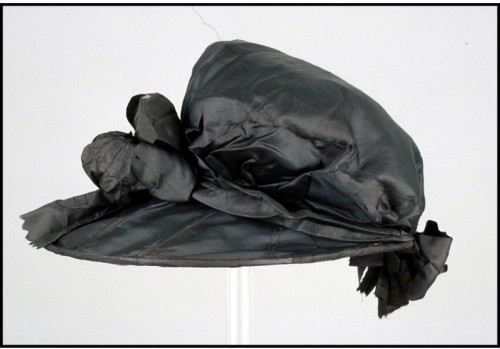
    Black alamode woman’s hat, ca. 1770-1780—Colonial Williamsburg Foundation., Acc. No. 1993-335.

    If you take a good look through the Glassford and Henderson ledger from the mid-eighteenth century, you’ll find that the usual fabrics from today and the more unusually titled fabrics explained here were bought in similar volumes and similar frequency. When you find something shocking, strange, or at odds with your modern perspective during research of an era past, fear not. There is likely a very simple explanation when you look into the context and add a little more digging into your research.


    [1] Alexander Henderson, et. al. Ledger 1760-1761, Colchester, Virginia folio 52, 59, 158 Debit, from the John Glassford and Company Records, Manuscript Division, Library of Congress, Washington, D.C., Microfilm Reel 58 (owned by the Mount Vernon Ladies’ Association).

    [2] Dictionary.com, “Alamode,” accessed March 23, 2017, http://www.dictionary.com/browse/alamode.

    [3] Gaye Wilson, “Slave Clothing,” Thomas Jefferson’s Monticello, accessed March 23, 2017, https://www.monticello.org/site/plantation-and-slavery/slave-clothing.

    [4] Dictionary.com, “Drill,” accessed March 23, 2017, http://www.dictionary.com/browse/drill.

    [5] Linda Baumgarten, “Looking at Eighteenth-Century Clothing,” Colonial Williamsburg Online Resources, accessed March 23, 2017, http://www.history.org/history/clothing/intro/clothing.cfm.

    [6] Peter Earle, Making of the English Middle Class: Business, Society, and Family Life in London (London: Methuen, 1991), 288.

  • Down the Silk Route We Go

    Down the Silk Route We Go

    Sarah Green // AMH 4110.0M01 – Colonial America, 1607-1763

    For most, silks are a fabric associated with the finer things. Silk is a rich, luxury fabric by today’s standards but what about in eighteenth-century America? Silk was as favored back then as it is now.

    While examining ledger pages from the Glassford and Henderson Colchester store (1760-1761) in Fairfax County, Virginia, silk is mentioned more than once. People bought silk in many different forms.[1] Silk garters, for example, were used to hold up stockings and to prevent them from rolling down. As garters were essentially the eighteenth-century version of suspenders, both men and women used them.

    Alexander Henderson’s account showing several purchases of silk in various different forms (Folio 8 Debit).

    Cultivated for thousands of years, silk commonly came from China, Italy, and France. The English wanted to rival the French and Italians in the production of silk, but the damp and cold English climate was not agreeable with its production. In 1603, King James sent silkworm eggs and mulberry seeds to America.[2] However, silk was produced inconsistently until the middle of the 1700s and by then, the American colonies were far better at producing cash crop like tobacco.

    Woman’s dress of lustring (taffeta) silk that was originally crafted in the 1750s and remade in the 1770s, courtesy of the Colonial Williamsburg Foundation, Acc. No. 1975-340,2.

    Trading, for the American colonies, was rather constricted and controlled by the English crown limiting access to open trading. When it came to trading with America, goods had to pass through England as part of the Navigation Act of 1651.[3] The act put more control on the British handlings of domestic goods, placing a restraint on colonial trading and decreasing demand for imported goods; the Act of 1651 also stated that goods were required to be carried in British vessels.[4] While homespun fabrics produced in the colonies were an alternative to buying imported fabrics and textiles, silk remained a popular purchased fabric in America even with the importation restrictions.

    Man’s coat possibly of lustring (silk taffeta), courtesy of the Colonial Williamsburg Foundation, Acc. No. 1970-155.

    Because silk is a lightweight and breathable fabric, it provides comfort to its wearers during the hot summer months in Virginia. Wealthy white women liked to keep cool as much as possible, so they chose to dress in a silken fabric called lustring.[5] Silk was worn in many forms, year round, and not just by women, but by men too. Fabrics made of silk for men’s clothing were often a mix of fibers such as with wool to create alapeen or hairbine which was made with worsted.

    While more accessible today than in the eighteenth century, silk was a statement of wealth back then, a way of feeling important as well as being functional. There were many forms to buy silk that added to fashion as well as function. Silk is a timeless fabric that has been sought after for not just for a hundred years, but thousands, and is still popular today.


    [1] Alexander Henderson, et. al. Ledger 1760-1761, Colchester, Virginia folio 8 Debit, from the John Glassford and Company Records, Manuscript Division, Library of Congress, Washington, D.C., Microfilm Reel 58 (owned by the Mount Vernon Ladies’ Association).

    [2] David Landry, “History of Silk,” Mansfield Historical Society, accessed April 19, 2017, http://www.mansfieldct-history.org/history-of-silk-production/.

    [3] Carmen Miner Smith,”Navigation Acts (1651, 1660),” Encyclopedia of North Carolina, accessed April 18, 2017, http://www.ncpedia.org/navigation-acts-1651-1660.

    [4] Smith, “Navigation Acts.”

    [5] Linda Baumgarten, “Looking at Eighteenth-Century Clothing,” Colonial Williamsburg, accessed April 14, 2017,
    https://www.history.org/history/clothing/intro/clothing.cfm.

  • A Man and His Clothes

    A Man and His Clothes

    Amanda Eversz // AMH 4110.0M01—Colonial America, 1607-1763

    We can gain some insight into the economic priorities of those living in colonial Virginia from an account ledger from John Glassford and Alexander Henderson’s Colchester store in Fairfax County dating back to 1760-1761 which contained an accounting record for the overseer, Jeremiah Thomas, of Colonel Thomas Lee’s farm.[1] At first glance, these purchases seem to be a part of the typical shopping experience with a customer buying clothing materials and household goods. It is not until after further research that we can uncover more specific usage and purpose in Thomas’ purchases of these goods. This account gives a record of the items purchased by Thomas and may shed light on the societal purpose for some of his choices.

    Jeremiah Thomas’ account in the Glassford and Henderson ledgers, showing the variety of his purchases (Folio 51D).

    Thomas’ transactions show that various textiles were purchased with supplies such as buttons, thread, and lace with the likelihood of making clothes. The materials Thomas purchased imply he was a man concerned with his appearance and status within society. He purchased coat straps, silk handkerchiefs, and combs—things intended to keep up his appearance of wealth, even as an overseer of another man’s land. Appearances played a vital role in colonial Virginian society. This was especially the case because colonists often tried to emulate the current fashions and trends of England.[2] Mr. Thomas’s largest line items were for women’s shoes, stockings, blue wool, and an assortment of buttons. He spends significantly less on home goods like nails, salt, and sugar. Clearly, if one were trying to make it in society, one needed to make a serious commitment to budgeting for his wardrobe.

    Rendering of a 1750s tailor shop from London. These shops would have been extremely important for the upkeep of one’s appearance. – © Trustees of the British Museum. G, 12.111.

    There is another aspect of Virginian life that is revealed by the textiles purchased by Jeremiah Thomas: climate. In order to pursue wealth through agriculture, Virginia colonists were willing to go through extreme temperatures throughout the year. Mr. Thomas’s purchases reflect these extremes of hot and cold. He purchased expensive cotton for its breathability in warm climates. He also purchased dufill, which is a heavy wool, frequently used in making heavy coats.[3] It is worth noting that even while Jeremiah Thomas was being practical when purchasing cotton and dufill fabrics, he purchased the “best Cotton” and a rather expensive “Blue Dufill.”[4] It seems as though his public presentation still maintained priority no matter the weather.

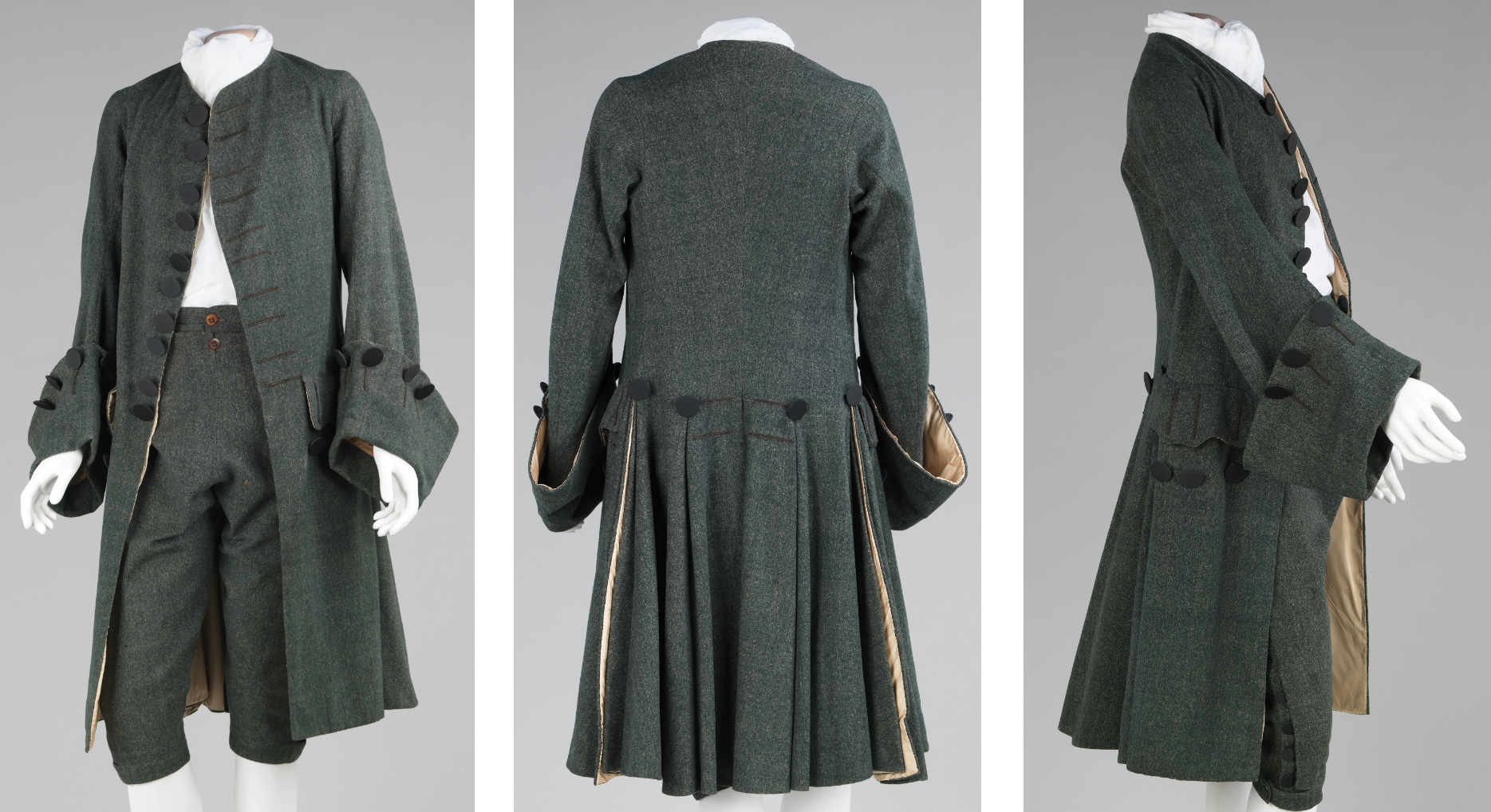
    A wool and silk coat, ca. 1755-1765, made in England. Colonists often copied fashions of the homeland. Images courtesy of the Brooklyn Museum Costume Collection at The Metropolitan Museum of Art, Gift of the Brooklyn Museum, 2009; H. Randolph Lever Fund, 1968. 2009.300.916a, b.

    Reading a ledger at first seems like a meaningless glimpse into someone’s finances. However, we can gain a deeper understanding of who Jeremiah Thomas was. He was clearly a man that chose to spend a large portion of his spending money on fashion and appearance. This  shows that he pursued a social life in front of other colonists. This familiar aspect of staying up to date with the newest European trends is common to both eighteenth-century Virginia and twenty-first-century America.


    [1] Alexander Henderson, et. al. Ledger 1760-1761, Colchester, Virginia folio 51 Debit, from the John Glassford and Company Records, Manuscript Division, Library of Congress, Washington, D.C., Microfilm Reel 58 (owned by the Mount Vernon Ladies’ Association).

    [2] Linda Baumgarten, “Looking at Eighteenth-Century Clothing,” Colonial Williamsburg, accessed May 3, 2018, http://www.history.org/history/clothing/intro/clothing.cfm?showSite=mobile-regular.

    [3] Oxford English Dictionary, “duffel, n. and adj,” OED Online, accessed May 3, 2018,
    http://www.oed.com.ezproxy.net.ucf.edu/view/Entry58272?redirectedFrom=duffel#eid.

    [4] Henderson, et. al. Ledger 1760-1761 folio 51 Debit.

  • Benjamin Hawkins: Rum and the Consumer Revolution

    Benjamin Hawkins: Rum and the Consumer Revolution

    Griffin Bixler // AMH 4110.0M01 – Colonial America, 1607-1763

    In the mid-eighteenth century, several stores in Fairfax County, Virginia, were owned by two men, John Glassford and Alexander Henderson. Their store ledgers contain vast amounts of information about their customers, their credit, and the goods they bought. One interesting case within the ledger for the Colchester store (1760-1761) was Benjamin Hawkins, who purchased rum frequently from October 13, 1760, to June 8, 1761.[1] His purchases were a product of the changing economic environment that occurred around this period.

    For colonists in the Chesapeake, alcohol was an important part of life. Colonists consumed alcohol at every meal, during church, at social gatherings, and on numerous other occasions.[2] Early in the eighteenth century, colonists acquired alcohol through producing it at their household or buying it from planters and taverns.[3] By the mid-eighteenth century, the colonial economy expanded as a result of its connection to Britain and the rest of its empire.[4] Goods, such as alcohol, became cheaper and diverse. Colonists could purchase new variants of alcohol that were impossible or hard to create in the colonies.

    One of these was rum. A great source of rum came from Scottish traders.[5] Previously, Scottish traders could not operate in the colonies because Britain limited colonial trade through the Navigation Acts of 1663.[6] The Navigation Acts forced colonists, among other things, to export profitable goods, such as tobacco and sugar, only to Britain.[7] In 1707, England and Scotland united, allowing Scottish traders to sell their goods in the colonies. In fact, this uniting provided John Glassford, who was Scottish, to become so successful in the Chesapeake through his numerous stores. Rum became increasingly popular with the lower classes with many of the lower classes enjoying rum for its fortitude in the hot Chesapeake climate and its cheap price. Rum, along with other alcohols, also lessened servants’ dependence on planters for drink.[8]

    As mentioned earlier, the majority of Hawkins’ purchases were rum. His account shows that he purchased rum every couple of days through the month of November 1760. Hawkins mostly purchased rum one quart at a time, but there was an exception on November 4, 1760. On that day, Hawkins purchased a gallon of rum. The gallon of rum, according to the credit side of the account, was paid for in cash, although not in its entirety as the rum cost 6 shillings and Hawkins only provided the store 5. Hawkins returned the next day and purchased only “1/4 [one quart] Rum.”[9]

    Benjamin Hawkins’s purchases at the Colchester store, 1760-1761, folio 43D. Alcohol purchases are underlined.

    In all, he purchased seven gallons and two quarts of rum between October 13, 1760, and March 13, 1761. In addition to rum, Hawkins purchased brandy on several occasions (January 10, January 17, and February 5, 1761), a bridle (October 13, 1760), silk stockings (April 15, 1761), and a tin canister (June 8, 1761). The tin canister was the last purchase he made at the Colchester store in 1761.[10]

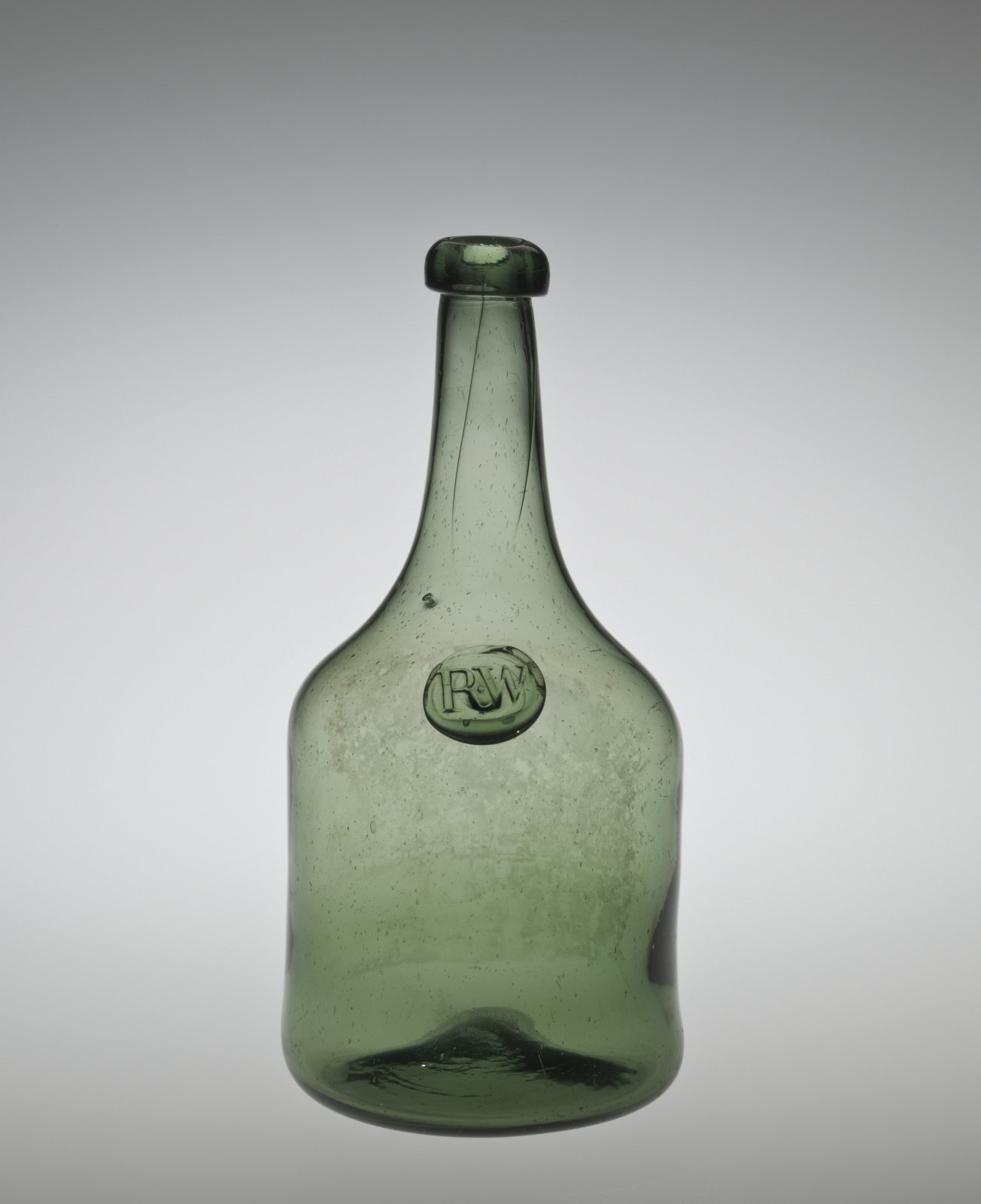
    An example of what might have been a rum bottle, made by Richard Wistar between 1745-55. Image from the Corning Museum of Glass, Acc. No. 86.4.196.

    An interesting element that came up during research was Hawkins’s involvement in several court cases. It seems that Hawkins legally quarreled with a man named Hugh Guttray. Hawkins was a defendant in an injunction case in opposition to Guttray.[11] An injunction is a court order that a person is either allowed or not allowed to do something. He was also involved as a plaintiff in a chancery suit.[12] A chancery suit entails a matter of equity, such as a dispute over land or individual status.[13] These court cases occurred after the period when Hawkins purchased his rum from Glassford and Henderson’s store, but were the disputes a reason for Hawkins’s drinking? It is difficult to tell whether his drinking was exacerbated by the court cases. After a hiatus in his account, it resumed in January 1765. Now living in Augusta, Virginia, Hawkins had to pay court fees to Prince William County (adjacent to Fairfax County). On the credit side, it showed that the payment was moved “By Ballance to Liber F,” which meant Hawkins accrued the fees as a debt. Hawkins did not buy alcohol during this period.[14]

    Benjamin Hawkins’ constant purchase of rum illustrates the changes that occurred in the colonial economy. Rum, and other accessible goods, became affordable to the colonists. His constant purchases of rum would have been inconceivable several decades earlier. The colonial economy was going through a “consumer revolution,” which facilitated the purchase of diverse goods at cheaper prices.[15]


    [1] Alexander Henderson, et. al. Ledger 1760-1761, Colchester, Virginia folio 43 Debit, from the John Glassford and
    Company Records,
    Manuscript Division, Library of Congress, Washington, D.C., Microfilm Reel 58 (owned by the
    Mount Vernon Ladies’ Association).

    [2] Sarah H. Meacham, Early America: History, Context, Culture : Every Home a Distillery : Alcohol, Gender, and
    Technology in the Colonial Chesapeake,
    (Baltimore: John Hopkins University Press, 2009), 6.

    [3] Meacham, Every Home, 82.

    [4] Alan Taylor, American Colonies: The Settling of North America, (New York: Penguin Books, 2001), 310.

    [5] Meacham, Every Home, 85.

    [6] Taylor, American Colonies, 258.

    [7] Ibid., 306.

    [8] Meacham, Every Home, 82-87.

    [9] Henderson, et. al. Ledger 1760-1761, folio 43 Debit.

    [10] Ibid.

    [11] Fairfax Court Order Book 1756, page 572, March 18, 1761, Fairfax Circuit Court Historic Records Center,
    Fairfax, Va.

    [12] Fairfax Court Order Book 1756, page 596, June 16, 1761, Fairfax Circuit Court Historic Records Center, Fairfax,
    Va.

    [13] Fairfax County, Virginia, “Historic Records Finding Aids,” accessed April 19, 2017, http://www.fairfaxcounty.gov/courts/circuit/historical-records-finding-aids.htm

    [14] Alexander Henderson, et. al. Ledger 1765, Colchester, Virginia folio 38 Debit, from the John Glassford and
    Company Records,
    Manuscript Division, Library of Congress, Washington, D.C., Microfilm Reel 59 (owned by the
    Mount Vernon Ladies’ Association).

    [15] Taylor, American Colonies, 310.

  • Tobacco: The Most Versatile Cash Crop

    Tobacco: The Most Versatile Cash Crop

    Joseph Swiderski // AMH 4110.0M01—Colonial America, 1607-1763

    In colonial America, tobacco was one of the most influential crops in cultivation. Colonies like Virginia profited heavily from its agricultural success. The successful cultivation of tobacco began when John Rolfe planted South American tobacco seeds called Nicotiana tobacum in 1612. From there, “tobacco production spread from the Tidewater area to the Blue Ridge Mountains, especially dominating the agriculture of the Chesapeake region.”[1] It became such a huge commodity that the Virginia House of Burgesses made it a requirement for tobacco to be inspected, and directed the construction of warehouses and port towns where tobacco would be brought by planters.[2] As tobacco became more valuable, its uses expanded from smoking to use as currency. It was used for just about anything: purchasing indentured servants and slaves to cultivate the crop, paying taxes, or purchasing manufactured goods and items from the local store.[3]

    Tobacco plants hung to dry. Image courtesy of VirginiaPlaces.org under CC3.0.

    What really caught my attention was something much more interesting than the tobacco itself. While transcribing ledgers from the Colchester store accounts (1760-1761) of John Glassford and Alexander Henderson, I noticed that not all of the people paying their accounts were doing so with their own tobacco, but tobacco from other people. This intrigued me because obviously people that grew tobacco could use it as currency, but how did a random man use someone else’s tobacco as a form of currency to pay their account? The answer was that tobacco itself became a source of social currency as well as money. It became a way of paying off your accounts and a way of paying others, who then purchased items at the store using someone else’s tobacco as payment.

    A payment by Daniel Laughlin to his account at the Colchester store (1760-1761) using a crop note from Joseph Stephens (folio 045C).

    The picture above is an example of account credits from the Colchester store (1760-1761) of Glassford and Henderson. This account belonged to a man named Daniel Laughlin. On  July 31, 1761, Laughlin credited a crop note for 1 hogshead (a barrel) of tobacco from the Pohick warehouse to pay for his account.[4] He used tobacco as payment so that he could purchase items from the store. What I found interesting was the interesting mark indicating the tobacco’s “ownership” or tobacco mark: a capitalized I, a superscripted S, and a capitalized A. It reads ISA, which was a tobacco mark that represented not Daniel Laughlin but Joseph Stephens. Tobacco marks most frequently matched the initials of the owner (in this case it would be DL which was identified as Laughlin’s mark in 1759).[5] This ledger shows that Daniel Laughlin credited the Colchester store 1 hogshead of Joseph Stephens’ tobacco; in September, 1761, Stephens paid his account with an additional hogshead of tobacco.[6]

    A 1751 map cartouche depicting the inspection and shipping of tobacco hogsheads. From the Library of Congress, Geography and Map Division, LCCN 74693166.

    I found no immediate relationship between these men in the ledger other than that Laughlin used Stephens’ tobacco to buy goods that he needed. As a local landowner, Stephens may have hired Laughlin for some service and paid him in tobacco. Regardless, Laughlin profited by nine pounds, 19 shillings on the transaction enabling him to purchase many different fabrics from the Colchester store: cotton, bearskin, osnaburg, roles, linen, striped Holland, German serge, shalloon, sheeting, ferrit, check, and buckram.[7]

    Purchases made by Daniel Laughlin at the Colchester store from 1760-1761 (folio 045D).

    Through my research I learned a lot about what eighteenth century life was like. Tobacco opened up a new world of possibilities for American colonists, and it widened the range of its uses as time passed. People not only used their own tobacco as currency, but they used that of others as well. They exchanged tobacco for goods or paid other people with the crop, who then used it as currency in the local economy for whatever they needed. Although I do not know the specific relationship between these two men, they were  connected through tobacco. Tobacco brought them together in a way that was beyond currency. It went from being a cash crop to a social crop. It brought individuals, families,  and communities together. In my opinion, tobacco was not only the most valuable crop monetarily, but also culturally. Tobacco became its own culture and that is what had an effect on me while doing my research. I was inspired by how this leafy green and relatively ugly looking plant took over the colonial economy and also impacted people’s lives.

    Growing tobacco plants. Image under CC0.


    [1] Emily Jones Salmon and John Salmon, “Tobacco in Colonial Virginia,” Encyclopedia Virginia, accessed March 23, 2017, https://www.encyclopediavirginia.org/Tobacco_in_Colonial_Virginia.

    [2] William Waller Hening, ed., The Statues at Large; Being a Collection of All the Laws of Virginia from the First Session of the Legislature in the Year 1619 (Richmond: Franklin Press, 1820), Vol. 4, Ch. III, 247-271, accessed May 21, 2018,
    http://vagenweb.org/hening/vol04-13.htm.

    [3] Salmon and Salmon, “Tobacco in Colonial Virginia.”

    [4] Alexander Henderson, et. al. Ledger 1760-1761, Colchester, Virginia folio 45 Credit, from the John Glassford and Company Records, Manuscript Division, Library of Congress, Washington, D.C., Microfilm Reel 58 (owned by the Mount Vernon Ladies’ Association).

    [5] Beth Anderson Mitchell, “Colonial Virginia Business Records as a Genealogical Resource,” National Genealogical Society Quarterly 62, no. 4 (December 1974): 261.

    [6] Henderson, et. al. Ledger 1760-1761, folio 88 Credit.

    [7] Ibid., folio 45 Debit.

  • Turlington’s Balsam of Life: Colonial American Snake Oil?

    Turlington’s Balsam of Life: Colonial American Snake Oil?

    Andrew Abbott // AMH 4110.0M01 – Colonial America, 1607-1763

    It is 1761 in Fairfax County, Virginia. You feel a pain in your abdomen that will not go away. What can you do to make the pain go away? You can go see a physician to get your ailment diagnosed and treated, if you can afford it. Alternatively, you can save money by treating your condition with Turlington’s Balsam of Life.

    Turlington’s Balsam was a medicine created by Robert Turlington, who obtained a patent from King George II in 1744. The medicine, Turlington claimed, would successfully treat a wide variety of illnesses, including “kidney and bladder stones, colic, and inward weakness.”[1]  In a time before both significant medical advancement and regulations on medicine, patent medicines such as Turlington’s Balsam of Life were able to make claims that seem ridiculous or deceptive by modern standards, and the average colonial American was willing to believe in such claims. As the holder of the patent, Robert Turlington had the exclusive right to manufacture his product and sell it where he wanted, including the Colchester store of John Glassford and Alexander Henderson in Fairfax County, Virginia.

    Turlington’s Balsam purchased by the enslaved Negro Jack at the Colchester store in September 1761 (folio 114D).

    From 1760-­1761, there are at least thirteen recorded instances of customers purchasing Turlington’s Balsam of Life at the Glassford and Henderson store in Colchester, with the price  ranging from four shillings and four pence to eight shillings and eight pence.[2]  This price range seems to indicate either the arrival of a new shipment from Glasgow or multiple sizes of the product for sale: there were three references to the bottle being “large.”[3] By making his product in different sizes, Robert Turlington was able to sell his product to a larger number of people, especially those who could not afford to be treated by a physician.

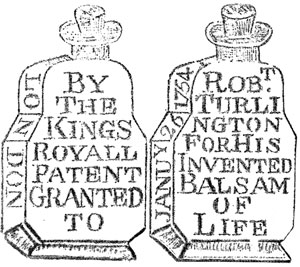
    A drawing of both sides of Turlington’s unique pear-shaped bottle. Image by Robert Turlington, 1755.

    One problem with patent medicines, especially in 18th-century America, was the marketing of a different concoction under the same name as the patented product. Turlington’s Balsam of Life suffered this fate, which led to a decrease in sales. By 1754, the problem with counterfeit  medicines led Turlington to come up with a clever way to ensure the consumers that they were getting his product: a pear­shaped bottle.[4] Turlington applied the same innovative spirit he used in creating his medicine in order to protect his intellectual property, which led to one of the more unique mass­produced glass containers of colonial America. In addition to the innovative bottle shape, Turlington also issued statements warning of the potential for counterfeit versions of his product, encouraging his customers to “…be extremely careful and particular, to examine unto each Bottle that he buys, that he may not be imposed upon by any pretended or false Balsam, which may be of the greatest Prejudice to the Health and Constitution of the unhappy Patient, instead of a perfect Cure.”[5]

    Much like today, colonial Americans sought cost-effective ways to treat physical ailments without having to take time out of their day to visit a physician. Products such as Turlington’s Balsam of Life allowed them to do just that. Though they did not have access to the vast amount of readily ­available information as we do, colonial Americans knew enough about their bodies to be able to treat many physical problems without consulting a medical professional, but possibly with the assistance of “Every Man his own Doctor: OR The Poor Planter’s Physician” first published in the colonies in 1734. Detractors of Turlington may have referred to him as the creator of an ineffective medical panacea, familiarly known as “snake oil,” but the popularity of Turlington’s Balsam of Life suggests that there were some positive results from its use.

    Turlington's Balsam of Life Infographic


    [1] George B. Griffenhagen and James Harvey Young, “Old English Patent Medicines in America,” Pharmacy in History 34, no. 4 (1992): 204, accessed March 22, 2017, www.jstor.org/stable/41111487.

    [2] Alexander Henderson, et. al. Ledger 1760-1761, Colchester, Virginia folios 12, 22, 24, 30, 60, 68, 77, 78, 79, 114 133 Debit and 12 Credit, from the John Glassford and Company records, Manuscript Division, Library of Congress, Washington, D.C., Microfilm Reel 58 (owned by the Mount Vernon Ladies’ Association).

    [3] Alexander Henderson, et. al., Ledger 1760-1761, folio 22, 24, and 133 Debit.

    [4] Griffenhagen and Young, “Patent Medicines,” 211.

    [5] Robert Turlington, “[No Headline],” The New-York Mercury, 22 September 1760. Readex: America’s Historical Newspapers, accessed November 14, 2017